Friday, August 23, 2013

The Peaks Keep Peaking; or, Yup, a Garden is Female

Post 79


Two posts ago I said the garden was peaking out. I inadvertently lied. Because the garden is still peaking and is going to continue to do so whatever I say.


I think I have finally figured this out. There is no peak; there are peaks. Call it a blooming mountain range. The above ground peaks start at the end of March and end sometime in October/November. And a winter camilia is just a token of the peaking going on under the earth through winter as roots grow and seeds burst open. But here I am, waiting for the garden to lessen it's impact just because the solstice is passed.


Luckily, the garden will have its way and show delight regardless of the odd, theoretical words this gardener gets stuck on. Which seems a good cue for perhaps some finer words, apropos as summer comes to a close.

WHO MAKES A GARDEN
by Nancy Byrd Turner
Who makes a garden plans beyond her knowing.
Old roads are lost; old dwellings have their day;
And she herself, far summoned, passes hence
An unfamiliar way;--

But no, she has not perished with her going;
For year by year as April's heart is stirred,
Spring after punctual Spring,

Across the little acres' wintry grey
Comes slowly traced, an old authentic word
In radiant lettering:

A shining script of tendril, vine and whorl,
New green, faint rose, clear lavender and pearl,
Petal by delicate petal, leaf by leaf,

As though her own hand from the Mystery 
Wrote, for all earth to see, upon a fadeless, beauteous scroll,
Her brief for immortality.


Who knows? It is all a big fat mystery, however we see it. We might as well enjoy it, allowing our mistakes the mercy they deserve,


and our harmless delights the respect they deserve, the dignity they harbinger and the beauty that perhaps they foretell.

.
August
by Edmund Spenser

August, being rich arrayed
In garment all of gold down to the ground,
Yet rode he not, but led a lovely maid
Forth by the hand, that which was crowned
With ears of corn, and full her hand was found:
That was the righteous Virgin, which of old
Lived here on earth, and plenty made abound. 


Monday, July 8, 2013

Shout Out for an Unlikely Garden Guru--John Fowler


Like most, I tune out wisdom by cliche. Wisdom by surprise, however, acts on me like an interesting  garden does; it energizes me.

Above is a book about interior design that I read in the 90s. The library no longer owns it, so I can no longer quote from it. It is mostly about a design firm that specialized in big, old, English houses, defining a style that was comfy, livable and condign with the houses' and the country's history. Colefax and Fowler did not single-handedly create the modern English County House Style, nevertheless, their fingerprints remain all over it. And John Fowler, who with Nancy Lancaster (an American from Virginia,) was head of the company, was the man who oversaw the decorative painting and soft furnishings. No one could do trim like him.


 So how does that make him a garden guru? Good question.


Somewhere in that big book pictured above, Fowler makes a remark incidental to decorative painting. It caught my attention because it described something different from the aesthetic modes that were zipping around through the 60s and 70s and influenced my taste.

Fowler said that a viewer's eye is pleased by the combination of bright and muddy colors. Always add a little mud, he said (or something to that effect;) it makes the brights stand out. Visualize such a combination in your mind's eye versus a Peter Max poster or a David Hicks' room. Works by 60s icons tended to be all bright on bright, all the colors at the same high intensity, while in the 70s things went all drab on drab, remaining at the same low intensity. Think of sage green and mauve, or grey-blue and beige or that ubiquitous (shudder,) avocado, burnt orange and mustard. These tints were everywhere, in the clothes we wore, the rooms we sat in, the possibilities we imagined, a mood of the times.                                                                                                                                But Fowler hearkened back to a different time (and mood,) all together.

Here is an early painting by Gainsborough. Note how dull the overcast day is, yet somehow an errant sunglow has escaped from the otherwise beautifully clotted colors to light up the artist and his family. Look how handsomely that crimson waistcoat shines forth. Even the grass upon which the family sits is luminous, and all the more luminous for the otherwise drab surroundings. Not only is this a fittingly accurate show of Brit weather, it is also (perhaps,) a loving tribute to the light of family love in individual consciousness, for this is Gainsborough painting himself with his own family. Note how the wife's clear, sky-blue dress seems to almost chide the sky.


So what does that out-of-the-blue art lecture have to do with gardens, or more specifically, my garden, as pictured above. Well, though I love it when plants blossom, it is hard to keep them all blossoming all the time. Plants need rest. Then how do you supply interest? You can do it with structure. You can do it with texture. You can do it with foliage color.


Lots of books will tell you to use variations of foliage color other than leaf-green so as break up what can otherwise be a boring mass of green. However, most colorful foliage is not as enticing as flowers, meaning this method shouldn't really work. Yet it does. Could this be so because Fowler is right about muddies and brights?  For in the garden, foliage can create constant highlights and lowlights, giving illusions of depth and light and therefore, of greater space.


So--in this post are pictures of my garden showing four useful foliage colors. I like using yellow-green and pale grey-green as highlights and dirty purple/brown, darker grey-green and blue-green as lowlights.


Above is a pic that contains three of these foliage colors; blue-green, pale grey-green and purple-brown. Sure they are dull-- but oh, what dulls!


My favorite may be the muted blue-green. Its coolness gives contrast to the more usual warm green of typical foliage, adding depth and giving sparkle.


Well, enough blathering. I haven't even mentioned red as a foliage color or all the variegated foliage possibilities that abound, but I expect that you get the picture.


Gardening is a visual art (among other things,) so you can learn a lot about it from things that claim to have nothing to do with it. Learning builds on itself regardless of how we humans chop up our naturally seamless lives into categories.


All this I have learned from a gentleman who named his favorite dull colors things like "Elephant's Breath," and "Mouse Back"-- and then used them to shine up the grandest of grand houses. There is something about that, a balance, a weird humility, a sense of wholeness, that I really like.


Thursday, June 20, 2013

Midsummer, PHS and Making the Garden that Pleases You

Post 77


Happy Midsummer.

By now, if all has gone well, you will have finished the hard work of Spring-- planting, transplanting and weeding. For the next few months, if all goes well (and here's hoping it will,) you will be able to take a bit of a garden vacation. A little weeding, a bit more watering, some deadheading, this will be all you have to do till late September.

There is no getting around the fact that gardens take work, sometimes a great deal of work . And, if the owner  wants to be fully engaged with the garden, or if they are on the budget, they will do this work themselves.

Hence the pleasure of pausing with the sun for a rest.

To be motivated to do all this work, to want to do all this work, it is important that you  love your garden.  Somehow that makes the work easier. And the best way to love your garden is to make it the one you have always wanted, the garden that most pleases you. If you make your garden to please others or to meet some abstract idea of what a garden should be, you will end up resenting the work it entails. And your garden will suffer. It may remain perfect in a technical sense but it will lose the liveliness, the panache, that depends on personal engagement.


If you love your garden because it comes close to realizing your vision of beauty, the work will not be labor, it will be vocation or avocation. And so you will keep at it, even as  the garden changes.


The garden may rest for a bit, but it will never stop developing. Things will grow and things will die. Proportions will change.It will grow--and so will you.

Your vision, your style, will develop, and, as it does, over time, you will come to better understand how  much of it -- has come from other people.


Others whom you have loved, others whose visions and styles have excited and pleased you. You will be aware of being part of a greater stream, a tradition, a shared pursuit that includes past, present and future.


For me, this is a good time to pause and give thanks.


And here is one thing I am very thankful for. We are lucky to have the Philadelphia Horticultural Society (PHS,) in our area  With its library, its webpage, its tree-tenders, green initiatives, City Gardens contest and more, it is a cornucopia of relevant gardening information, inspiration and delight. One of the main ways I learned about gardening is that I seeped myself in the vast collection of big beautiful garden books at PHS's McLean Library.


Which leads me to the happy news that this garden blog, Wissahickon Schist, has been included as a link in the "Good Reads" section of PHS's resource webpage for local gardening.Whoohoo. I am,as the English would say,  utterly "chuffed."


Happy Summer.


Tuesday, June 4, 2013

May/June, or When Gardens Explode (in a good way)

Post 76


In May/June, when gardens explode, for one's own safety, follow these instructions--


Take in a slow, scented breath and stand still long enough to contemplate the tableau before you.


Then repeat to yourself, "I did not do this."


Because you didn't. Nature did. You just did some work to help things along.


For which Nature rewards you.


Because as with all real work (versus a job,) there is something extra that appears. Something that must have happened when you were checking soil levels or weeding or planting seeds, in short, when you were doing some practical task that has nothing to do with love or dedication or ardor. Because somehow, the garden caught fire. 


So during the explosion (and there are often explosions (the good kind) when you are doing things you love,) keep calm and remember, you have no idea how this happened. You are just lucky to be around at the time.


Saturday, May 25, 2013

What Makes a Style?


Post 75

Why do we like what we like? This week I've realized how much exciting times from my childhood have shaped my sense of style.

My small garden does not follow the usual  good taste model, that of planting in large drifts, with many plants of the same variety planted together. Large drifts work well for larger gardens, but for me, it can get boring in a small one. My eye needs to roam. It needs to be drawn in and then drawn forward,  moving in expectation and delight till it takes its moment of rest at a particular cynosure, only to re-energize and take off again.


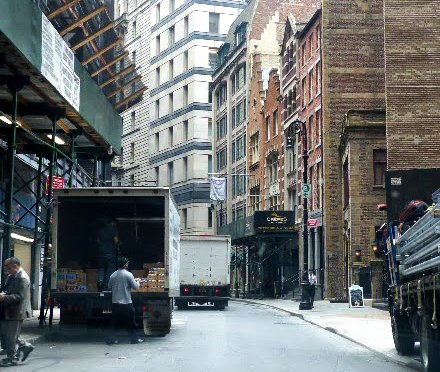
 Part of my inspiration has been country meadaows, part late Medieval millefleur tapestries, part has been Fleur Cowles illustrations, but I've just understood another big, and highly unexpected influence: Lower Manhatten.

Growing up one of the most exciting things I could do was visit my Dad at his office in Hanover Place near Wall St in Manhattan. Which was very different than the city where I lived and spent my usual days.


The city I knew was the spacious grid of the East Side where light shone thru wide canyons that opened up in logical right angles. It was a spacious, rational, prediciteble world where 65th Street followed 64th, where the blocks were all the same size and views were long and  unobstructed. But down around Wall Street was a different world.


 The streets were small, cantered and illogical. The buildings were all over the place and almost seemed to be falling over each other.


This new, hodge-podge city was wonderful to me because I was with my Daddy and it was his world.


Everybody knew him, many called him affectionate nicknames I'd never heard of. Through good and ill it was his kingdom. He loved it and came fully alive there.


Above, you can see him as he is today, or rather as he was a few days ago, on his 100th birthdy, when he rang the closing bell at the New York Stock Exchange. He, I and the NYSE are much different from what we were when I first saw Wall Street in the late 50s, early 60s -- but the geography of the place remains the same. And now I am old enough to be conscience of its past and present effect on me, and how it has perhaps inspired and strengthening my delight in fetching disorder.


So perhaps this is why, whatever I'm creating, it will usually have a combination, a balance, of order and disorder. My garden has its quinquinix structure, over, around, thru and about which, runs perennial plants acting like random meadow annuals.


And here I am below as a teenager with my dad in his salad days. He and my mother (as I mentioned in my post about Fleur Cowles) have influenced my style in more ways than I can say, for childhood loves make for much in adult life. Our styles, if authentic, often come from what we have loved, and how strongly we have loved.