Showing posts with label Smells. Show all posts

Thursday, April 26, 2012

High Spring, Quasi-Miracles and Variegated Solomons Seal

Not my garden, just a gate I passed.

Ahhh--High Spring

 Post 35                  

Variegated Solomon's Seal & Tulips

Sometime in the spring, late April or May, you look at the garden and wonder, how has this happened? How does this fresh, sweet (for it smells of lilac, lily of the valley, and later, roses ) lushness of High Spring happen?  How can the piddling amount of work a human can do translate into this? And something fills up inside of you because no amount of work could turn into this. There is something like a miracle going on here that has nothing to do with work. For all that work is doing is giving a little goose to the quasi-miracle.         
                                                                                                  
  I am writing this while watching "Dancing with the Stars." I am a sucker for dancing and enjoy the dance routines. But slowing down the fun  is a competitive drama, replete with tearful protestations of hard work, full commitment and being in this to win/triumph/dominate. 
No one would argue that work is utterly necessary for great dancing. or great anything. But what exactly is this work?  Maybe on one level it is a privilege, a chance to participate in the real miracle: the miracle of  a healthy human body fully realizing its grace, beauty and balance.                                                                                                                                                      Now look at this flower on the left. It is dancing, its arms extended, its legs poised, its beaming head turned upward towards us, the audience. It is a part of nature just as we are part of nature, and nature is economical in how she creates her abundance. The same principles come into play. And Nature has more principles up her extended sleeve than just competition.                                                                                                                                                

Some say we are more than we know, just as any garden is more than what we can do. What plays in nature plays in us, allowing us to work just hard enough to feel as if we have helped make a part of the garden's beauty.


What powers my garden work? Love. And at High Spring I feel as if I can smell, taste and apprehend that love coming back to me in physical form. Within the year's cycle, it is as if here is where nature figures reciprocating love.

Variegated Solomon's Seal, Forget-me-Nots, Tulips, Adjuga, Grass
From little often comes much. Great things do not just come from competition, though that is the message our culture sends. Great things also come from cooperation, open communication and inspiration, especially if they are powered by real love. It is love in the garden that makes for what I call the Amended Golden Rule -- "if I were that individual member of a particular life-form, how would I want/need to be treated in order to properly flourish."  This is what allows lives to develop into their best true being. Without these glorious spring weeks, we might forget the peace and wholeness that the best really signifies.

Competition can be brutal and brutalizing. It can stamp out what is best in people as they pursue a limiting goal. It can breed anxiety, insecurity, depression and various partial escapes, especially addictions.

But if we are more than we can know; if we are more than what we can do--then there is more to the story. Gardening can lead us out of the ego's competitive trap. And it is good to learn wisdom firsthand,  through the work of your hands and the labor of your heart.

Variegated Solomon's Seal
So--what is this plant to the right? In this post, two of the pictures above also show it, but here it stands alone, an adaptive, easy, beautiful plant for semi-shade with a mighty and mystical name: Varigated Solomon's Seal (aka Polygonatum odoratum 'Variegatum'.) In legend Solomon's Seal quelled demons with an insignia of the four elements balanced into wholeness. The plant got its name because if you detatch a stem away from its rhizome, you  see an image of the Seal; the Seal being what binds the sun-and-air-processing leaves and stem to the earth-and-water-gathering roots.


Ned Wolfe Park with Variegated Solomon's Seal,Creeping Phlox & Tulips

So here is a sign for High Spring, for balance, peace, wholeness and love. And of course it has variegated leaves as a sign that here on this earth, who of us is not?  And best of all, it plays well with others. Woodland flowers spring up around it in early spring before the trees take leaf. Its graceful flowering curve of small white bells blends in with gaudier tones. Then as summer approaches the other plants loose their flowers and the Solomon's Seal's variegation brightens up the otherwise pure green shade.


----------------------

How to Solomon's Seal:  It does need some shade and some sun but is not too fussy about the proportion. It needs water, but once established is pretty drought-tolerant and its beautiful leaves usually stay fresh looking all summer. It is said to want good drainage but the large patch in the earlier picture has its feet in fairly compacted clay soil. It will reproduce easily, often at an exponential rate, but can be easily dug up. In short, an excellent plant.


Wednesday, March 7, 2012

Lungworts and Hyacinths, or Breathing Happiness

 Post 28


Green stalks prod their way up through soil seeking... what? If plants could feel, what would it feel like, pushing your way through earth for reasons you do not know?  To break through and feel something unexpected, such as light, course into your pores as photosynthesis, energy, begins. 

It probably would feel like what we felt, when as infants we pushed our way out to take in that first gulp of air, a substance for which we had no anticipating concept. AIR!, Strange, improbable, undreamt of air. Surprise! Of course we cried out, then quieted, finding a rhythm in this new thing breath. And rhythm we knew from our mothers' bodies.

We can't remember..., but we can imagine. Nature, thriftily-extravagent, uses similar processes at different levels in different ways, allowing for some imaginative analogy, empathy in context.  And gardens,-- where skill, comensurate with sensitivity, developes, --are great places for imagining. Enhancing sensitivity and imagination is one way gardening can change the gardener.

To breathe the air, to feel light, to enter a different state of being, how did we ever survive the shock? Well, cause not everything changed, there remained the lilt of known voices, touch, being held, tenderness, states we came to know as love and trust. From these, with these, we could grow to find pleasure in strange new things such as light and air. 

Here is the beginning of the pink Lenten Rose at the crest of the old buried staircase. Only one stalk is blooming, facing down towards a Lungwort which is about to bloom.

Lungworts are usually grown in some shade and therefore aren't usually this early. But I grow grey-leaved ones in sun. Older strains have greener leaves and need more shade. 

The reason the plant is called Lungwort is because its spotted leaves were once thought to resembled lungs. The flowers are the breath, the leaves are the lungs.


It's right there, isn't it?  It's a world I hardly knew existed before gardening. As a gardener, I've learned so many things -- sensitivity and skill, patience, respect, cooperation, and something else.  Something very like an everyday ecstasy. 

“Flowers and sunlight, air and silence—‘luxe, calme et volopte.’”  Patricia Simon

It comes to different people in different ways. For me, it's after I've been working in the garden for awhile. I'm physically tired but alert. So I lean forward or back to preen this frond or that and there it is, a stillness, a lively, peaceable calm. It is like the smell of a hyacinth as you walk down a busy street when, for a moment, everything else disappears, or rather, becomes more real.


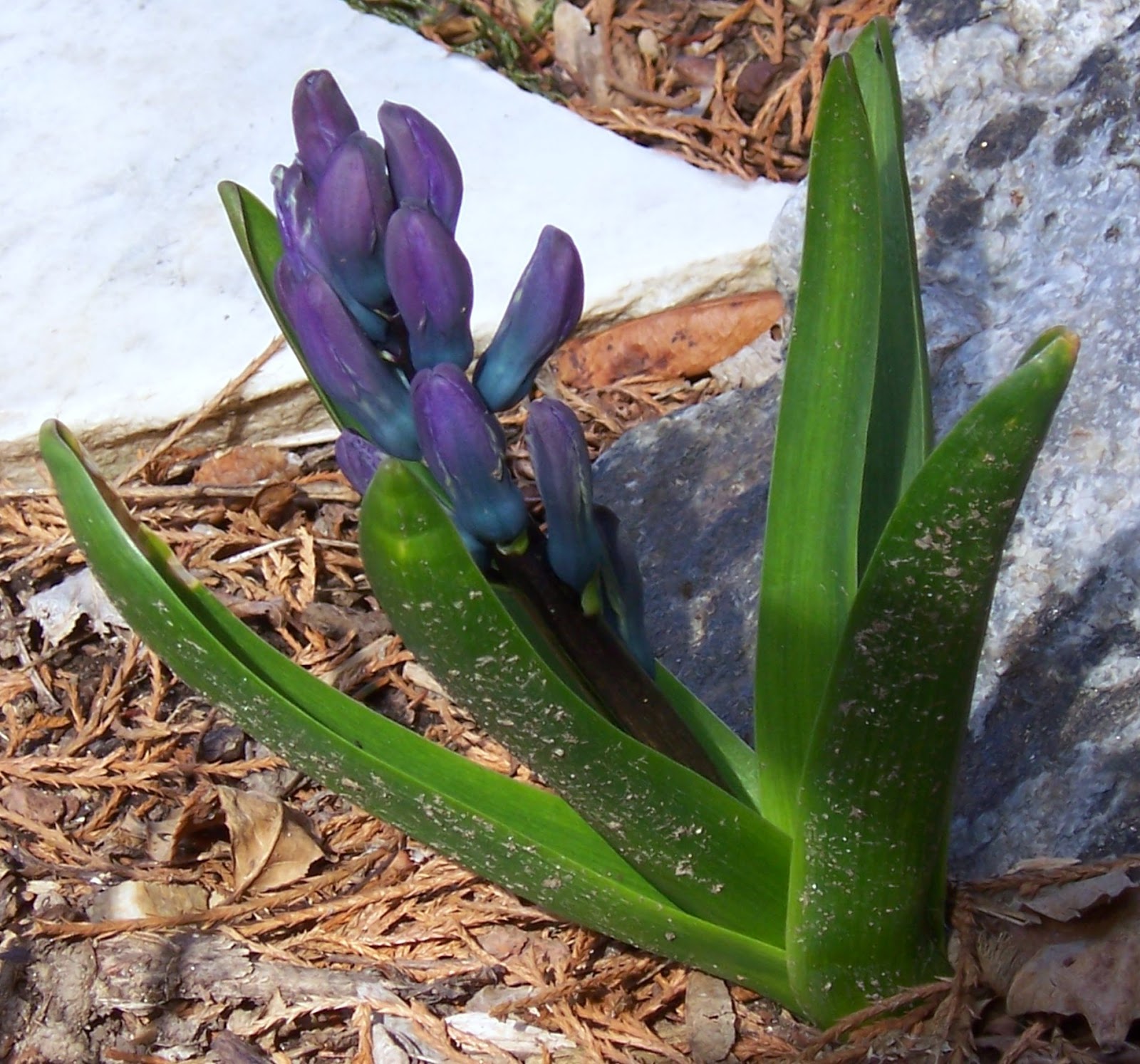
And you are a child again. A hyacinth has been placed on your windowsill for Easter. You watch it grow. At first it is a stalk of dark, deeply purple, secretive shells, like a long row of muscle shells fastened onto seaweed on the beach at tide-turn. Then the purple lightens, the shells slowly open  and they aren't shells at all, but tender, pliable flowers. And the smell, the smell is like nothing at all, or everything. It is everywhere, it is nowhere, it is Air. And as you  breathe it in, it is a delivery, an earnest, on the strange promise of that very first unremembered breath.

_______________________________________________

How to Lungwort (another great plant that easily grows around here): If you have shade or sun, like blue, purple, pink  or almost white flowers, this is a useful plant. Lungwort, or  Pulmonaria grows from rhizomes and needs moisture, especially if it gets a lot of light. Part of its appeal is that it blooms for almost two months, its escalating flowery bits growing ever longer. The best thing to do for it is to cut the flowers back hard before they are fully done blooming. So at about six weeks clip back as much of it as you can: flowers, stems and any tatty leaves.  If you do this new leaf growth with proceed nicely and you will end up with great foliage plants for the rest of the summer. If you do not cut it back when it needs it, I have found that it can  droop, get mildew or even die, especially in sun. It is as if making new leaves while keeping up the old stuff is almost too much for it  If you want more plants, and you have a variety that makes viable seed, just shake a handful of spent stems over a moist bit of shaded earth. Next spring you will have babies to transplant as you wish.


Most writers tell you not to grow Lungworts in clay, but I have found they do fine in my only slightly amended clay soil. So just make sure they are in somewhat well-drained soil, not pure clay where the rhizomes can rot. Many of mine are on the slope of a hill, which must help.


Hyacinth a few days later

How to Hyacinth: Hyacinthus Orientalis is a bulb that has been bred from the wild Hyacinth, a native of Turkey. As with most bulbs, plant it to a depth just a little deeper than its own size in the fall. It will bloom for a short time the next spring, and if you are lucky, again the year after.  For all that bother though, the powerful sweet scent is well worth the effort. The blue/purple flower, versus the other colors, is perhaps the most treasured of all; it stands for sincerity.

Full bloom
.