Showing posts with label Beauty. Show all posts

Monday, April 22, 2013

The Easy Beauty of Quince and Bluebells, with a side glimpse at the Golden Apples of the Hesparides

Post 72


 This time of year it is hard to chose what to write about. So much is burgeoning forward.  In past years I've written about old-fashioned tulips that come back along with kerria, as well as lungworts and hyacinths.  This still leaves too many choices from the bulbs, shrubs and early perennials that appear around now.

But even spoiled for choice, it is hard to resist this:


Extraordinary, yeh?  Well the ancients thought so. Well before there were any sort of noteworthy apples in Europe there was quince, called the honey apple, a hard fruit that has to be cooked and mixed with honey to be edible. And these were its flowers.

Above the blooms are in full flower; on the side they are just starting, most of the blooms are just pale, round peas thickly clustering the bough. So when they bloom it is like there is hardly room for them. No roses have ever clustered so densely.


My bush is Chaenomeles x superba "Cameo. "  There are varieties that have orange or red flowers, but I like this color best --its crayon could be called "Caucasian Flesh."  And yes--quince is originally from Caucasia. 


It is absurdly easy to grow in sun. In fact, the only real effort needed to tend it is to offer a periodic douse of  restraint. It grows to about 5 feet to five feet, so keeping it within three feet by three feet (best size for my small garden,) means I need to prune after bloom and in fall remove the suckers that appear. That's all. Easy beauty, -- no wonder quince was decicated to Venus and said to be the apple of the Hesparides.

And do you know what else is easy? Virginia Bluebells.


Nothing beats true blue in the garden (Caucasian Flesh may be a tie, though.) Bluebells, our native ones, flourish around here as long as they get some sun.  In fact, they spread.


If early quince flowers look like pale peas, early bluebells look like violet fingernails. Thats right, like many true blue plants in the borage family, they start pink. Above you can see early blooms top right and left, the one in the middle has broken out into blue. They are all surrounded by epimedium, both the yellow flowers and the leaves, plus a few muscari. All this is right under a tree--normally a hard place  to plant.


Here it all is a few days later, the bluebells all now beginning blue. I like having them with some epimedium, which is a superb, tough groundcover.  Because the bluebell is a spring ephemeral, after about three weeks of ever-enlarging bloom it will start to go to seed. And it's pretty round leaves will start to look charred and raggety. But said leaves will by then be covered by the epimidiem,-- which never looks bad. 

So, between bluebells


 And quince


It's not hard, this time of year, to find easy beauty in the garden.


Sunday, April 14, 2013

Sakura Sunday

Post 71


The mood of early spring is hard to define. But here and there you get perfect days, cool, not yet balmy but gentle nevertheless, brightening light intensified by the lack of tree cover, revealing the unexpected delicacy of emerging vegetation.


Somehow the Japanese cherry, Prunus serrulata, sums up, in its bloom,  the beauty of the season in which it blooms.

Philadelphia, like D.C. and Newark, has a magnificent public collection of cherry trees, thanks to the generosity of the Japanese people, who, for over a century have donated several thousand trees to these and other American cities.


Just from the way the blossoms fall,  you feel like you understand Japanese aesthetic sensibility that much better. And there are worse ways of encouraging international understanding than sharing beauty.


Today is Sakura Sunday, the day of the Cherry Blossom Festival. Sakura is the Japanese word for cherry tree. Below is a picture of one of the two cherries we have previously planted as street trees.


And today we planted our third. Thanks to a sale at Lowes, this one is a weeper. It bloomed early and is now without blossoms, but only until next year.


Small at they are now, it is comforting to think how they will look in 20, 50, 100 years. When they grow as large as the wonderful specimens in Rittenhouse Town, trees that each have a history and a personality of its own, like this one below.


Or these two, that seem to be holding hands and dancing.


It feels good sharing beauty, knowing that a future you will never see will be that much better.


I am grateful to the generations of Japanese who developed these trees and shared them with the world.

----------------------------------------------------------

For the last few months I have had the luck of  walking daily thru an exhibit of Japanese prints put up by my accomplished colleague, Marian Jahn.  Below is a photo of a portion of one of my favorites of these prints, the photo is taken from the Art Department's Facebook page at: http://www.facebook.com/pages/Art-Department-Free-Library-of-Philadelphia. The exhibit has one more week to run.

 When I was growing up  my mom would often call  my attention to certain things that she felt were the best of their kind; she called this educating the eye. Now I wonder if my exposure to these beautiful prints might have influenced how I have apprehended this spring's blossoming, thus inspiring this post.

We never know all the ramifications of the simple deeds we do in our lives. I thank Marian for all the effort and knowledge she put into this exhibit, because here the influence can be traced and she can be thanked. We owe so much to so many. And as the cherry blossoms fall after their quickening bloom, I hope I can keep that knowledge with me.


Thursday, October 4, 2012

Why does Beauty Matter?

Post 53


Why does beauty matter? (Sentiment alert here--if warmth make you uncomfortable, read no further.)

Why do we put so much work into gardens to grow beauty? While some would say the answer is self-evident, and others say that it is a matter of taste, or making something special or evolutionary tactics, I would like to imagine another possibility, one at the core of human experience.


You are born. If you are lucky, you are born to people who love you right from the start. It has nothing to do with anything you have done; it is pure gift. And these people who love you and who you come to love, take care of you, meet your needs and often even your wants. Theirs are the faces you associate with care and love. Their faces are beautiful to you.

 
 When you are a bit older you may notice that some of your friends have more pleasing faces than you initially thought. I remember talking to my Mom as a teenager about fixing up a female friend with a male acquaintance. My Mom thought I was greatly over-evaluating my friend's attractiveness. I had no idea what she was talking about. Anyone with eyes could see that my friend was a beauty.


Love sheds light around people you love, places you love, almost anything you love. Love makes the stuff of life beautiful, whether there is beauty in it to begin with or not.


So--is it possible that this connection, hardwired into our brains--sometimes works backward? That when we see beauty we feel loved? But are not aware that we are working backwards, from where the warm feeling is coming?
Then -- does this influences us to make beautiful things? To need beauty around us the way we need love? 


Love, that thing money can't buy, is a problem for consumerism. We can be sold stuff that ties in with love --but not the thing itself. We can be sold beauty. We are every day. Yet there are people who will tell you that art is more than an investment, that music moves your soul and that beauty somehow matters more than the money that may buy it.


Tuesday, June 12, 2012

Chanticleer, or Wonder at the Call of the Dawn


 Post 42

Is the wish to share wonder the first stirring of art?


To combine wildness and order, light and shade through love so that you can share the inklings and glimmers of infinity that fill you, and seem to overflow from you?

Welcome to Chanticleer.


Chanticleer  is an extraordinary pleasure garden on the Main Line.  Chanticleer is named after a rooster who shows up in Northern European folklore. a rooster like the one emblemed on top of this pool houses.


How do you communicate moments of wonder, when your senses seem to be taking in more than they can hold? Like at first light, when out of nowhere, emerges the rich complexity of reality.


Go to Chanticleer, walk around, maybe sit for a bit.


Such beautiful, expansive and witty public gardens, 'built solely for pleasure', are a blessing of this area. Within a few hours or less you can reach Chanticleer, Longwood Garden, Winterthur, Scott Arboretum , Morris Arboretum, Mt. Cuba , Wavehill, Brooklyn Botanical Gardens New York Botanical Garden and others. All of these are inspiration on many levels,


So, if you are lucky and willing, here are dawns, foretastes, or deep tastes, of what reality might be, or could be, or is, at sublime moments of joy and awe.


When everything mixes up at levels of complexity beyond human reason, but not beyond human experience, imagination and art.


Perhaps it is what Coleridge called Reason. Or not. Perhaps something else. But whatever it is, it includes the wonder that overflows and makes people make things.


... gardens, emblems of possibility, if you can just let its pleasures reach you. 


P.S. --Apologies for the pics, which do not do justice to this great garden. It was mid-day on a sunny day when I was there, and that is a hard time to get decent shots.

Thursday, March 15, 2012

Lead with seed to a flowery mead

Post 29

Is it too late?

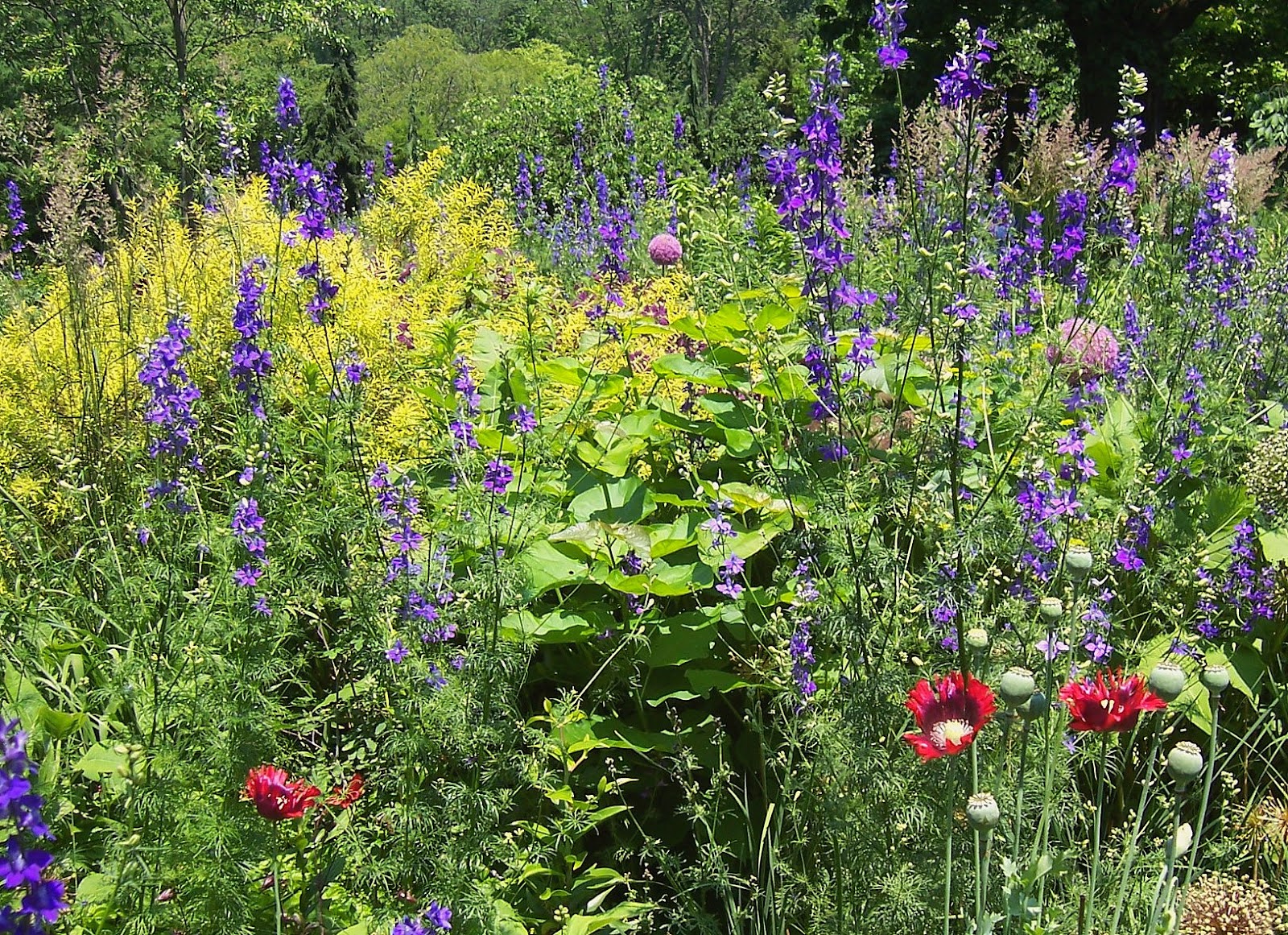
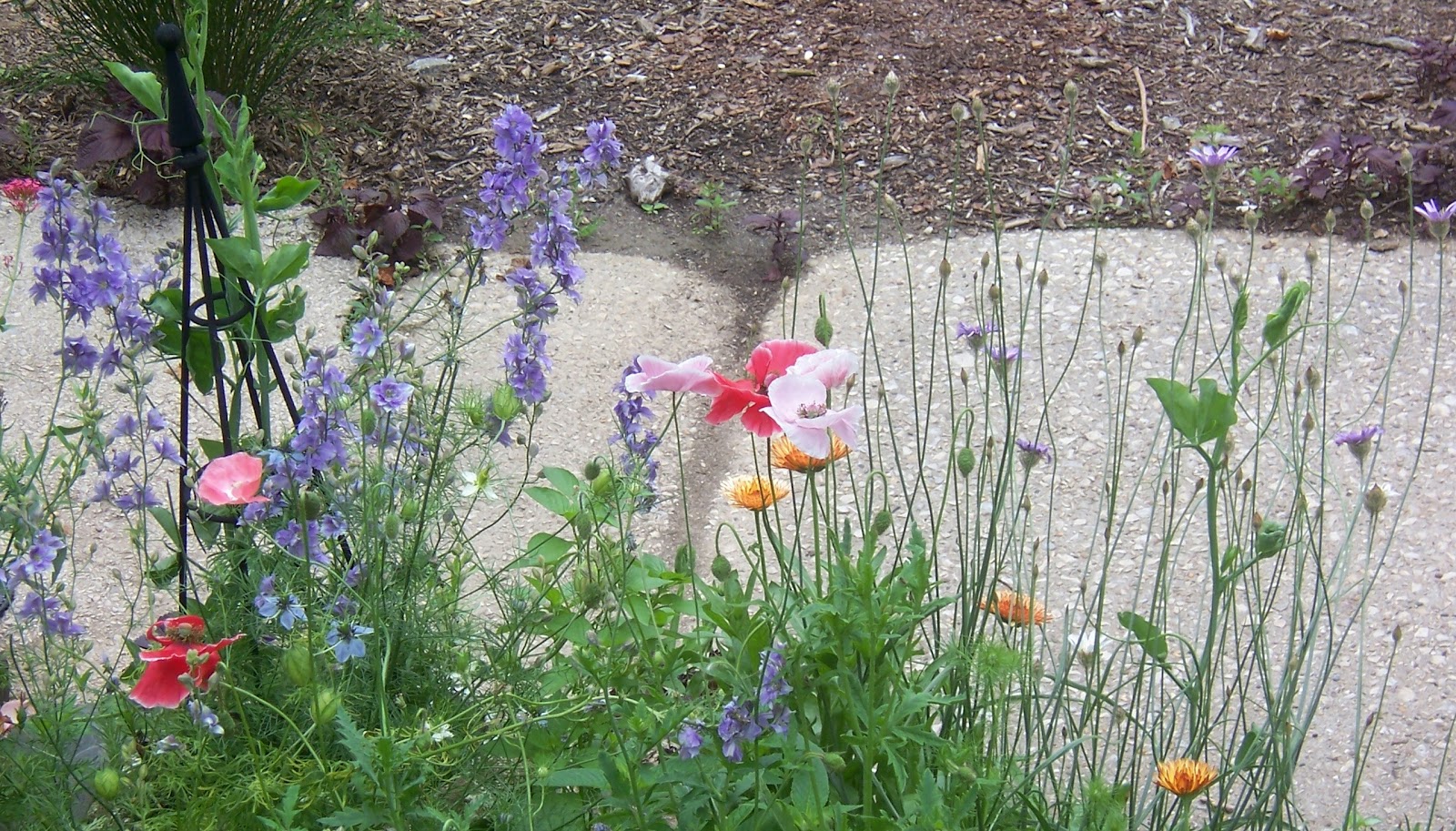
Every year in late winter I throw a lot of seed around. An illustration of the results is on the left. It shows three of my favorites,-- larkspur, poppy and pot marigold. Winter seeding brings lots and lots of  summer flowers.

On the right you can see these three, with sweet pea thrown in, filling in between the perennial Cupid's Dart, Coneflower and Lavender.  One of the people whose questions helped inspire me to write this blog wanted to know how I managed to have such dense planting with so much in bloom. Annual seeds are part of the answer.

To look good, most perennial gardens need to meet three needs: 1) they need to have a succession of abundant flowering and/or interesting foliage that lasts from early spring to late fall, 2)  week to week, with whatever is in or out of flowering, the garden needs to look visually balanced as a whole and 3) colors should not clash, nor should there be too much of any one shape of flower or leaf texture together, nor should the rise and fall of the overall composition of the plants be too uniform and boring.


Can you imagine trying to figure this all out logically? What a boring nightmare! Luckily you do not have to. You do need patience, some intelligence and a decent eye though. And an ability to throw seed on the ground.

Every year, all through the year, I take time to look at my garden and mentally note what is not working. Then, in spring and fall I transplant or plant as needed and every late winter I throw seed at bare patches. It makes for a dense, vibrant look that pleases me and many others. Plus, it does not take much time or money. Seeds are cheap.

How did I fall on this solution? Not by looking for a solution but by following desire.

16th century Belgium tapestry in the V & A, Creative Commons
Since I was young I have felt something strange, wonderful and good in the atmosphere I picked up from the style of some late Medieval, Northern European things. It's a style that shows in the interlacing narratives of the Arthurian romances and the flowery meads (see above) depicted in the backgrounds of miniatures and tapestries. It's a style with a delicate, graceful strength that to seems to quiet and transmute the arrogant and aggressive tendencies of its day.


As a decorative style it is called Mille Fleurs, a thousand flowers. I have no meadow clearing to dedicate to it. But I do have bits and drabs of a garden. And so it was by searching for an ideal that I discovered a highly practical reality. By using seed for old fashion annuals, and by allowing as much self-seeding as possible, I had figured out how to balance the garden thru the whole growing season, while filling it up to its brink.

But then I usually throw out the seeds while it still feels like winter. Is it too late, this spring in winter that feels out of time? I hope not. I need the frail, brilliant beauty of  poppies. I need their delicate, graceful strength.


----------------------------------------------------------------------------

How to Seed:  O.K., so I extravagated a bit about being able to throw -all- the seeds. Poppy seeds you can throw and maybe larkspeare. Sweet pea you really plant in. Most of the others you just barely cover. Take your finger, indent a trench about 1/8 of an inch deep, dribble in the seeds, dribble over some earth, done. Its that easy if...the ground is damp. Do it right after, or right before, rain.
Tuesday, November 29, 2011

Advent and the Calla Lily's Call

Post 17
Bare Tree, Bright Tree
Hello and welcome to Advent, the last part of the darkening year, the first part of the yet-to-be-born year.  Traditionally it's a time for quiet and meditation --after the garden's bounty, after the harvest and feast, before the light.

"God beyond answers
Lord beyond words
Spirit beyond imagining
Move us today. Amen"

This prayer, from the Church of Scotland's website, greatly moved me when I read it.  Unbidden, there arose in my mind's eye a globe, alight and vibrant with uncountable,  invisible connections.  And accompanying it, a bit like an inaudible trumpet's call, was the urge to write this...


"What if you could thank everyone who has ever prayed for you or blessed you or wished you well?

Who would you meet?

The stranger who once saw your stricken face through a car window?


The cashier you were impatient with?


The patron you were able to cheer?


Your spouse, in mid-argument? Your spouse, in mid-pleasure?


A teacher you can hardly remember?
Someone who read something you wrote, or heard secondhand something you said?
 
The atheist who wished you well?
The person whose dog played with your dog in the dog park?
The child or sibling or relative who never understood you, or whom you never understood? The child or sibling or relative you think doesn’t understand, but understands you too well?


The friend who sympathizes?  The friend who has outgrown you?  The friend you have outgrown?
The enemy who wishes you were not so easy to despise?  The enemy who wishes you were not so hard to despise?  The enemy who is no enemy at all?

The parent who wishes life could teach you more gently?  The parent who wishes life could teach you at all? The parent who wishes love had more power in this world? The child who wishes they could save their parents?


What if everyone you had prayed for, or blessed, or wished well, could thank you?


What if we found out we had all prayed for each other or wished each other well? Wished each other better?


What if we all forgave each other?

What if we were all grateful?

Would, even could I?  Would, even could you, any of us?

Or is that what something like heaven is for? I do not know, but I wonder."

If you think it's a bit treacly, well yeah, it might be. But why are we so overly afraid of treacly in our culture?  Cool is like a gangster boss inside our souls demanding cash for not much of value.  I chose not to give in to that.  So while I'm not much for mortifying my flesh; I am for mortifying my cool.


----------------------------------------------------------------------------------


How-to Calla:  The white and maroon trumpeting flowers you see above are scientifically no longer either Calla or Lily, but thankfully, such a melodious name for such a fetching plant remains. Their flowers remind me of the elongated instruments played by etoilated angels that brighten Medieval manuscripts.


Zantedeschia aethiopica, originates, as you can guess, in Africa. As such, our climate is a bit too cold and wet for them to overwinter. You can dig out their rhizones in the fall and overwinter them as you would a Dahlia. This means dig up the gnarly rootstock after cold has damaged the leaves, dry the rootstock out, then pack up in moistened perlite. In spring plant back up with plenty of water. Callas like some shade and water, while good drainage and rich soil is a plus. But all, in all, they are easy. 


They can be expensive though, which is why I only grew them one year.  (Should have overwintered them.  Should have overwintered them.)  I found the two varieties pictured above at Produce Junction, for a price too low to resist. (Produce Junction is a thrifty grab-bag of whatever they can pick up, fruits, veggies, plants, garden supplies--you never know week to week.) There is something fun about not knowing what pleasantly surprising plant you might find. And these Callas took my breath away.