Showing posts with label Gardening. Show all posts

Tuesday, June 4, 2013

May/June, or When Gardens Explode (in a good way)

Post 76


In May/June, when gardens explode, for one's own safety, follow these instructions--


Take in a slow, scented breath and stand still long enough to contemplate the tableau before you.


Then repeat to yourself, "I did not do this."


Because you didn't. Nature did. You just did some work to help things along.


For which Nature rewards you.


Because as with all real work (versus a job,) there is something extra that appears. Something that must have happened when you were checking soil levels or weeding or planting seeds, in short, when you were doing some practical task that has nothing to do with love or dedication or ardor. Because somehow, the garden caught fire. 


So during the explosion (and there are often explosions (the good kind) when you are doing things you love,) keep calm and remember, you have no idea how this happened. You are just lucky to be around at the time.


Friday, November 2, 2012

Wissahickon Style VIII, Smaller Hidden Kingdoms

Post 55

Hidden kingdoms can be hidden in plain sight. Like here, with blue Wolfsbane receding behind bramble and pink anemones.


I was lucky that I had parents who knew how to look for beauty and who taught me the habit. So when I come out of Weaver's Way in Chestnut Hill and am loading my grocery bags into the car, it is not unusual for my interest to be piqued by this...

  
Hmmm, what is the old stone wall from and these ruined buildings beyond.  And beyond them,  is that a charming garden I spy?


There is something about an expanse of old wall that excites curiosity.


What is this stuff and how did it get into contemporary, built-up Chestnut Hill?

So, imagine my pleasure when I was garage sailing one morning and a lovely, gardening couple allowed me into their back yard, where I was lured forward by lulling sights like this...


To turn to one side and see...


That I had stumbled upon one small hidden kingdom without even knowing it.  For here in this charming garden that I had hitherto only imagined,  lay a reality far more charming than I had been able to imagine.


The gentleman of the couple explained to me a bit about what he had heard about the ruins. Once a farm with its own s smokehouse (which explains the barn-like structure,) the property had been bought by Ruth's Funeral Home, where in that very smokehouse, they stored the cold dead bodies.


So--Boo! Ha! And  doesn't this recent discovery make for a perfect All Souls' Day post?  So the next time you're at Weaver's Way and see that quaint old barn thing...

Remember that the lovely body you are filling with such healthy food is but a bit dust and ash in the long haul!

And that some think something may or may not lie beyond. Of which we can not discern much. But rumor does ascribe great beauty and even greater charm to what, for now, we can at best only imagine.

 So prayers now for the beloved dead, if that is your wont. And isn't that a neat lamp on the back of the smokehouse? And, yeah, yeah, the light beyond, etc. Had no idea I was going to go all symbolic when I started this post. But the metaphors just seemed to line themselves up.
-------------------------------------------------------------------

I got to be part of a Halloween celebration that entailed wearing a costume to work. I work in a complex place and it was a complex costume --having something to do, I think, with Katherine Hepburn and time travel and the makings of: a currently mislaid, silent movie from the twenties that inexplicably stars an almost 60-year old Hepburn; "Bringing Up Baby, " and; "The Madwoman of Chaillot."  To stifle my usual long-windedness  I nicknamed it for the feminist literary crit. classic "The Madwoman in the Attic."

And while I rarely show myself in this blog, I figure this isn't really,  me-- so what the hey? Therefore, mix well this small dusting of ash with a big pinch of salt.


Tuesday, August 21, 2012

Mycobacterium vaccae or Why Gardening is Good for You

Post 49


What if we are built to live in the natural world? What if our bodies need to be in the natural world in order to function properly?


I started this blog for several reason, one of which was to explore how the garden gardens the gardener. I thought it might have to do with smells plants produce. I was half right. It looks like it has to do with the smells the soil produces.
Enter Wikipedia--
"Mycobacterium vaccae is a nonpathogenic species of the Mycobacteriaceae family of bacteria that lives naturally in soil. Its name originates from the Latin word, vacca (cow), since it was first cultured from cow dung in Austria. Research areas being pursued with regard to killed Mycobacterium vaccae vaccine include immunotherapy for allergic asthma, cancer, depression, leprosy,] psoriasis, dermatitis, eczema and tuberculosis.
There are scientists who believe that exposure to Mycobacterium vaccae may work as an antidepressant because it stimulates the generation of serotonin and norepinephrine in the brain. More specifically, it induces the neurogenesis of neurons that produce those two compounds...
Research, as of 24 May 2010, has shown that when Mycobacterium vaccae was injected into mice, it stimulated some growth of neurons. It also increased levels of serotonin an decreased levels of anxiety. "We found that mice that were fed live M. vaccae navigated the maze twice as fast and with less demonstrated anxiety behaviors as control mice", says Dorothy Matthews of The Sage Colleges in Troy, New York, who conducted the research with her colleague Susan Jenks."

Well Holy Cow! Skeptical of Wikipedia? How about The Economist, Apr 4th 2007?
“BACTERIA cause disease. The idea that they might also prevent disease is counterintuitive. Yet that is the hypothesis Chris Lowry, of Bristol University, and his colleagues are putting forward in Neuroscience. They think a particular sort of bacterium might alleviate clinical depression
The chance observation that Dr Lowry followed up to arrive at this conclusion was made by Mary O'Brien, an oncologist at the Royal Marsden Hospital in London. Dr O'Brien was trying out an experimental treatment for lung cancer that involved inoculating patients with Mycobacterium vaccae. This is a harmless relative of the bugs that cause tuberculosis and leprosy that had, in this case, been rendered even more harmless by killing it. When Dr O'Brien gave the inoculation, she observed not only fewer symptoms of the cancer, but also an improvement in her patients' emotional health, vitality and general cognitive function.
This result is intriguing for two reasons. First, it offers the possibility of treating clinical depression with what is, in effect, a vaccination. Indeed, M. vaccae is considered a bit of a wonder-bug in this context. Besides cancer, and now depression, it is being looked at as a way of treating Crohn's disease (an inflammation of the gut) and rheumatoid arthritis.
Second, it opens a new line of inquiry into why depression is becoming more common. Two other conditions that have increased in frequency recently are asthma and allergies, both of which are caused by the immune system attacking cells of the body it is supposed to protect.
One explanation for the rise of these two conditions is the hygiene hypothesis. This suggests a lack of childhood exposure to harmless bugs is leading to improperly primed immune systems, which then go on to look for trouble where none exists.
In the case of depression, a similar explanation may pertain. If an ultra-hygienic environment is not stimulating the interaction between immune system and brain, some people may react badly to the consequent lack of serotonin. No one suggests this is the whole explanation for depression, but it may turn out to be part of it."


And  a shout out the Plant Delights (one of the best mail order nurseries around,) newsletter, which alerted me to this.
“In some fascinating gardening research, new studies from Sage College of New York confirm a 2007 study from Bristol University and University College London that dirt is indeed a great anti-depressant. Many of us have known this for years, but we just didn’t know why...guess that’s why I don’t make the big bucks. As it turns out, a soil-borne bacteria, Mycobacterium vaccae, acts as an anti-depressant by causing brain cells to produce high levels of the happy hormone, serotonin. Serotonin occurs naturally in the body from the gut to the brain, and plays a particularly important role in mood. Low serotonin levels have been linked to anxiety, depression, aggression, OCD, bipolar disorder, fibromyalgia, and irritable bowel syndrome...who knew? Mycobacterium vaccae has already been used medically in cancer patients to increase their quality of life. The next time you hear that line about not being in the mood, grab your significant other, sans gloves, and head for the garden to get dirty."
From Plants Delights Nursery Update August 2012


Is it possible we need to be around earth to be happy and well? It can be fun to sit around a computer and pound keys, but what if that is only what we want but not what we need?


Have I just veered off subject? Of course not.  

I just spent a weekend out on Long Island (if you want you can read about it, there is my other blog, http://lkbwbackyard.blogspot.com/) and once again was struck by how calmly invigorated I felt. Sorta like how gardening makes me feel.

Being by the seaside seems to make many people feel good. Besides the most obvious reasons, have you ever wondered why? This is from WebMD.com

“There's something in the air and while it may not be love, some say it's the next best thing -- negative ions. Negative ions are odorless, tasteless, and invisible molecules that we inhale in abundance in certain environments. Think mountains, waterfalls, and beaches. Once they reach our bloodstream, negative ions are believed to produce biochemical reactions that increase levels of the mood chemical serotonin, helping to alleviate depression, relieve stress, and boost our daytime energy.
Ions are molecules that have gained or lost an electrical charge. . They are created in nature as air molecules break apart due to sunlight, radiation, and moving air and water. You may have experienced the power of negative ions when you last set foot on the beach or walked beneath a waterfall. While part of the euphoria is simply being around these wondrous settings and away from the normal pressures of home and work, the air circulating in the mountains and the beach is said to contain tens of thousands of negative ions -- Much more than the average home or office building, which contain dozens or hundreds, and many register a flat zero.
"The action of the pounding surf creates negative air ions and we also see it immediately after spring thunderstorms when people report lightened moods," says ion researcher Michael Terman, PhD, of Columbia University in New York.
And for a whopping one in three of us who are sensitive to their effects, negative ions can make us feel like we are walking on air. You are one of them if you feel instantly refreshed the moment you open a window and breathe in fresh, humid air.
"You may be one of them if you feel sleepy when you are around an air-conditioner, but feel immediately refreshed and invigorated when you step outside or roll down the car window," Howard tells WebMD. "Air conditioning depletes the atmosphere of negative ions, but an ion generator re-releases the ions that air conditioners remove."


Even if you are skeptical of global warming (I am not,) there is no doubt that if we go on using our power over the earth to loot and disrupt her ecosystems, we may well be destroying one of our own best shots at joy. Once upon a time most humans lived as farmers, hunters and fishermen. They breathed in chemicals that allowed them to cope with their often brutal, dismal and uncivilized worlds. Now, many of us have civilization,-- but we are out of touch with what can make us happy.


I do not think that alienating ourselves from the natural world is what God had in mind when S/He (or, if you are not a Deist, however you think, de facto, we got  dominance,) gave us stewardship of this planet. 


Aren't we supposed to make of this place a garden? 

Monday, July 23, 2012

A Phlox of Confessions


Post 45

Phlox of Confessions

Now is the time for tall garden phlox,(Phlox paniculata.)  Just as summer  turns up the heat and regular life droops, up springs these wide clouds of white, pink and lavender, to drift through the garden and lull us into the dog days.


Full summer, like long winter, slows down time. Confession -- slows down to such an extent that I can't seem to wax lyrical in my wonted way. See-- its not quite turning out right, is it? Even though phlox is a plant I really like and which grows great around here.

Confession--this might be partially because my camera woes continue. Thou my lost camera was returned, all the packing and unpacking resulted in a broken battery recharger. And since my camera is not spanking new, both proper battery and recharger are hard to find and cost enough to make me think twice. Twice, and then forward dreamily to a spanking new camera for Christmas. So for now I'm using a cheaper drugstore camera that does not have as good picture quality. --But, ... I draw inspiration from pics that are able to suggest the garden's reality. Bright, clear pics like this one.


Better pic than the two recent ones at the top of this post, right?

And Confession-- I just realized another reason why I might be blocked--camera,.shamera -- I'm evading an issue.

 I Do Not Really Garden Between the 4th of July and Labor Day.

My garden has its own seasons. Bare Bones, Emergence, Flourishing, Rampant, Rank, Late Beauty, Scenic Decay, and Wow, Is That Still Blooming?

We are now at Rampant heading into Rank. And it's a jungle out there, a beautiful, hot, teeming, beneficent jungle. O.K., on maybe one or two almost cool mornings I will grab a machete and hack out some of the seething undergrowth. But on a whole I figure that the garden is best experienced from somewhere comfortable, somewhere with air-conditioning and cool drinks. Like inside.

Hate Philly summers and hate being out in them. So here is my garden blog, based on my love of gardening, that admits to not gardening all summer. And penultimate Confession--I doubt I am the only one of whom this is true. (Final Confession--I am not sure I used 'whom' correctly in the last sentence, but 'who' sounds wrong. The "only one" is linked to "I" and therefore the subject, but the "I doubt" undoes the link? Or what?)

-------------------------------------------------

How to Phlox--  First tip, not with white string. The secret of beautiful Phlox is to find cultivars that are mildew resistant.

"David,"which is white, and Katherine, which is lavender, work well for me. I also have a tall hot pink one that is nameless. Long ago and far away, in Stowe Vermont, there was an alright but not great restaurant called Whiskers, now defunct. Set in the valley before Mt. Mansfield, it had a large outdoor deck that bordered on a wonderful, rampaging, wild garden(which, sadly, is now abandoned, neglected and slowly going to weed.) I was allowed a small bit of phlox, which I brought back to Philly, not sure it could take our humid furnace of a summer. Well, it can and it does, bountifully. The woman who created the garden said it was a native, and that is all I know.

So, if you have a mildew-resistant strain, plant it in full sun or almost full sun in regular garden soil. It likes some water, but aside from that is easygoing. If you are lucky it will spread, but not too quickly.


Thursday, March 15, 2012

Lead with seed to a flowery mead

Post 29

Is it too late?

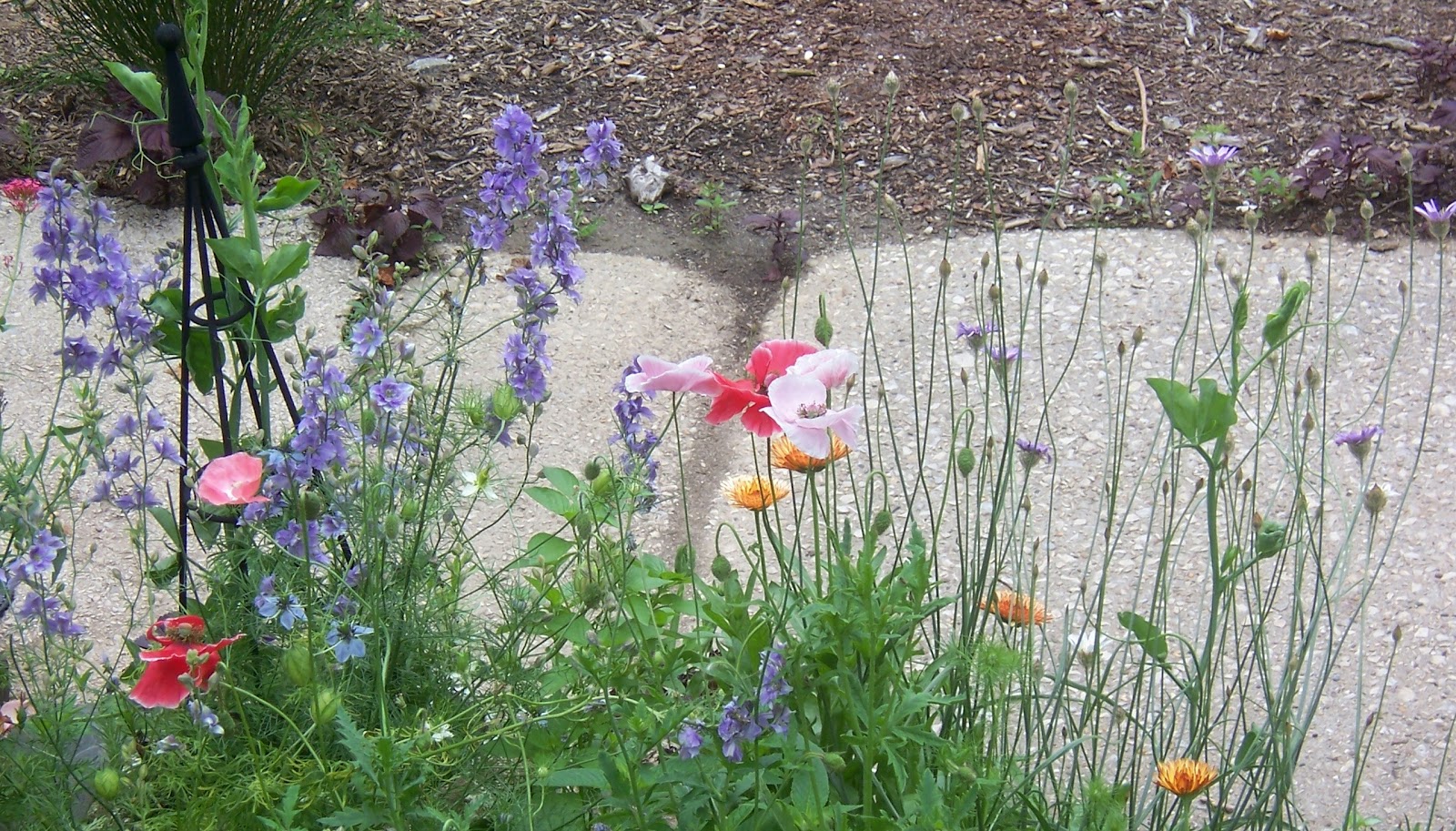
Every year in late winter I throw a lot of seed around. An illustration of the results is on the left. It shows three of my favorites,-- larkspur, poppy and pot marigold. Winter seeding brings lots and lots of  summer flowers.

On the right you can see these three, with sweet pea thrown in, filling in between the perennial Cupid's Dart, Coneflower and Lavender.  One of the people whose questions helped inspire me to write this blog wanted to know how I managed to have such dense planting with so much in bloom. Annual seeds are part of the answer.

To look good, most perennial gardens need to meet three needs: 1) they need to have a succession of abundant flowering and/or interesting foliage that lasts from early spring to late fall, 2)  week to week, with whatever is in or out of flowering, the garden needs to look visually balanced as a whole and 3) colors should not clash, nor should there be too much of any one shape of flower or leaf texture together, nor should the rise and fall of the overall composition of the plants be too uniform and boring.


Can you imagine trying to figure this all out logically? What a boring nightmare! Luckily you do not have to. You do need patience, some intelligence and a decent eye though. And an ability to throw seed on the ground.

Every year, all through the year, I take time to look at my garden and mentally note what is not working. Then, in spring and fall I transplant or plant as needed and every late winter I throw seed at bare patches. It makes for a dense, vibrant look that pleases me and many others. Plus, it does not take much time or money. Seeds are cheap.

How did I fall on this solution? Not by looking for a solution but by following desire.

16th century Belgium tapestry in the V & A, Creative Commons
Since I was young I have felt something strange, wonderful and good in the atmosphere I picked up from the style of some late Medieval, Northern European things. It's a style that shows in the interlacing narratives of the Arthurian romances and the flowery meads (see above) depicted in the backgrounds of miniatures and tapestries. It's a style with a delicate, graceful strength that to seems to quiet and transmute the arrogant and aggressive tendencies of its day.


As a decorative style it is called Mille Fleurs, a thousand flowers. I have no meadow clearing to dedicate to it. But I do have bits and drabs of a garden. And so it was by searching for an ideal that I discovered a highly practical reality. By using seed for old fashion annuals, and by allowing as much self-seeding as possible, I had figured out how to balance the garden thru the whole growing season, while filling it up to its brink.

But then I usually throw out the seeds while it still feels like winter. Is it too late, this spring in winter that feels out of time? I hope not. I need the frail, brilliant beauty of  poppies. I need their delicate, graceful strength.


----------------------------------------------------------------------------

How to Seed:  O.K., so I extravagated a bit about being able to throw -all- the seeds. Poppy seeds you can throw and maybe larkspeare. Sweet pea you really plant in. Most of the others you just barely cover. Take your finger, indent a trench about 1/8 of an inch deep, dribble in the seeds, dribble over some earth, done. Its that easy if...the ground is damp. Do it right after, or right before, rain.

Wednesday, March 7, 2012

Lungworts and Hyacinths, or Breathing Happiness

 Post 28


Green stalks prod their way up through soil seeking... what? If plants could feel, what would it feel like, pushing your way through earth for reasons you do not know?  To break through and feel something unexpected, such as light, course into your pores as photosynthesis, energy, begins. 

It probably would feel like what we felt, when as infants we pushed our way out to take in that first gulp of air, a substance for which we had no anticipating concept. AIR!, Strange, improbable, undreamt of air. Surprise! Of course we cried out, then quieted, finding a rhythm in this new thing breath. And rhythm we knew from our mothers' bodies.

We can't remember..., but we can imagine. Nature, thriftily-extravagent, uses similar processes at different levels in different ways, allowing for some imaginative analogy, empathy in context.  And gardens,-- where skill, comensurate with sensitivity, developes, --are great places for imagining. Enhancing sensitivity and imagination is one way gardening can change the gardener.

To breathe the air, to feel light, to enter a different state of being, how did we ever survive the shock? Well, cause not everything changed, there remained the lilt of known voices, touch, being held, tenderness, states we came to know as love and trust. From these, with these, we could grow to find pleasure in strange new things such as light and air. 

Here is the beginning of the pink Lenten Rose at the crest of the old buried staircase. Only one stalk is blooming, facing down towards a Lungwort which is about to bloom.

Lungworts are usually grown in some shade and therefore aren't usually this early. But I grow grey-leaved ones in sun. Older strains have greener leaves and need more shade. 

The reason the plant is called Lungwort is because its spotted leaves were once thought to resembled lungs. The flowers are the breath, the leaves are the lungs.


It's right there, isn't it?  It's a world I hardly knew existed before gardening. As a gardener, I've learned so many things -- sensitivity and skill, patience, respect, cooperation, and something else.  Something very like an everyday ecstasy. 

“Flowers and sunlight, air and silence—‘luxe, calme et volopte.’”  Patricia Simon

It comes to different people in different ways. For me, it's after I've been working in the garden for awhile. I'm physically tired but alert. So I lean forward or back to preen this frond or that and there it is, a stillness, a lively, peaceable calm. It is like the smell of a hyacinth as you walk down a busy street when, for a moment, everything else disappears, or rather, becomes more real.


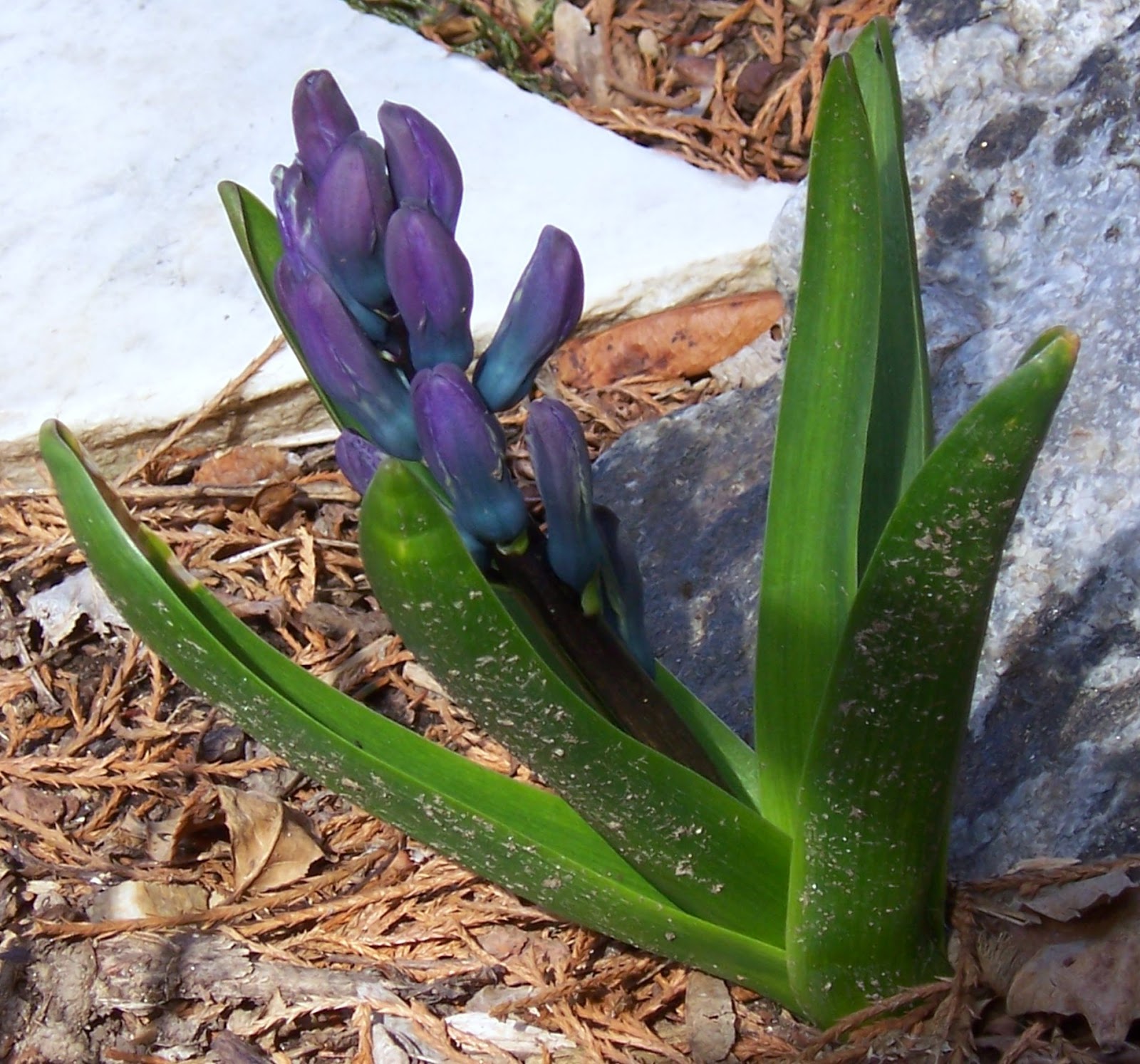
And you are a child again. A hyacinth has been placed on your windowsill for Easter. You watch it grow. At first it is a stalk of dark, deeply purple, secretive shells, like a long row of muscle shells fastened onto seaweed on the beach at tide-turn. Then the purple lightens, the shells slowly open  and they aren't shells at all, but tender, pliable flowers. And the smell, the smell is like nothing at all, or everything. It is everywhere, it is nowhere, it is Air. And as you  breathe it in, it is a delivery, an earnest, on the strange promise of that very first unremembered breath.

_______________________________________________

How to Lungwort (another great plant that easily grows around here): If you have shade or sun, like blue, purple, pink  or almost white flowers, this is a useful plant. Lungwort, or  Pulmonaria grows from rhizomes and needs moisture, especially if it gets a lot of light. Part of its appeal is that it blooms for almost two months, its escalating flowery bits growing ever longer. The best thing to do for it is to cut the flowers back hard before they are fully done blooming. So at about six weeks clip back as much of it as you can: flowers, stems and any tatty leaves.  If you do this new leaf growth with proceed nicely and you will end up with great foliage plants for the rest of the summer. If you do not cut it back when it needs it, I have found that it can  droop, get mildew or even die, especially in sun. It is as if making new leaves while keeping up the old stuff is almost too much for it  If you want more plants, and you have a variety that makes viable seed, just shake a handful of spent stems over a moist bit of shaded earth. Next spring you will have babies to transplant as you wish.


Most writers tell you not to grow Lungworts in clay, but I have found they do fine in my only slightly amended clay soil. So just make sure they are in somewhat well-drained soil, not pure clay where the rhizomes can rot. Many of mine are on the slope of a hill, which must help.


Hyacinth a few days later

How to Hyacinth: Hyacinthus Orientalis is a bulb that has been bred from the wild Hyacinth, a native of Turkey. As with most bulbs, plant it to a depth just a little deeper than its own size in the fall. It will bloom for a short time the next spring, and if you are lucky, again the year after.  For all that bother though, the powerful sweet scent is well worth the effort. The blue/purple flower, versus the other colors, is perhaps the most treasured of all; it stands for sincerity.

Full bloom
.  

Tuesday, November 22, 2011

Thanksgiving

Post 16
Deerfield Village, MA


Now is the time for giving thanks. We are problem-solving, stimuli-hungry animals who lose track of the common and uncommon graces of our lives.


Somehow, for me, gardening slows down time. For after an hour or so of digging, smelling, placing, moving, something in me stills. Only then do I truly begin to feel, really feel, the sun massaging my shoulders or the fine texture of  grit on my fingers

It's easy to be so busy thinking/planning/solving that living, feeling unwanted, gets out of the way.

The word gratitude, comes from the Latin gratitudo and gratus. Which means thankful. It also means pleasing, as in pleasure...

Pleasure gets no respect. We suspect it because it can lead us astray. But it can also lead us right.

Part of adolescence is learning to extract pleasure from things we originally find repugnant. From booze to tobacco to movies without happy endings, we learn to overcome instinctive pleasure. How else can we be cool and grown-up? We learn to tolerate, even be proud of,  the deadening side effects of overiding our nature, and then wonder, years later, what's gone wrong.

Maturity, among so many other things, may be about shedding such roughshodding over pleasure.

Pleasure is easy.  It is everywhere. And much of it is innocent. It does not hurt you or anyone else. That is the pleasure to go for, to be grateful for.


According to the OED, the second meaning of gratitude is grace. Like the the grace of innocent pleasure, there for us when we want it.

So is the act of feeling pleasure, in an of itself, a type of gratitude? The answer seems both obvious and paradoxical.

The reason I've made a garden is because it gives me pleasure, a pleasure I learned about by experiencing other peoples' garden. I hope my garden passes on that pleasure. I hope this blog with its pictures does too. It is a way of saying thanks.