Showing posts with label Spring. Show all posts

Friday, June 1, 2012

Valerian or All-Heal, A Calming Pause


Post 40


Roses and rhodos crown spring.  But after roses, what can  follow? Usually there is a pause.  In a normal year, which is not this year, most perennial gardens are a bit bare before the midsummer eyeopener of daylily, daisie, coneflower and monarda .


Which is why valerian, a perennial herb that looks like a giant Queen Anne's Lace, is such a useful plant. It steps forward as the roses end and then recedes as midsummer color takes over.

It is a tall, leggy herb with uplifted hands and head. Emerging out of a rosette of leaves the stems can grow up to 4 feet high. On its own the flower is pretty but lacks pizzazz. However, team it with some non-green ground covers and interesting flowers as they come and go, and it carries the garden through. Also, because it is tall, it is great behind smaller, denser plants. After bloom it can be cut back down to its nondescript green rosette. If you leave it standing after the peak of bloom seeds will set and you should get baby valerians, perhaps all over your yard. The seeds are light and travel in the wind. It is an easy plant to dig up and put elsewhere or give away.


It is not always an easy plant to buy. For like Corydalis lutea (Post 15,)  it has not been modified it into a patented commodity that warrants a marketing campaign. If a nursery carries Valerian, it is usually in the herb section, but since it is not a cooking herb you may need to ask for it. Or buy some seeds. Then, in two years you will have tall, lovely plants.


It's full name is Valeriana officinalis.  It can be called garden heliotrope, which is really another plant (cherry pie,) and red valerian, which is also really another plant (Jupiter's Beard.) Valerian has been called all-heal since medieval times because there is a medicine made from its roots, which, when properly prepared and administered, has a gentle calming effect.


So, if you have a space in sun or semi-shade that gets adequate water and needs some sprucing up this time of year, -- consider adding the sweet-smelling presence of this plant.

Saturday, May 26, 2012

Reviewing Spring


Post 39

Spring is just about done as the summer humidity begins to hit. No more of of the above--

Or the below--


Such fresh sparseness has had its day


Till next year.

Here are a few more of my favorite pics from the season that is passing.


Geums worked well this year with almost two months of bloom, giving a strong, airy dash of color.

This native azalea is a Pinxter Azalea and gives height to the right of the front side path, sorta like a big, fat  pink exclamation point.I like the openness of the native azaleas. There is something about plants that are so covered in blooms you cannot see any air or green that uneases me. Looks stubby, not graceful. I prune this one back right after flowering, otherwise it could grow to 15 feet or so, which would look weird, considering the size of my yard. It likes decent drainage, acid soil and moderate water.  If happy it suckers a bit, but the stems have shallow roots and are easy to dig up and transplant elsewhere.


This was taken in my back yard, which gets a few hours of dappled sun. It shows a rhododendron that was there when we moved in. Next to it I planted an Aucuba japonica that I got at Rare Finds Nursery in N.J. (Rare Finds is a bit out of the way, but it has interesting and unusual stock.) I'm not sure what variety of Aucuba it is, I think maybe Golden King. Anyway, it does great competing with the roots of the silver maple it is sited under.
It is a highly unfashionable plant but nevertheless the right presence in the right spot.


Does anyone not like Irises? They need their own post though, and this one is long enough. So another pic, no more words, and done.


Thursday, April 26, 2012

High Spring, Quasi-Miracles and Variegated Solomons Seal

Not my garden, just a gate I passed.

Ahhh--High Spring

 Post 35                  

Variegated Solomon's Seal & Tulips

Sometime in the spring, late April or May, you look at the garden and wonder, how has this happened? How does this fresh, sweet (for it smells of lilac, lily of the valley, and later, roses ) lushness of High Spring happen?  How can the piddling amount of work a human can do translate into this? And something fills up inside of you because no amount of work could turn into this. There is something like a miracle going on here that has nothing to do with work. For all that work is doing is giving a little goose to the quasi-miracle.         
                                                                                                  
  I am writing this while watching "Dancing with the Stars." I am a sucker for dancing and enjoy the dance routines. But slowing down the fun  is a competitive drama, replete with tearful protestations of hard work, full commitment and being in this to win/triumph/dominate. 
No one would argue that work is utterly necessary for great dancing. or great anything. But what exactly is this work?  Maybe on one level it is a privilege, a chance to participate in the real miracle: the miracle of  a healthy human body fully realizing its grace, beauty and balance.                                                                                                                                                      Now look at this flower on the left. It is dancing, its arms extended, its legs poised, its beaming head turned upward towards us, the audience. It is a part of nature just as we are part of nature, and nature is economical in how she creates her abundance. The same principles come into play. And Nature has more principles up her extended sleeve than just competition.                                                                                                                                                

Some say we are more than we know, just as any garden is more than what we can do. What plays in nature plays in us, allowing us to work just hard enough to feel as if we have helped make a part of the garden's beauty.


What powers my garden work? Love. And at High Spring I feel as if I can smell, taste and apprehend that love coming back to me in physical form. Within the year's cycle, it is as if here is where nature figures reciprocating love.

Variegated Solomon's Seal, Forget-me-Nots, Tulips, Adjuga, Grass
From little often comes much. Great things do not just come from competition, though that is the message our culture sends. Great things also come from cooperation, open communication and inspiration, especially if they are powered by real love. It is love in the garden that makes for what I call the Amended Golden Rule -- "if I were that individual member of a particular life-form, how would I want/need to be treated in order to properly flourish."  This is what allows lives to develop into their best true being. Without these glorious spring weeks, we might forget the peace and wholeness that the best really signifies.

Competition can be brutal and brutalizing. It can stamp out what is best in people as they pursue a limiting goal. It can breed anxiety, insecurity, depression and various partial escapes, especially addictions.

But if we are more than we can know; if we are more than what we can do--then there is more to the story. Gardening can lead us out of the ego's competitive trap. And it is good to learn wisdom firsthand,  through the work of your hands and the labor of your heart.

Variegated Solomon's Seal
So--what is this plant to the right? In this post, two of the pictures above also show it, but here it stands alone, an adaptive, easy, beautiful plant for semi-shade with a mighty and mystical name: Varigated Solomon's Seal (aka Polygonatum odoratum 'Variegatum'.) In legend Solomon's Seal quelled demons with an insignia of the four elements balanced into wholeness. The plant got its name because if you detatch a stem away from its rhizome, you  see an image of the Seal; the Seal being what binds the sun-and-air-processing leaves and stem to the earth-and-water-gathering roots.


Ned Wolfe Park with Variegated Solomon's Seal,Creeping Phlox & Tulips

So here is a sign for High Spring, for balance, peace, wholeness and love. And of course it has variegated leaves as a sign that here on this earth, who of us is not?  And best of all, it plays well with others. Woodland flowers spring up around it in early spring before the trees take leaf. Its graceful flowering curve of small white bells blends in with gaudier tones. Then as summer approaches the other plants loose their flowers and the Solomon's Seal's variegation brightens up the otherwise pure green shade.


----------------------

How to Solomon's Seal:  It does need some shade and some sun but is not too fussy about the proportion. It needs water, but once established is pretty drought-tolerant and its beautiful leaves usually stay fresh looking all summer. It is said to want good drainage but the large patch in the earlier picture has its feet in fairly compacted clay soil. It will reproduce easily, often at an exponential rate, but can be easily dug up. In short, an excellent plant.


Sunday, April 15, 2012

Gardening Spring: Kerria & Tulips


Post 34

What has sprung up this spring? The  picture on the left was taken recently and shows local spring staples like tulips (the bits of color spotted about) and kerria ( the big yellow blob to the left of the birdbath.). Both are common around here because they are easy, and if done well, attractive.

Kerria japonica Golden Guinea:
Here is a picture of a small bit of Kerria just beginning. What I like about this plant is that it can take a fair amount of shade, fills in an awkward time of year (the one between blindingly brassy forsythias and either horribly or gloriously brassy azaleas,) and when done right, is not brassy at all. It is a mellower yellow than forsythia, and naturally grows in a squiggly way. If you let it squig and do not plant it in too solid blocks (or buy the double flowered version, which too my eyes is way too dense,) and cut it back hard right after blooming, you will be rewarded with a woodland plant that spreads just enough to let you easily divide it and use the suckers elsewhere. It will even do some reblooming later in the summer.


Tulipa clusiana:  Here you see kerria with one of my favorite tulips, Lady Tulip. It has a graceful form where the stalk is not overwhelmed by the flower, which shows that it is a species tulips, an old type of tulip that naturalizes easily.  In good conditions can count on it coming back for, well, a lot longer than non species tulips. Carolus Clusius (1526-1609),humanistic botanist,  is supposed to have first brought it to the Netherlands and hence Europe. Give it sun ,water and good drainage. After bloom deadhead most but leave a few to develop seeds, seeds that may end up in places you never expected.


This is a back, utility part of the garden. Yet somehow it has acquired a stray euphorbia and a small Lady tulip. Good surprises are part of what I love about the garden. Sure, you can rip up everything that does not fit with your plans. But why would you want to? Sometimes things turn out better than your plans could have imagined. Next year,  I may try to plant more of this combination of Lady tulip and wood spurge. It works.

Now, while my main investment is in species tulips, I admit to having a hard time passing up the cheap bags of bulbs they sell in the box stores. So if the price is right, I give in, knowing I'm getting tulips good for at best 2 or 3 years.


Here is a bunch in bloom right now. They make me think of the stately tulips in old Dutch still lives. The painterly feathers of red on cream were then the result of a potato blight which caused the color to "break," which made the tulips rare, expensive and the cause of a financial crash that briefly ruined the baroque Dutch economy.  Now, of course, these tulips are not the effects of a blight, but bred to look this way. Still, they are a lovely reminder of how silly humans, and even  whole societies, can be.


From a few years back, these tulips on the left are another of my favorite tulips, but I can not remember what they were called, nor have I seen them again. They were a strong, jubilant pink that fanned  out in ruffled, variegated stripes. They looked good from bud to bloom to falling apart, as they are pictured here. I do hope they turn up again. 


I had a neighbor who once told me that our
contiguous front yards were poisoned, that the soil had been harmed in some way. What he meant was that when he plunked a plant down into said soil's embrace, the plant would die. But it died because he paid no heed to what the plant needed. 

He had dry shade with low pH but he expected plants to grow that needed different, easier conditions.The soil was difficult--all compacted clay riddled with tree roots. But he did not care to improve the structure of the soil with compost or dig out some of the tree roots.  Still, he could not fathom why a plant, a living thing, did not thrive under such stringent conditions.

Anybody can get a plant, but it is care, taking care, that makes a garden. I like kerria because it reminds me of this, just as tulips remind me how silly we humans can be, and how we all need care, all of us, if our lives are to flourish.


How to Kerria: Kerria does well in all but the deepest shade, is not fussy about soil type and has the main drawback of growing like Topsey. So cut it back hard after blooming and in the spring or fall, dig up and transplant any suckers to where you want more of it. Because you will want more of it.             

Sunday, April 1, 2012

Wissahickon Style V, or Who will Spring for Spring Bank?

Post 32

Ahhh, Spring. Spring forward. Spring out. Usually once a year... unless you have a an actual spring stream running through your property..

Somewhere out there is a local history buff with a mere extra million burning a hold in her or his pocket. One who needs an interesting house where the kids get their own space, yet is intimate enough for a normal size family. One who wants a house with a bit of soul to it.


A peaceful place, with its own creek,with an extra lot of wilderness that can be gardened or, perhaps built on later. Maybe a small Green cottage to retire in, while the next generation takes over the main house. A house part colonial, part late Victorian,  part recent, sensitive renovations.


It  even has its own ruins-- two stone, spring houses, one of which houses what must be the most tastefully situated Jacuzzi ever. There is even a hook half-hidden in the stone for your towel, if you feel you need it. For notice the porch stairs on your left, you can spring back into the house without anyone the wiser.


So, why buy a McMansion when you can hang out where colonial Rittenhouses, Poe, lunatics, Frank Furness (his being the addition,) and the gentleman  who commissioned the "Toleration" statue in Fairmont Park, have hung out?


Did a mention that, besides this view, this wonder also includes a sleeping porch, a breakfast porch, a house-long glassed-in winter garden and a house-long open porch? A walled garden? A servants' back staircase so sunny and glossy you could sit there and read all day? A dining room fireplace mantel of King of Prussia marble? Did you know there -was- King of Prussia marble?


Sold?  I hope so. You will get your money's worth and more on this one. If so, contact the broker:

Loretta C. Witt, CRS, GRI Associate Broker
Prudential Fox & Roach Realtors 14 West Evergreen Avenue Philadelphia, PA 19118
office 215-247-3750 direct line 215-248-6522
e-mail Loretta@lorettawitt.com

P.S. If you google Spring Bank you will see the price listed as as $1,200.000. I believe it is now closer to a million. And no, I am not related to anyone involved with this, nor am I getting (nor want) any incentive for writing this post. I just think this property is part of what makes this part of the world such an interesting, beautiful and meaningful bit of earth, and would like to see it tended by an appreciative hand.

For old pictures of how Spring bank once looked, check out the Library Company's photo Here and some from the Univ. of Penn., Here


Monday, March 19, 2012

Time of Soft Trees

Post 30


Now is the time of soft trees, 
the beginning, when hints of pink, green and yellow tint the taupes and blues of winter.

So, below, a poem about life. Very short. Very slight. 
And fit for an Equinox, - at least half bright.


Tilth


Deep in the underhush 
   Dig low, pile high;
Warm as the underbrush
   Deep as the sky


Warm as the underbrush,
   Grasses and sedge,
Berries and daisies
   Fringe a low ledge.


A stream at the edge
Moves through the dew,
The deeper the life
The stronger the clue.


Happy Spring


Thursday, March 15, 2012

Lead with seed to a flowery mead

Post 29

Is it too late?

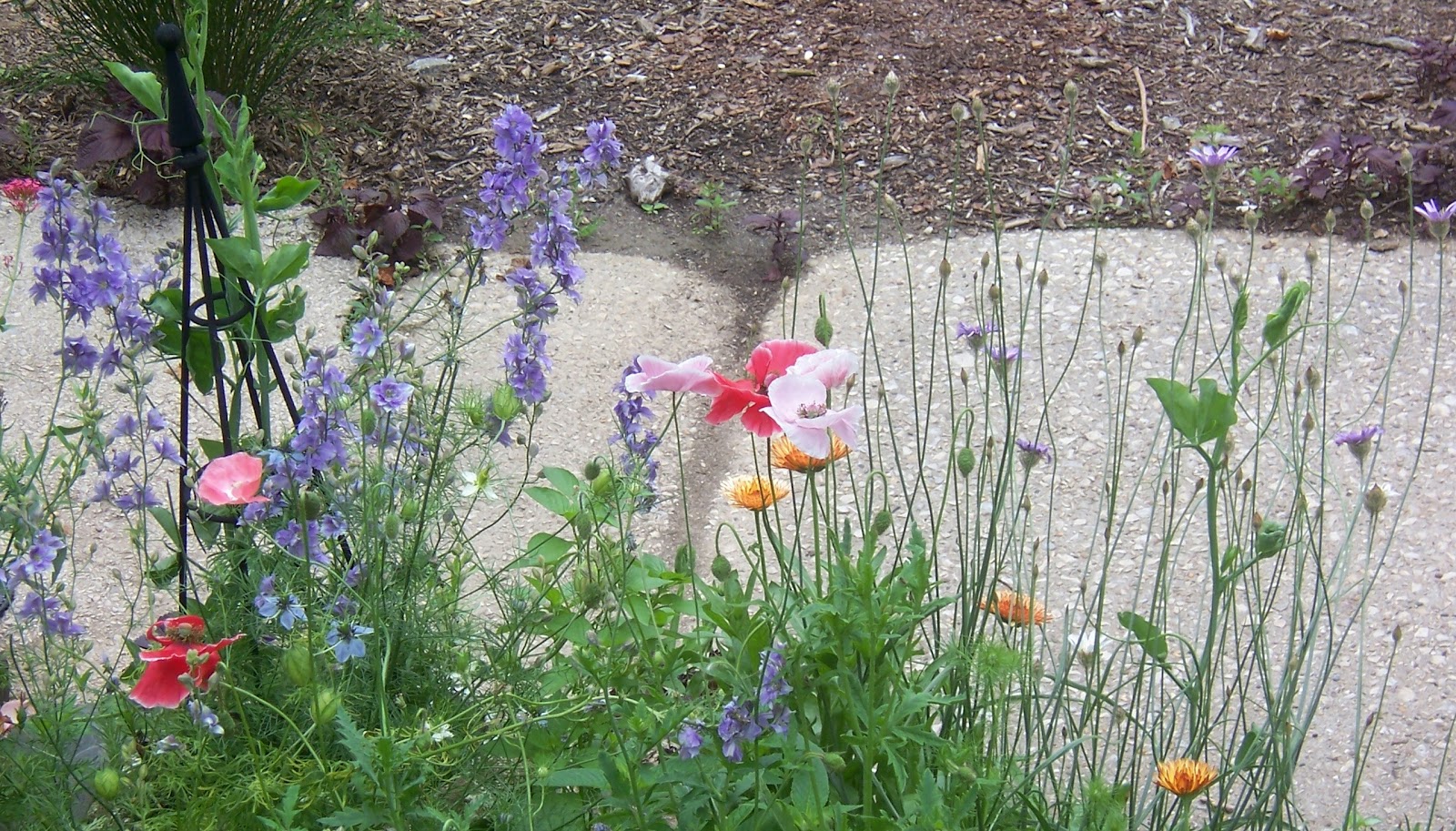
Every year in late winter I throw a lot of seed around. An illustration of the results is on the left. It shows three of my favorites,-- larkspur, poppy and pot marigold. Winter seeding brings lots and lots of  summer flowers.

On the right you can see these three, with sweet pea thrown in, filling in between the perennial Cupid's Dart, Coneflower and Lavender.  One of the people whose questions helped inspire me to write this blog wanted to know how I managed to have such dense planting with so much in bloom. Annual seeds are part of the answer.

To look good, most perennial gardens need to meet three needs: 1) they need to have a succession of abundant flowering and/or interesting foliage that lasts from early spring to late fall, 2)  week to week, with whatever is in or out of flowering, the garden needs to look visually balanced as a whole and 3) colors should not clash, nor should there be too much of any one shape of flower or leaf texture together, nor should the rise and fall of the overall composition of the plants be too uniform and boring.


Can you imagine trying to figure this all out logically? What a boring nightmare! Luckily you do not have to. You do need patience, some intelligence and a decent eye though. And an ability to throw seed on the ground.

Every year, all through the year, I take time to look at my garden and mentally note what is not working. Then, in spring and fall I transplant or plant as needed and every late winter I throw seed at bare patches. It makes for a dense, vibrant look that pleases me and many others. Plus, it does not take much time or money. Seeds are cheap.

How did I fall on this solution? Not by looking for a solution but by following desire.

16th century Belgium tapestry in the V & A, Creative Commons
Since I was young I have felt something strange, wonderful and good in the atmosphere I picked up from the style of some late Medieval, Northern European things. It's a style that shows in the interlacing narratives of the Arthurian romances and the flowery meads (see above) depicted in the backgrounds of miniatures and tapestries. It's a style with a delicate, graceful strength that to seems to quiet and transmute the arrogant and aggressive tendencies of its day.


As a decorative style it is called Mille Fleurs, a thousand flowers. I have no meadow clearing to dedicate to it. But I do have bits and drabs of a garden. And so it was by searching for an ideal that I discovered a highly practical reality. By using seed for old fashion annuals, and by allowing as much self-seeding as possible, I had figured out how to balance the garden thru the whole growing season, while filling it up to its brink.

But then I usually throw out the seeds while it still feels like winter. Is it too late, this spring in winter that feels out of time? I hope not. I need the frail, brilliant beauty of  poppies. I need their delicate, graceful strength.


----------------------------------------------------------------------------

How to Seed:  O.K., so I extravagated a bit about being able to throw -all- the seeds. Poppy seeds you can throw and maybe larkspeare. Sweet pea you really plant in. Most of the others you just barely cover. Take your finger, indent a trench about 1/8 of an inch deep, dribble in the seeds, dribble over some earth, done. Its that easy if...the ground is damp. Do it right after, or right before, rain.