Showing posts with label Grace. Show all posts

Tuesday, June 12, 2012

Chanticleer, or Wonder at the Call of the Dawn


 Post 42

Is the wish to share wonder the first stirring of art?


To combine wildness and order, light and shade through love so that you can share the inklings and glimmers of infinity that fill you, and seem to overflow from you?

Welcome to Chanticleer.


Chanticleer  is an extraordinary pleasure garden on the Main Line.  Chanticleer is named after a rooster who shows up in Northern European folklore. a rooster like the one emblemed on top of this pool houses.


How do you communicate moments of wonder, when your senses seem to be taking in more than they can hold? Like at first light, when out of nowhere, emerges the rich complexity of reality.


Go to Chanticleer, walk around, maybe sit for a bit.


Such beautiful, expansive and witty public gardens, 'built solely for pleasure', are a blessing of this area. Within a few hours or less you can reach Chanticleer, Longwood Garden, Winterthur, Scott Arboretum , Morris Arboretum, Mt. Cuba , Wavehill, Brooklyn Botanical Gardens New York Botanical Garden and others. All of these are inspiration on many levels,


So, if you are lucky and willing, here are dawns, foretastes, or deep tastes, of what reality might be, or could be, or is, at sublime moments of joy and awe.


When everything mixes up at levels of complexity beyond human reason, but not beyond human experience, imagination and art.


Perhaps it is what Coleridge called Reason. Or not. Perhaps something else. But whatever it is, it includes the wonder that overflows and makes people make things.


... gardens, emblems of possibility, if you can just let its pleasures reach you. 


P.S. --Apologies for the pics, which do not do justice to this great garden. It was mid-day on a sunny day when I was there, and that is a hard time to get decent shots.

Monday, May 21, 2012

Roses: The Which and the How, No Need to Explain the Why.


Post 38


Happy Rosetime.

I grew up scared of roses.

Out on Long Island in the 60's, roses were either beautifully wild at dunes' edge or hybrid tea roses that needed to be fussed over, if not fussed over they decayed. Plus, the white ones my parents grew were old sock white by the second day of their 5 day, once a year, bloom.

I had no idea how easy it would be to grow these reblooming beauties ( including the rose at the top of the post. (And yeah--both readings work.))


These are not my best roses.  These are the dead-easy roses that gave me confidence to try other roses. These are all Knock-Out Roses in blush pink, yellow, coral and red. They are as likely to be sold at box stores as at nurseries. They have been joined by a new series with "carpet" in the title, and I have high hopes for pretty 'Amber" below. All these need is 5 hours of sun a day, average water, a wack back in March, followed by another after first bloom. If you throw in mulch, compost and/or Rose-Tone, you will be amply rewarded


A slightly more difficult but lovey climbing rose came with the house, though she was growing in a part of the back yard that no longer gets much sun. I transplanted her to the side of the house and still do not know her name. She gets black spot every year as summer turns humid, but my lack of fussing and spraying has not lessened her ardor. She remains a doer.


So, after these,  was I ready to advance into higher rosedom?  Well, ready or not, I did. And Anglophile that I am, it was, of course, right into David Austin Roses.


One day, end-of-season, I saw a droopy, neglected rose on sale called Christopher Marlowe. Taking him home, I gave him as much amended Golden Rule love as I could, for which he thanked me eloquently with blooms like this--red at bursting, then pink with golden tangerine tinges, sorta Elizabethean psychadelic.  

And--after I saw that I hadn't managed to kill Kit ( he can suffer from non-lethal blackspot thou,) I added Grace, and at full price too. She is achingly comely.


She goes well with Kit, who, lets face it, always needed some kind of Grace. I'd like to add Will soon.


And those roses I mentioned earlier, the ones at dunes' edge that I'd loved as a kid? They were/are species Rugosa Roses, which are hardy and easy. They will grow almost anywhere--including this cultivar in my yard.

So--that's almost all my roses for now. 

Well-till at the Ned Wolf Plant sale I saw Theresa Buget, a Canadian rose without real thorns but with almost ferny foliage and spun sugar blooms (see left.) I'm trying her in the sunniest part of my backyard, since I'm running out of space in the sunny front yard. Which only means I need a bigger sunny front yard! 

I hope I have quieted any rose fears. Roses are really no more difficult than most plants, slightly heavier feeders maybe, but that is easy to provide. And one last basic but important rule: when you are pruning, always cut just above the node of a stem that has five leaves on it: never 3, always 5. Do that and all will be, not only hunky-dory, but also more sweet-smelling than you could have imagined.

Thursday, April 26, 2012

High Spring, Quasi-Miracles and Variegated Solomons Seal

Not my garden, just a gate I passed.

Ahhh--High Spring

 Post 35                  

Variegated Solomon's Seal & Tulips

Sometime in the spring, late April or May, you look at the garden and wonder, how has this happened? How does this fresh, sweet (for it smells of lilac, lily of the valley, and later, roses ) lushness of High Spring happen?  How can the piddling amount of work a human can do translate into this? And something fills up inside of you because no amount of work could turn into this. There is something like a miracle going on here that has nothing to do with work. For all that work is doing is giving a little goose to the quasi-miracle.         
                                                                                                  
  I am writing this while watching "Dancing with the Stars." I am a sucker for dancing and enjoy the dance routines. But slowing down the fun  is a competitive drama, replete with tearful protestations of hard work, full commitment and being in this to win/triumph/dominate. 
No one would argue that work is utterly necessary for great dancing. or great anything. But what exactly is this work?  Maybe on one level it is a privilege, a chance to participate in the real miracle: the miracle of  a healthy human body fully realizing its grace, beauty and balance.                                                                                                                                                      Now look at this flower on the left. It is dancing, its arms extended, its legs poised, its beaming head turned upward towards us, the audience. It is a part of nature just as we are part of nature, and nature is economical in how she creates her abundance. The same principles come into play. And Nature has more principles up her extended sleeve than just competition.                                                                                                                                                

Some say we are more than we know, just as any garden is more than what we can do. What plays in nature plays in us, allowing us to work just hard enough to feel as if we have helped make a part of the garden's beauty.


What powers my garden work? Love. And at High Spring I feel as if I can smell, taste and apprehend that love coming back to me in physical form. Within the year's cycle, it is as if here is where nature figures reciprocating love.

Variegated Solomon's Seal, Forget-me-Nots, Tulips, Adjuga, Grass
From little often comes much. Great things do not just come from competition, though that is the message our culture sends. Great things also come from cooperation, open communication and inspiration, especially if they are powered by real love. It is love in the garden that makes for what I call the Amended Golden Rule -- "if I were that individual member of a particular life-form, how would I want/need to be treated in order to properly flourish."  This is what allows lives to develop into their best true being. Without these glorious spring weeks, we might forget the peace and wholeness that the best really signifies.

Competition can be brutal and brutalizing. It can stamp out what is best in people as they pursue a limiting goal. It can breed anxiety, insecurity, depression and various partial escapes, especially addictions.

But if we are more than we can know; if we are more than what we can do--then there is more to the story. Gardening can lead us out of the ego's competitive trap. And it is good to learn wisdom firsthand,  through the work of your hands and the labor of your heart.

Variegated Solomon's Seal
So--what is this plant to the right? In this post, two of the pictures above also show it, but here it stands alone, an adaptive, easy, beautiful plant for semi-shade with a mighty and mystical name: Varigated Solomon's Seal (aka Polygonatum odoratum 'Variegatum'.) In legend Solomon's Seal quelled demons with an insignia of the four elements balanced into wholeness. The plant got its name because if you detatch a stem away from its rhizome, you  see an image of the Seal; the Seal being what binds the sun-and-air-processing leaves and stem to the earth-and-water-gathering roots.


Ned Wolfe Park with Variegated Solomon's Seal,Creeping Phlox & Tulips

So here is a sign for High Spring, for balance, peace, wholeness and love. And of course it has variegated leaves as a sign that here on this earth, who of us is not?  And best of all, it plays well with others. Woodland flowers spring up around it in early spring before the trees take leaf. Its graceful flowering curve of small white bells blends in with gaudier tones. Then as summer approaches the other plants loose their flowers and the Solomon's Seal's variegation brightens up the otherwise pure green shade.


----------------------

How to Solomon's Seal:  It does need some shade and some sun but is not too fussy about the proportion. It needs water, but once established is pretty drought-tolerant and its beautiful leaves usually stay fresh looking all summer. It is said to want good drainage but the large patch in the earlier picture has its feet in fairly compacted clay soil. It will reproduce easily, often at an exponential rate, but can be easily dug up. In short, an excellent plant.


Thursday, March 15, 2012

Lead with seed to a flowery mead

Post 29

Is it too late?

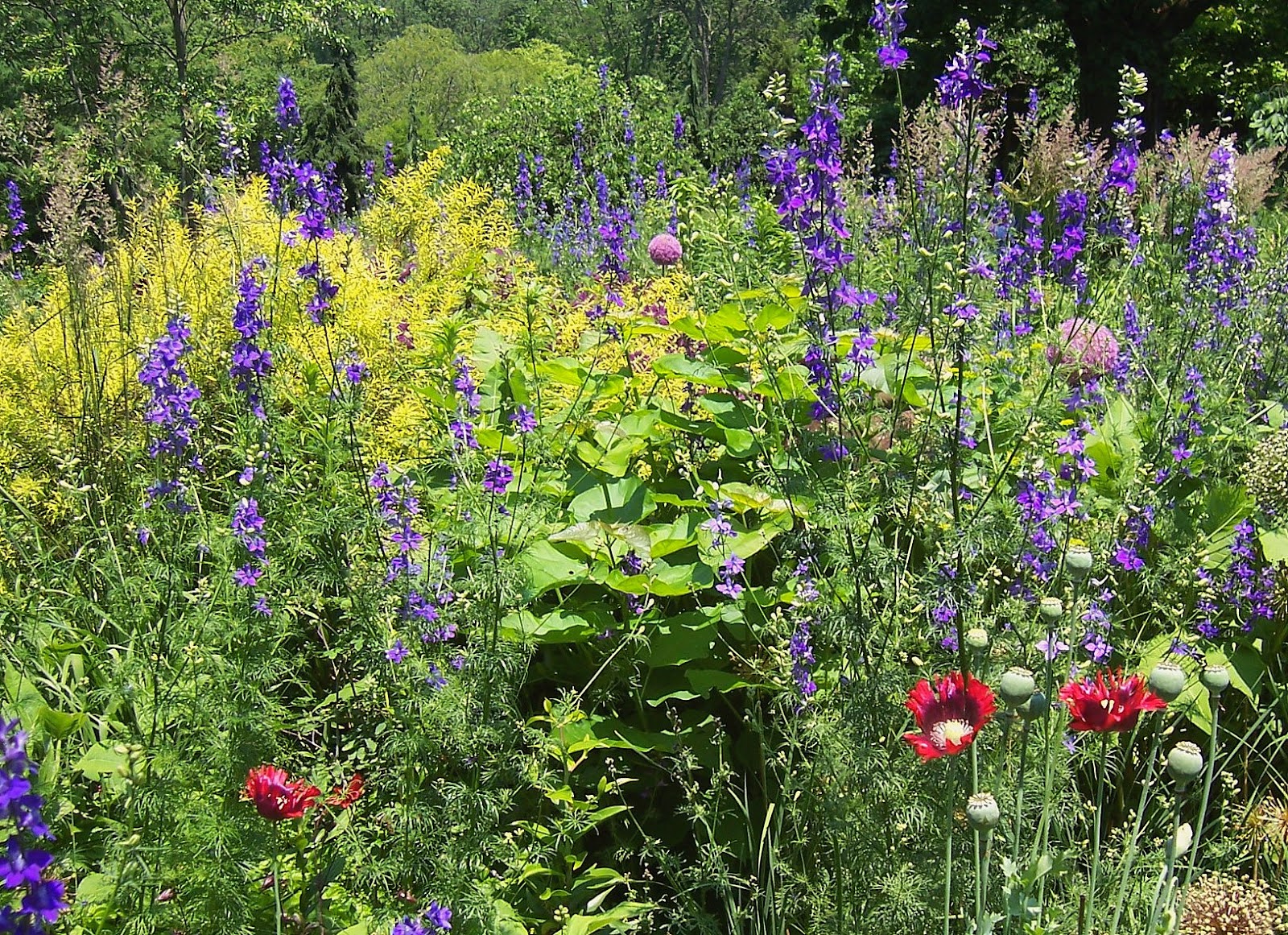
Every year in late winter I throw a lot of seed around. An illustration of the results is on the left. It shows three of my favorites,-- larkspur, poppy and pot marigold. Winter seeding brings lots and lots of  summer flowers.

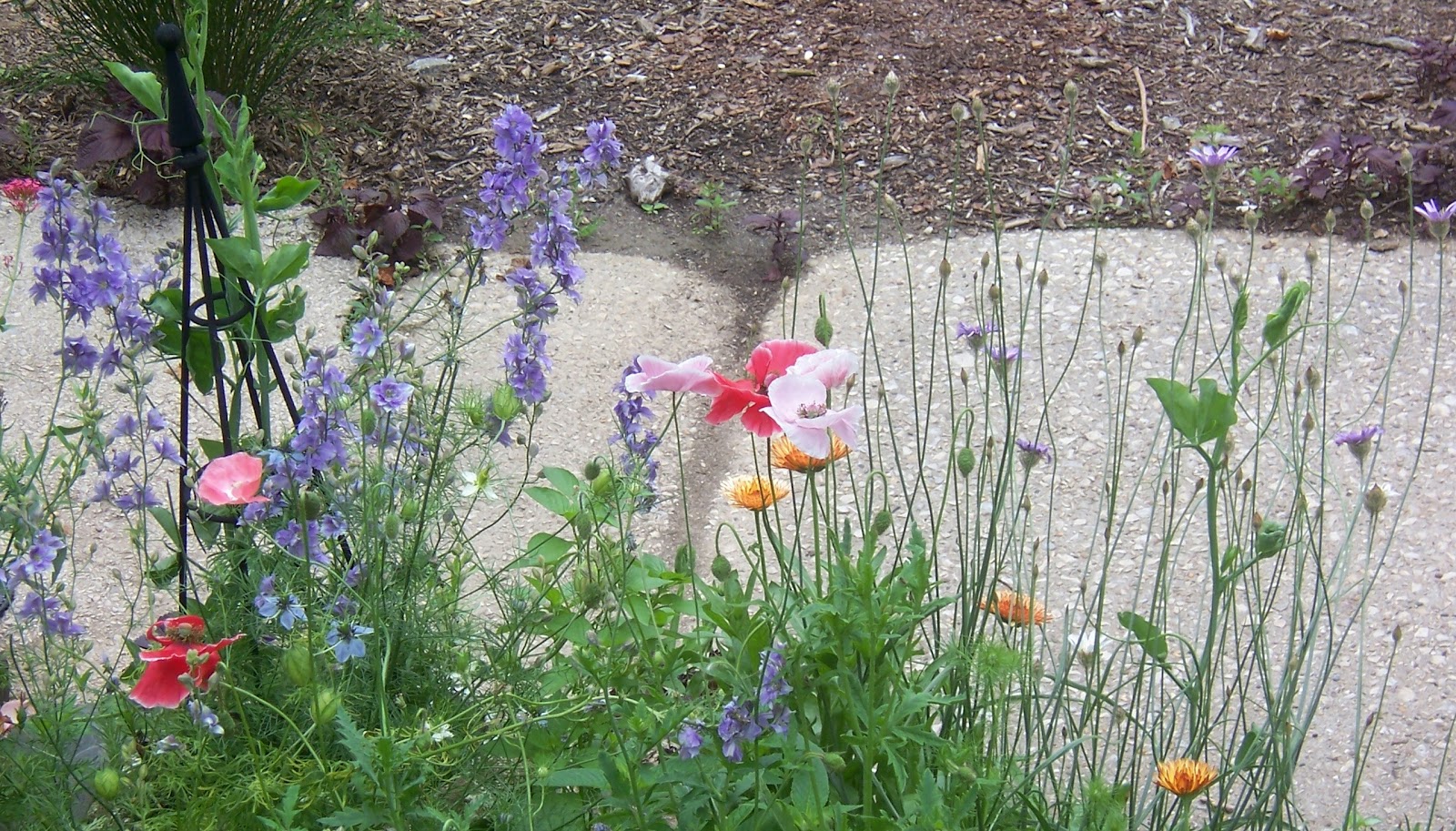
On the right you can see these three, with sweet pea thrown in, filling in between the perennial Cupid's Dart, Coneflower and Lavender.  One of the people whose questions helped inspire me to write this blog wanted to know how I managed to have such dense planting with so much in bloom. Annual seeds are part of the answer.

To look good, most perennial gardens need to meet three needs: 1) they need to have a succession of abundant flowering and/or interesting foliage that lasts from early spring to late fall, 2)  week to week, with whatever is in or out of flowering, the garden needs to look visually balanced as a whole and 3) colors should not clash, nor should there be too much of any one shape of flower or leaf texture together, nor should the rise and fall of the overall composition of the plants be too uniform and boring.


Can you imagine trying to figure this all out logically? What a boring nightmare! Luckily you do not have to. You do need patience, some intelligence and a decent eye though. And an ability to throw seed on the ground.

Every year, all through the year, I take time to look at my garden and mentally note what is not working. Then, in spring and fall I transplant or plant as needed and every late winter I throw seed at bare patches. It makes for a dense, vibrant look that pleases me and many others. Plus, it does not take much time or money. Seeds are cheap.

How did I fall on this solution? Not by looking for a solution but by following desire.

16th century Belgium tapestry in the V & A, Creative Commons
Since I was young I have felt something strange, wonderful and good in the atmosphere I picked up from the style of some late Medieval, Northern European things. It's a style that shows in the interlacing narratives of the Arthurian romances and the flowery meads (see above) depicted in the backgrounds of miniatures and tapestries. It's a style with a delicate, graceful strength that to seems to quiet and transmute the arrogant and aggressive tendencies of its day.


As a decorative style it is called Mille Fleurs, a thousand flowers. I have no meadow clearing to dedicate to it. But I do have bits and drabs of a garden. And so it was by searching for an ideal that I discovered a highly practical reality. By using seed for old fashion annuals, and by allowing as much self-seeding as possible, I had figured out how to balance the garden thru the whole growing season, while filling it up to its brink.

But then I usually throw out the seeds while it still feels like winter. Is it too late, this spring in winter that feels out of time? I hope not. I need the frail, brilliant beauty of  poppies. I need their delicate, graceful strength.


----------------------------------------------------------------------------

How to Seed:  O.K., so I extravagated a bit about being able to throw -all- the seeds. Poppy seeds you can throw and maybe larkspeare. Sweet pea you really plant in. Most of the others you just barely cover. Take your finger, indent a trench about 1/8 of an inch deep, dribble in the seeds, dribble over some earth, done. Its that easy if...the ground is damp. Do it right after, or right before, rain.

Tuesday, November 22, 2011

Thanksgiving

Post 16
Deerfield Village, MA


Now is the time for giving thanks. We are problem-solving, stimuli-hungry animals who lose track of the common and uncommon graces of our lives.


Somehow, for me, gardening slows down time. For after an hour or so of digging, smelling, placing, moving, something in me stills. Only then do I truly begin to feel, really feel, the sun massaging my shoulders or the fine texture of  grit on my fingers

It's easy to be so busy thinking/planning/solving that living, feeling unwanted, gets out of the way.

The word gratitude, comes from the Latin gratitudo and gratus. Which means thankful. It also means pleasing, as in pleasure...

Pleasure gets no respect. We suspect it because it can lead us astray. But it can also lead us right.

Part of adolescence is learning to extract pleasure from things we originally find repugnant. From booze to tobacco to movies without happy endings, we learn to overcome instinctive pleasure. How else can we be cool and grown-up? We learn to tolerate, even be proud of,  the deadening side effects of overiding our nature, and then wonder, years later, what's gone wrong.

Maturity, among so many other things, may be about shedding such roughshodding over pleasure.

Pleasure is easy.  It is everywhere. And much of it is innocent. It does not hurt you or anyone else. That is the pleasure to go for, to be grateful for.


According to the OED, the second meaning of gratitude is grace. Like the the grace of innocent pleasure, there for us when we want it.

So is the act of feeling pleasure, in an of itself, a type of gratitude? The answer seems both obvious and paradoxical.

The reason I've made a garden is because it gives me pleasure, a pleasure I learned about by experiencing other peoples' garden. I hope my garden passes on that pleasure. I hope this blog with its pictures does too. It is a way of saying thanks.