Showing posts with label Memory. Show all posts

Saturday, May 25, 2013

What Makes a Style?


Post 75

Why do we like what we like? This week I've realized how much exciting times from my childhood have shaped my sense of style.

My small garden does not follow the usual  good taste model, that of planting in large drifts, with many plants of the same variety planted together. Large drifts work well for larger gardens, but for me, it can get boring in a small one. My eye needs to roam. It needs to be drawn in and then drawn forward,  moving in expectation and delight till it takes its moment of rest at a particular cynosure, only to re-energize and take off again.


 Part of my inspiration has been country meadaows, part late Medieval millefleur tapestries, part has been Fleur Cowles illustrations, but I've just understood another big, and highly unexpected influence: Lower Manhatten.

Growing up one of the most exciting things I could do was visit my Dad at his office in Hanover Place near Wall St in Manhattan. Which was very different than the city where I lived and spent my usual days.

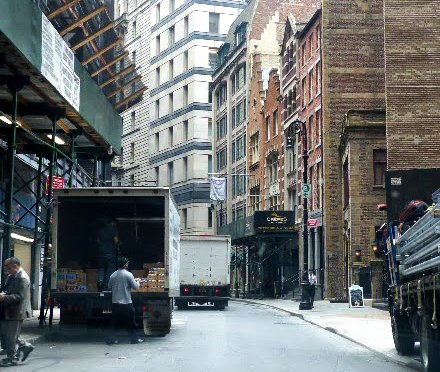
The city I knew was the spacious grid of the East Side where light shone thru wide canyons that opened up in logical right angles. It was a spacious, rational, prediciteble world where 65th Street followed 64th, where the blocks were all the same size and views were long and  unobstructed. But down around Wall Street was a different world.


 The streets were small, cantered and illogical. The buildings were all over the place and almost seemed to be falling over each other.


This new, hodge-podge city was wonderful to me because I was with my Daddy and it was his world.


Everybody knew him, many called him affectionate nicknames I'd never heard of. Through good and ill it was his kingdom. He loved it and came fully alive there.


Above, you can see him as he is today, or rather as he was a few days ago, on his 100th birthdy, when he rang the closing bell at the New York Stock Exchange. He, I and the NYSE are much different from what we were when I first saw Wall Street in the late 50s, early 60s -- but the geography of the place remains the same. And now I am old enough to be conscience of its past and present effect on me, and how it has perhaps inspired and strengthening my delight in fetching disorder.


So perhaps this is why, whatever I'm creating, it will usually have a combination, a balance, of order and disorder. My garden has its quinquinix structure, over, around, thru and about which, runs perennial plants acting like random meadow annuals.


And here I am below as a teenager with my dad in his salad days. He and my mother (as I mentioned in my post about Fleur Cowles) have influenced my style in more ways than I can say, for childhood loves make for much in adult life. Our styles, if authentic, often come from what we have loved, and how strongly we have loved.


Tuesday, September 6, 2011

Cleome, History's Muse

White Cleome
Post 6
Clio is the muse of history, but what does that mean? What inspires history, moving us to remember and commemorate the past, especially the good of the past?


Every gardener was once a child and as a child wondered through a garden or gardens, leaving vivid snapshot memories. Old fashioned flowers may call up scenes of a patio bordered by swaying lilies, or a porch swing near an unknown flower.


Cleo and Nicotiana alata

One difference between many present plants and ones we think of as old-fashioned is that the old fashioned plants reproduce.  Because modern taste has gravitated towards more and larger blooms that last longer, this has led to hybridization that keeps plants from setting seed, or setting seeds that reproduce unpredictibly.
 Select Seeds, one of the companies that specialize in old-fashioned seeds and plants,(Perennial Pleasures is another, Seed Savers' Exchange another,) gives these older plants this definition:
"Antique, or heirloom flowers are open-pollinated varieties that originated fifty or more years ago. Open-pollinated flowers are fertilized by insects, hummingbirds or wind, and the resulting seeds will produce plants that are identical or very similar to the parent plant." 
Cleome,  which makes me think of a voluptuous sylph in a silk dressing gown, manages to look blowsy and delicate at the same time. Originally from the West Indies, it is a repeating annual in our area -- by repeating, I mean that it reproduces every year from seeds it sheds the year before. Because it so easily reproduces from seed, once you have some you will soon have more. If it spreads too much, it is easy to pull out and transplant. Or give to a friend, which is how I acquired my first stand.

It starts blooming in July and often keeps up till frost.  This is because its flower turns into seed pods as the plant rises, making a sort of spiraling ladder.  The seed pods, which are like steps,  are easy to gather and spread where you would like. It is as if Cleome were writing its history in unwinding seed posd.

“All things are engaged in writing their history.” Ralph Waldo Emerson


So, my tentative answer to the opening question -- what is history's muse?-- is this. Though history, anyone's history, includes repungnant, not to mention sad and difficult incidents as well as happy ones, all  these incidents have been experienced by the self. And what has formed this self? On the most mundane level, it is love. For a child who is given no love or care at all dies. The baby's earliest sense of self comes from interaction with love.

" One does not love a place the less for having suffered in it, unless it has been all suffering."  Jane Austen


Clio, from www.oberlin.edu/history/Brown.
 
Perhaps, because love sets the structure of self, that structure brings a kind of love to what the self experiences. And so the past, and its path, acquires worth.

Cleome, tall, fertile and full-blown, self-seeds itself around the garden like memory, framing new vistas amidst old-fashioned plumes. It is a good flower to plant in a place that you love, there to perhaps bring history's best gifts,  good report and peace.

----------------------------------------------------

How-to: Cleome hasslerana is an easy self-seeder. In fall throw seed pods or seeds where you want it, then thin in late spring. I've seen it colored white, pink and white, bubblegum pink, lavender, lavender and white and purple. If it starts to fall over or gets too gangly, lop it off and two flowers will grow back lower. It like sun and lots of water or semi-shade and less water -- it looks piqued if allowed to dry out.