Showing posts with label Self-seeder. Show all posts

Tuesday, September 11, 2012

Two Kindly Weeds: Morning Glory Grandpa Otts and Gloaming Mistflower

 Post 51

Early Fall is when the air freshens up and it is pleasure to go back into the garden, a pleasure, that is, until you notice the weeds.

As you start to clear stuff out: weeds and dead or rotting matter, mildewed stems and spotted leaves, you realize that there is less blooming than earlier in the season. Annuals, the ones that did not burn out in the heat, are still strong but most perennials are done.


If you are lucky some perennials will look good as they age , such as the cones of the Pee-Gee hydrangea, above right. Still, if it were not for two late-flowering, beautiful, rampant things,  much of the garden would loose luster well before its end.


Here is my hell strip with some pink asters and the two kindly weeds: Granpa Otts Morning Glory and Wild Ageratum, or Mist Flower.

Though they spread like green rampage, they can work well in a wild garden


And why would I call a Morning Glory a weed? Well, because this one acts like one; it's hard to kill, overpasses its boundaries and, if allowed, can strangle other plants. Nevertheless, it is a kindly weed because it does not get its full growth till late in the season when you have the space and need the color. Best of all, it is easy to yank or hoe out, you do not even have to dig.

Here is what the Seed Savers Exchange says about it--

"(Ipomoea purpurea) One of the original Bavarian varieties that started SSE. Given to Kent and Diane (Ott) Whealy in 1972 by her grandfather, Baptist John Ott, who lived on a 40-acre farm near St. Lucas, Iowa. Beautiful deep purple flower with a red star in its throat. Reliably self-seeds each year. Plants will climb 15' or more, if given support. Self-seeding hardy annual at Heritage Farm (zone 4)."

 So, buy one seed packet once, and you will have this forever. Because it is dark, and has a cool navy purple with streaks of hot violet, its flower, though small, looks  dramatic and dynamic.


 Mistflower, on the other hand, is a receding blue grey that looks best at twilight, when the blue takes on a weird, delightful glow. It is a bit of a filler since it looks best highlighted by bolder plants.

The way I handle its invasiveness is that every year, once bloom is done, I pull it out by its shallow roots. Yet, by June of the next year, it starts to pop up again. This is good, cause this is an area where I have had a lot of bulbs and spring ephemerals.  With this late riser, I get two seasons out of one patch of soil. 

For me, it's less effort to restrain vigorous plants than to cajole fussy ones. And I like the balance of wildness to tame that they engender. This is probably more of a reflection of my particular inner balance than of any practical gardening wisdom. 


Whatever it is that gives personal style to the garden, or any other aspect of your life, it comes from inside you.

 
All the tips in the world, books, quotes, guides, are just fodder for the deep part of yourself that creates.


That creates out of love. 

Thursday, August 30, 2012

A Jubilee Parade for Labor Day: Zinnias

Post 50


I love zinnias. They are tough yet easy-going; sweet and exuberant; individualist yet cooperative  determined and brilliant.  And they get the job done.


Even though I have time, money and land, I can only create a garden because Nature (or Nature's God) has created life-- my own and that of plants.


My job is choosing the plants that will thrive and create beauty. But it's the plants that make it happen. You could say they are dependent on me,-- but only if you add that I am dependent on them.


So Happy Labor Day to all the zinnias of this world. May they (we) be properly paid for our honest labor that keeps this world functioning.


It is our productivity that produces value,


A fair portion of which value we have a right to,


And a duty to use that value,


So that we ourselves help create a better, more functional, more sustainable, more beautiful world.


We are all sub-creators, whatever our position in life.


Even when we think we do not have the power,


Even when we seem done,


 Until we return from where we came, and truly learn what our imperfect efforts,

 What our imperfect love,

Has created.

Happy Labor Day

Friday, June 1, 2012

Valerian or All-Heal, A Calming Pause


Post 40


Roses and rhodos crown spring.  But after roses, what can  follow? Usually there is a pause.  In a normal year, which is not this year, most perennial gardens are a bit bare before the midsummer eyeopener of daylily, daisie, coneflower and monarda .


Which is why valerian, a perennial herb that looks like a giant Queen Anne's Lace, is such a useful plant. It steps forward as the roses end and then recedes as midsummer color takes over.

It is a tall, leggy herb with uplifted hands and head. Emerging out of a rosette of leaves the stems can grow up to 4 feet high. On its own the flower is pretty but lacks pizzazz. However, team it with some non-green ground covers and interesting flowers as they come and go, and it carries the garden through. Also, because it is tall, it is great behind smaller, denser plants. After bloom it can be cut back down to its nondescript green rosette. If you leave it standing after the peak of bloom seeds will set and you should get baby valerians, perhaps all over your yard. The seeds are light and travel in the wind. It is an easy plant to dig up and put elsewhere or give away.


It is not always an easy plant to buy. For like Corydalis lutea (Post 15,)  it has not been modified it into a patented commodity that warrants a marketing campaign. If a nursery carries Valerian, it is usually in the herb section, but since it is not a cooking herb you may need to ask for it. Or buy some seeds. Then, in two years you will have tall, lovely plants.


It's full name is Valeriana officinalis.  It can be called garden heliotrope, which is really another plant (cherry pie,) and red valerian, which is also really another plant (Jupiter's Beard.) Valerian has been called all-heal since medieval times because there is a medicine made from its roots, which, when properly prepared and administered, has a gentle calming effect.


So, if you have a space in sun or semi-shade that gets adequate water and needs some sprucing up this time of year, -- consider adding the sweet-smelling presence of this plant.

Thursday, March 15, 2012

Lead with seed to a flowery mead

Post 29

Is it too late?

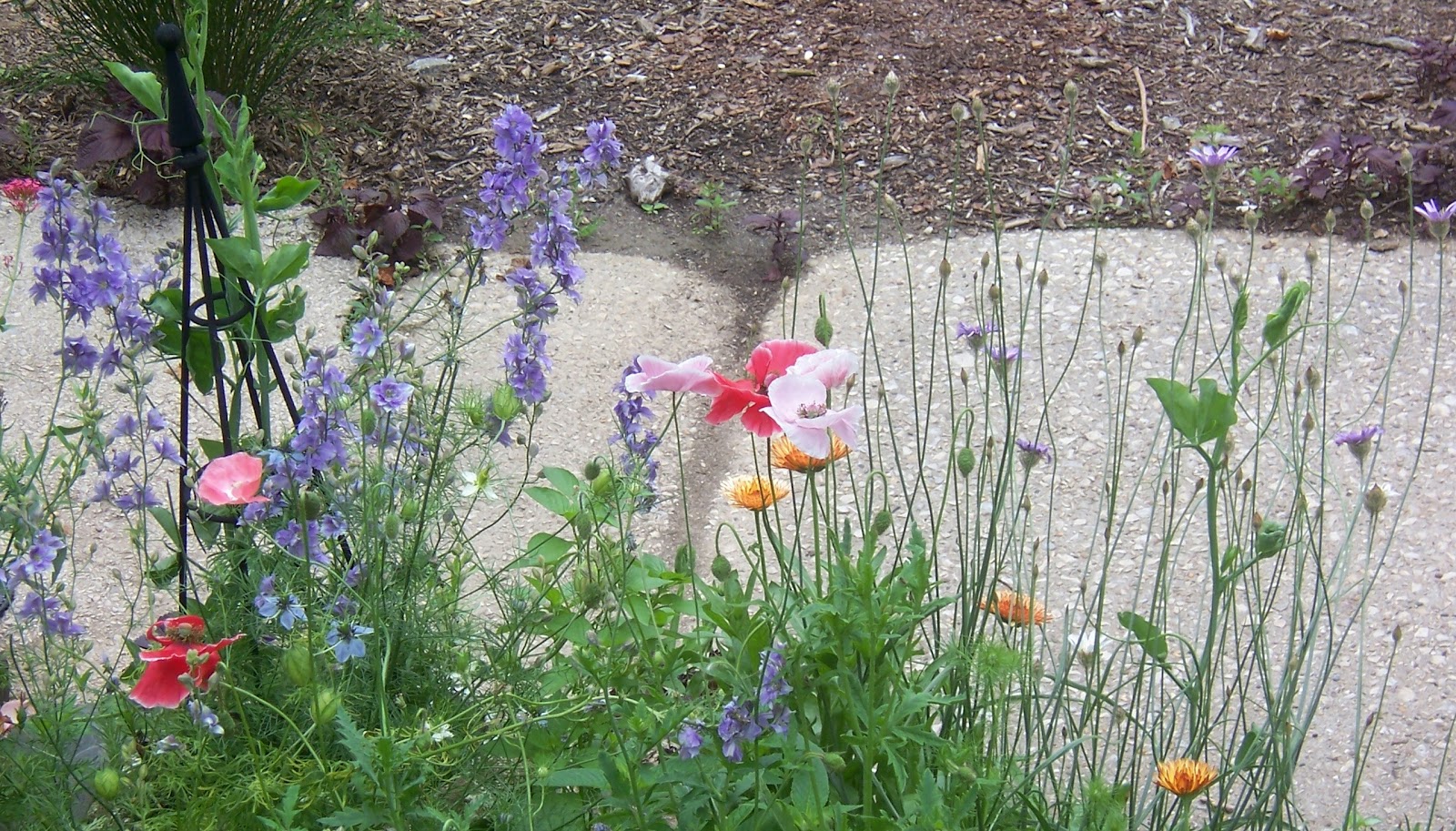
Every year in late winter I throw a lot of seed around. An illustration of the results is on the left. It shows three of my favorites,-- larkspur, poppy and pot marigold. Winter seeding brings lots and lots of  summer flowers.

On the right you can see these three, with sweet pea thrown in, filling in between the perennial Cupid's Dart, Coneflower and Lavender.  One of the people whose questions helped inspire me to write this blog wanted to know how I managed to have such dense planting with so much in bloom. Annual seeds are part of the answer.

To look good, most perennial gardens need to meet three needs: 1) they need to have a succession of abundant flowering and/or interesting foliage that lasts from early spring to late fall, 2)  week to week, with whatever is in or out of flowering, the garden needs to look visually balanced as a whole and 3) colors should not clash, nor should there be too much of any one shape of flower or leaf texture together, nor should the rise and fall of the overall composition of the plants be too uniform and boring.


Can you imagine trying to figure this all out logically? What a boring nightmare! Luckily you do not have to. You do need patience, some intelligence and a decent eye though. And an ability to throw seed on the ground.

Every year, all through the year, I take time to look at my garden and mentally note what is not working. Then, in spring and fall I transplant or plant as needed and every late winter I throw seed at bare patches. It makes for a dense, vibrant look that pleases me and many others. Plus, it does not take much time or money. Seeds are cheap.

How did I fall on this solution? Not by looking for a solution but by following desire.

16th century Belgium tapestry in the V & A, Creative Commons
Since I was young I have felt something strange, wonderful and good in the atmosphere I picked up from the style of some late Medieval, Northern European things. It's a style that shows in the interlacing narratives of the Arthurian romances and the flowery meads (see above) depicted in the backgrounds of miniatures and tapestries. It's a style with a delicate, graceful strength that to seems to quiet and transmute the arrogant and aggressive tendencies of its day.


As a decorative style it is called Mille Fleurs, a thousand flowers. I have no meadow clearing to dedicate to it. But I do have bits and drabs of a garden. And so it was by searching for an ideal that I discovered a highly practical reality. By using seed for old fashion annuals, and by allowing as much self-seeding as possible, I had figured out how to balance the garden thru the whole growing season, while filling it up to its brink.

But then I usually throw out the seeds while it still feels like winter. Is it too late, this spring in winter that feels out of time? I hope not. I need the frail, brilliant beauty of  poppies. I need their delicate, graceful strength.


----------------------------------------------------------------------------

How to Seed:  O.K., so I extravagated a bit about being able to throw -all- the seeds. Poppy seeds you can throw and maybe larkspeare. Sweet pea you really plant in. Most of the others you just barely cover. Take your finger, indent a trench about 1/8 of an inch deep, dribble in the seeds, dribble over some earth, done. Its that easy if...the ground is damp. Do it right after, or right before, rain.

Wednesday, December 7, 2011

Light in the Winter Garden

Post 19
                                                          
No, the garden is not over.


Nandina berries hang above angel by the door, the Heavenly Bamboo's lush foliage uplit by the variegated euonymus underneath


On the other side of the door, the Camellia, which last year did not bloom till February, now looks like it will soon mean business.


And this morning it did.


And another surprise, this one so unlikely as to bring a rush of wonder.


A violet. In spring violets cram the hellstrip, and in midfall there may be some rebloom...but in December? A December violet?


"A violet by a mossy stone,
Half hidden from the eye!
Fair as a star, when only one 
Is shining in the sky."


An image I have loved since High School, now, for a moment, seen.


The image comes from a group of poems by Wordsworth called "The Lucy Poems." His flower is of spring and isolation, growing along untrodden ways. But here is a very different violet indeed, one between well trodden sidewalk, stone and city street, blooming close to St Lucy's day.
--(If you live around Philadelphia and are open to Christian folk festivals (with strong pagan influence), get thee to Gloria Dei, Old Swedes Church to see a lovely antithesis to commercial pre-Christmas festivity.
Lucia Fest & St. Eric’s Fair at Old Swedes’ ChurchDecember 9-11, 2011Fri Dec. 9 - 6pm and 8pmSat and Sun Dec 10-11  2pm, 3:30pm and 5pm)--
Back to the garden... the hydrangeas still please


The grasses bend...
An azalea opens...
The roses bloom.


Early winter/late fall is not all brown after all, but can be full of good surprises. Less pie in your eye than midsummer, the light, nevertheless, remains sufficient to the day. Not a bad lesson to learn.


How to violet: Common Blue Violet or Viola papilionacea is another one of those plants that is hard to buy, but easy to find around. Yes, in proper conditions it will rapaciously self-seed, so keep it out of any place where you do not want it to spread. It flowers in spring in waste places that are moist and have dappled shade. Given enough moisture and shade the plants will continue till frost. In dry years or places, the plant will disappear, only to return the following spring.  And it is not just their shy beauty that is fetching, it is their odor as well. It is also an edible flower and looks lovely in salads, ice cream and on cupcakes.

Wednesday, November 16, 2011

Wissahickon Style I, or the Humility of Corydalis lutea, the plant money can't buy


Every place has its own feel. And the factors that go into this feel are too complex for rational analysis. No instrument can measure it; only human intuition is complex enough to process it


It's what the ancients called the Genius Loci, the intelligence of the place. If you garden in harmony with it, it will do the really hard work for you.

In Chestnut Hill/Mt. Airy/Germantown, with our Arts & Crafts Wissahickon Schist houses; acid, clayey soil; tall trees and the remnants of slate roofs and sidewalk, a distinctive style has spread without any trendy style guru laying down dictates, although a generous founding family has and does exert a benign influence.

Overall  it is a style that has evolved with the community through time. I love that, I love it and I love that folk-styles, of all sorts, can still exist in this product-driven ( fallen?) world.


Once this area was grand, where Philly's richest, (and those who strove to be its richest,) built. It was a shiny modern thing--a railroad suburb. Time has worn down the shine. Now it is home base for a combo of comfortable professionals, bohos, civil servants, middle and working class and the remains of a true American gentry, whose trust funds may not be what they once were,-- but whose taste is.

So often things are just a tad shabby. Items in the garden may look inherited, whether or not they are.You can always refer to wear as patina.


The Arts &  Crafts  influence (many of the houses were built 1880-1930,) comes in various substyles: Norman, Cotswold, Colonial, Queen Anne, William and Mary, Dutch, Carpenter Gothic and Italianate. Add to this some earlier houses, some Frank Loyd Wright-like numbers nestled into hillocks and brick rowhouse construction from Victorian times till post-WWII. None of these styles are pretentious. Some, if kept up gleamingly, may whisper wealth; none shout. One of the common factors to Wissahickon style is its mix of beauty with a comfortable lack of pretension.


"Homes built in the Wissahickon style of architecture are inspired by the vernacular architecture of France, England, and Colonial America ... They use native materials, such as Wissahickon schist, in their construction and native plants in their gardens...It’s very attractive, but it also makes sense ecologically,”  

Remark by historian David Contosta, from story in the Springfield Sun, Mar 24, 2011


When the houses have grown into the land, or the land has grown up around them,--and especially when its hard to tell which -- you've hit Wissahickon style paydirt. And in some corner or niche, you are likely to see a  humble, local weed/ flower. People who evaluate things by cost call it a weed, I call it an overlooked, undervalued treasure. Since it dislikes being potted up it usually spreads by seed, not sale. If you do not have any of this gem, yellow corydalis, just ask around. Chances are it modestly grows somewhere near you, peeking out of a crevice in a wall or from the underside of a step.

Its bluish, ferny, feathery foliage comes up early and leaves late. It blooms for months  in the spring and months in the fall; mid-summer it sulks and wishes it were north in a mountain glade. Each plant is short lived, but since it replaces itself so readily you are unlikely to notice this.  It is as good as a catmint or hardy geranium for underplanting larger, showier plants.

The nursery business has developed a slew of blue- and purple-flowered versions that are almost too lovely for words.  The bad news is that they are pretty finicky in our clay soil and high summer humidity. They are also expensive. I got a purple one, Blackberry Wine, to last for 3 years, but it never reseeded, which just did not seem right for a corydalis. There is a lovely, wispy biennial native form, Corydalis sempervirens, which has a pink and yellow flower and pines for mountain glades. There are also a host of yellow or white corydalis that the Brits grow as garden plants and which show up on sale from time to time. They are usually worth buying.
--------------------------------------


How to Corydalis.  Yellow corydalis or Corydalis lutea, likes semi-shade best. It will take full sun in spring as long as some foliage emerges above to provide relief during the hottest months. It can take full shade but does not like being directly under a tree or within the dripline of a house since it needs some moisture. It has an affinity for stone, liking soil a bit more alkaline than ours usually is. So if you have a wall, path, stairway, court, alley, well or edging in schist or slate, that is a great spot for it. The roots or corms (its rootstock looks like geraniums',) often break off, so transplanting is best done with tiny seedlings, not mature plants. And those tiny seedlings, once they come up in spring, will be large and billowing by fall. In fact, one is still blooming in a wind sheltered part of my garden.