Showing posts with label inspiration. Show all posts

Tuesday, June 12, 2012

Chanticleer, or Wonder at the Call of the Dawn


 Post 42

Is the wish to share wonder the first stirring of art?


To combine wildness and order, light and shade through love so that you can share the inklings and glimmers of infinity that fill you, and seem to overflow from you?

Welcome to Chanticleer.


Chanticleer  is an extraordinary pleasure garden on the Main Line.  Chanticleer is named after a rooster who shows up in Northern European folklore. a rooster like the one emblemed on top of this pool houses.


How do you communicate moments of wonder, when your senses seem to be taking in more than they can hold? Like at first light, when out of nowhere, emerges the rich complexity of reality.


Go to Chanticleer, walk around, maybe sit for a bit.


Such beautiful, expansive and witty public gardens, 'built solely for pleasure', are a blessing of this area. Within a few hours or less you can reach Chanticleer, Longwood Garden, Winterthur, Scott Arboretum , Morris Arboretum, Mt. Cuba , Wavehill, Brooklyn Botanical Gardens New York Botanical Garden and others. All of these are inspiration on many levels,


So, if you are lucky and willing, here are dawns, foretastes, or deep tastes, of what reality might be, or could be, or is, at sublime moments of joy and awe.


When everything mixes up at levels of complexity beyond human reason, but not beyond human experience, imagination and art.


Perhaps it is what Coleridge called Reason. Or not. Perhaps something else. But whatever it is, it includes the wonder that overflows and makes people make things.

... gardens, emblems of possibility, if you can just let its pleasures reach you. 


P.S. --Apologies for the pics, which do not do justice to this great garden. It was mid-day on a sunny day when I was there, and that is a hard time to get decent shots.

Thursday, March 15, 2012

Lead with seed to a flowery mead

Post 29

Is it too late?

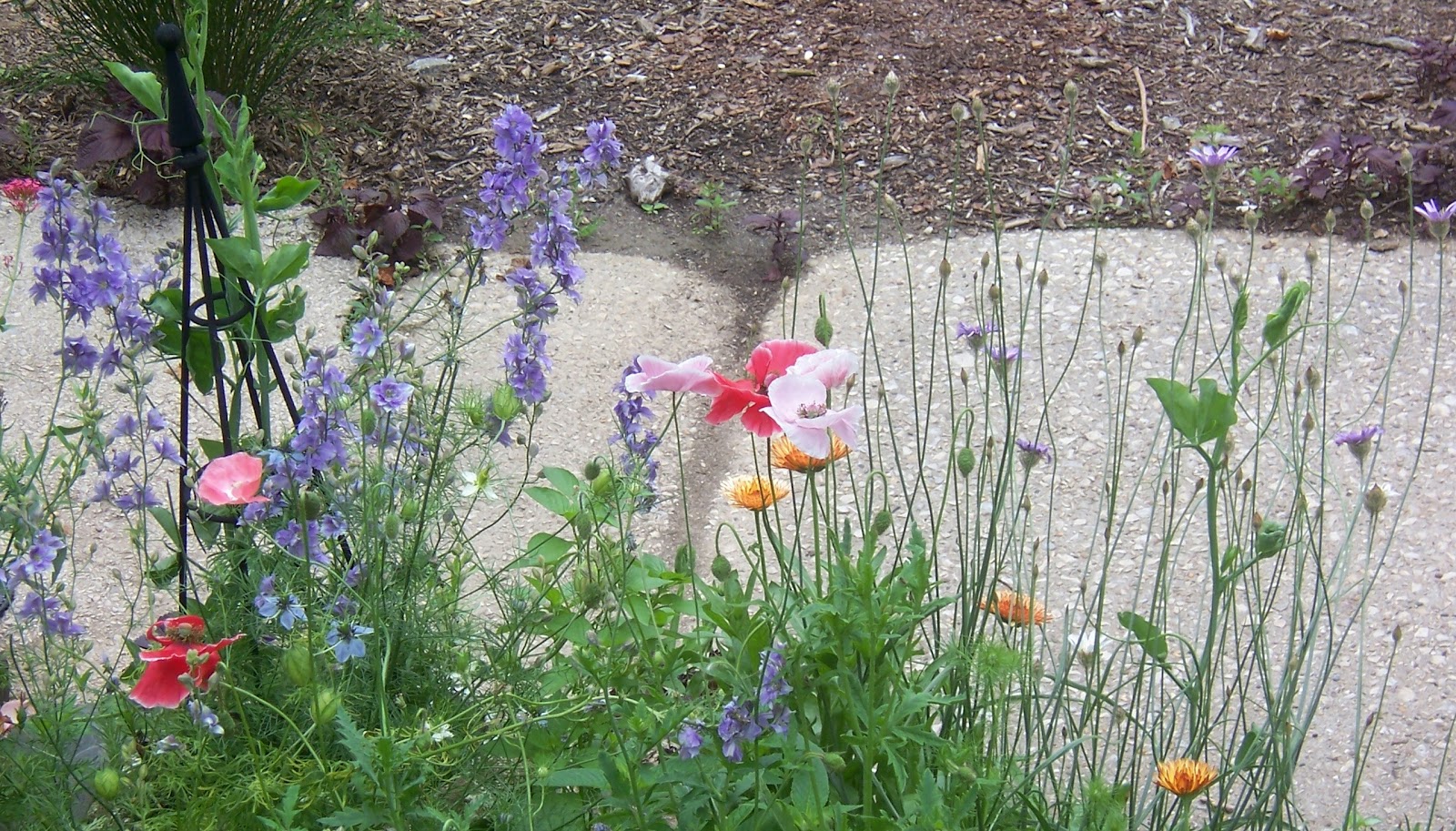
Every year in late winter I throw a lot of seed around. An illustration of the results is on the left. It shows three of my favorites,-- larkspur, poppy and pot marigold. Winter seeding brings lots and lots of  summer flowers.

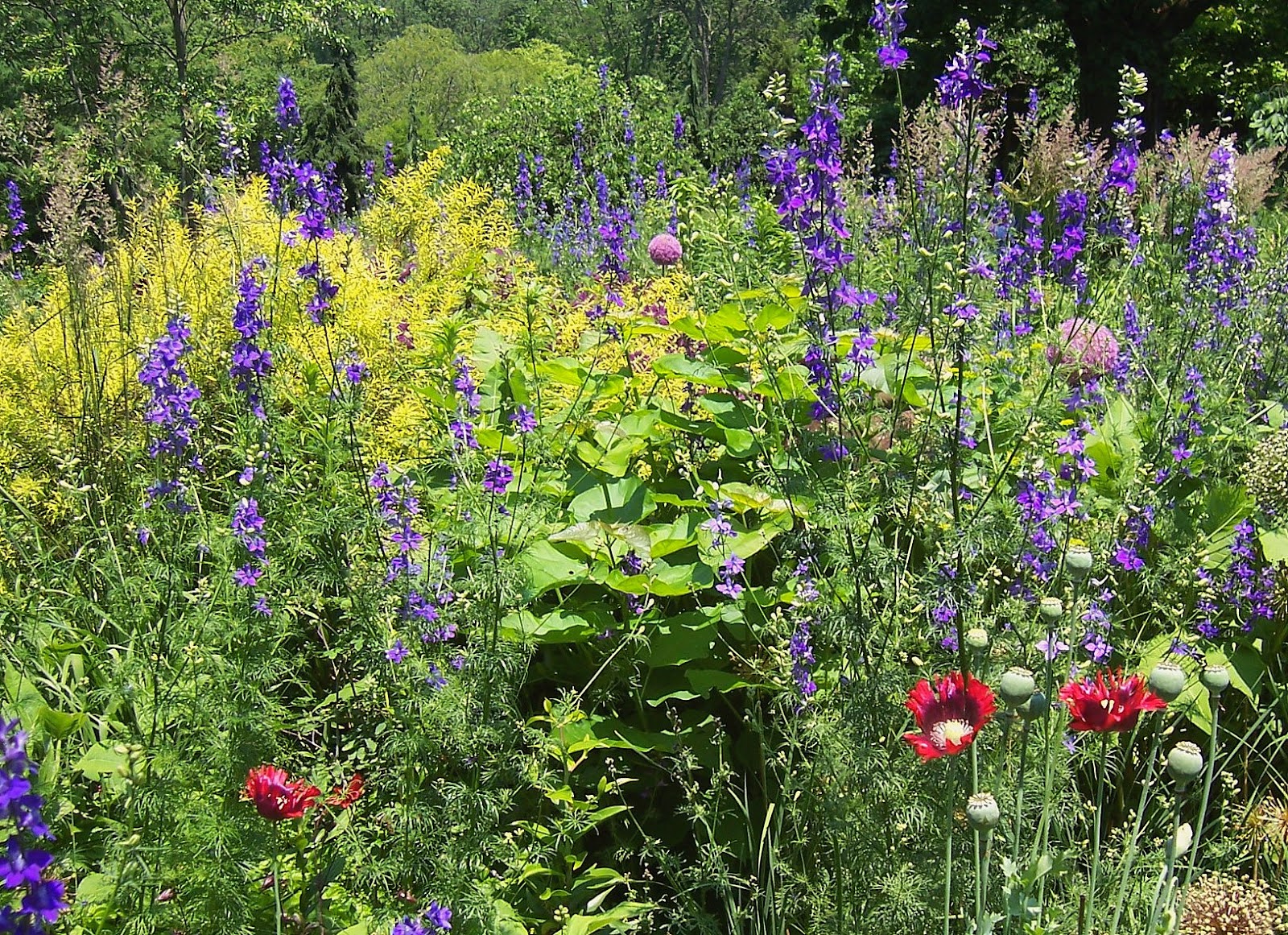
On the right you can see these three, with sweet pea thrown in, filling in between the perennial Cupid's Dart, Coneflower and Lavender.  One of the people whose questions helped inspire me to write this blog wanted to know how I managed to have such dense planting with so much in bloom. Annual seeds are part of the answer.

To look good, most perennial gardens need to meet three needs: 1) they need to have a succession of abundant flowering and/or interesting foliage that lasts from early spring to late fall, 2)  week to week, with whatever is in or out of flowering, the garden needs to look visually balanced as a whole and 3) colors should not clash, nor should there be too much of any one shape of flower or leaf texture together, nor should the rise and fall of the overall composition of the plants be too uniform and boring.


Can you imagine trying to figure this all out logically? What a boring nightmare! Luckily you do not have to. You do need patience, some intelligence and a decent eye though. And an ability to throw seed on the ground.

Every year, all through the year, I take time to look at my garden and mentally note what is not working. Then, in spring and fall I transplant or plant as needed and every late winter I throw seed at bare patches. It makes for a dense, vibrant look that pleases me and many others. Plus, it does not take much time or money. Seeds are cheap.

How did I fall on this solution? Not by looking for a solution but by following desire.

16th century Belgium tapestry in the V & A, Creative Commons
Since I was young I have felt something strange, wonderful and good in the atmosphere I picked up from the style of some late Medieval, Northern European things. It's a style that shows in the interlacing narratives of the Arthurian romances and the flowery meads (see above) depicted in the backgrounds of miniatures and tapestries. It's a style with a delicate, graceful strength that to seems to quiet and transmute the arrogant and aggressive tendencies of its day.


As a decorative style it is called Mille Fleurs, a thousand flowers. I have no meadow clearing to dedicate to it. But I do have bits and drabs of a garden. And so it was by searching for an ideal that I discovered a highly practical reality. By using seed for old fashion annuals, and by allowing as much self-seeding as possible, I had figured out how to balance the garden thru the whole growing season, while filling it up to its brink.

But then I usually throw out the seeds while it still feels like winter. Is it too late, this spring in winter that feels out of time? I hope not. I need the frail, brilliant beauty of  poppies. I need their delicate, graceful strength.


----------------------------------------------------------------------------

How to Seed:  O.K., so I extravagated a bit about being able to throw -all- the seeds. Poppy seeds you can throw and maybe larkspeare. Sweet pea you really plant in. Most of the others you just barely cover. Take your finger, indent a trench about 1/8 of an inch deep, dribble in the seeds, dribble over some earth, done. Its that easy if...the ground is damp. Do it right after, or right before, rain.

Wednesday, February 1, 2012

Roses in February

Post 25


It may be warm,  but it is bleak and the garden, well... see what I mean.

I need a rose.

Yes, that helps. It is not easy to write a gardening blog in these months, especially if you want to avoid the usual winter cliches. Looking at the local architecture that holds up our gardens, cradles and rocks them, is a partial solution, but not an entirely gratifying one. The light is hard, the buildings unsoftened. I need more roses.

Yes, better.  One of the drawbacks of bleakness, which feels like nature's boredom, can be a lack of solid inspiration. And without real inspiration I may start to extravagate (no, not a word but should be (OED--pay attention! (Like Auden, one of my dream aspirations is to coin a new word and get it credited there; unlike Auden, it's a dream aspiration.))) To clarify, to extravagate means to unthinkingly exaggerate to a point almost past truth (though a kernel remains.) It lacks malice but remains an easy temptation for those of us who are of imagination a bit too compact. Itself an example of extravagation, it is a word that I made up in High School without realizing I'd made it up. I extravagantly extravagated exaggeration into extravagate. 

In short, in my last post I extravagated. I dissed mansions and castles. I do not really dislike them, just the more money than taste ones. 

And now, keeping on theme,(yes, there is a theme,) I am going to slip back towards an earlier post, "Roses in January," and fill in some information I did not include in the earlier post on The Red Rose Girls.

Below is a picture of Cogslea that shows more of the house and less of the caryatids.


And here's one of Cogshill from the back


The pergola at Cogshill.


And here is a relevant illustration from Elizabeth Shippen Green's scrapbooks at the Free Library of Philadelphia.


Last of all. I want to credit the source of most of my information on The Red Rose girls. It is the book,  The Red Rose Girls: An Uncommon Story of Art and Love by Alice A. Carter, ISBN 978-0810944374.

And I also want to add a caveat, that this is an informal blog. Like informal correspondence and other forms of informal writing, such a blog is not meant to be read as a solid reference source. I try to be accurate but I do not fact check everything. For instance, I made a mistake about Edith Emerson in my earlier RRG post. I have gone back and corrected it as I value accuracy.  At times however, I can find even myself a bit too transported by the act of writing, and end up extravagating reality's rose into a slightly stranger flower. So please, take this with a grain, though not a bucket, of salt. I know I do.

Wednesday, December 14, 2011

Wissahickon Style II

Post 20

Looking for a good Christmas gift book? Consider "Metropolitan Paradise' by Carol Franklin and David Contosta. This work uses a series of snappy, well-illustrated vignettes that delight and instruct as they take you through the history of the Wissahickon watershed.

Carol Franklin, a landscape architect who grew up in Northwest Philly, first used the term 'Wissahickon Style' in a 1989 seminar. David Contosta has written so many books on this area that he probably dreams in schist. Together, they have created a work that feeds the senses, the intellect and the soul.


For Wissahickon Style posts, I include photos of other peoples' and public properties. Unless otherwise noted, these are photos taken by me from right of ways somewhere within the Wissahickon watershed. Except for already well-known places, I prefer not to identify locations for privacy reasons.

Thursday, September 15, 2011

Garden Story with Hydrangeas

 Post 7 

If Cleome is for history, what is for story? And, how are garden and story alike?


In literary works, it's often the atmosphere, the mood of a piece that is remembered. An atmosphere, created as much by the author's prose style and choice of metaphors as by plot, theme or character, is like a visit into an exteriorized consciousness. It can be what can makes us love an author's work even if it isn't always successful.  How stories are told is what matters.  Gardens are like that too. They have moods, modes, spirits, that self-reveal within their larger context, so that gardens experienced become like stories told, poems recited, songs sung.

Below is my garden's story. Garden design-wise, what my garden lacks in planning, lists and drawn-up diagrams is make-up for by a fable.  Changes made in the garden work if they are congruous with the story's vision. It gives me, and the garden, a flexible, open structure, around which to grow

  "Once upon a time there lived an old woman in an old, stone house in Northwest Philadelphia.  On weekdays she would take the train to East Falls, where she taught Baroque Literature at Wissahickon College. But on weekends, vacations and those long summer evenings when the light wouldn’t go away, she made a garden.    
Mophead Hydrangea new, with Cranesbills and Ladies Mantle 
And what a garden it was. She packed it with every possible flower. She induced the plants to flourish so that they grew, climbed and tumbled into intersecting layers, too complex for the eye to take in all at once,  so that, by overfeeding the senses, it simultaneously quickened consciousness. It was so beautiful in growth or decay that it made you feel that somehow our world was more wonderful than you had previously imagined it, all meadowbright with possibility and discovery.  It was a magnificent garden, and as you may have guessed, it is not the garden that you now see.


Mophead Hydrangea old
For one day the lady, after decades of being old, went away. No one saw her again. New people came and lived in the house with its garden, and then even newer people. None of these people have gardened like the old lady. Still, the garden, messy and half-wild, has thrived. Though not as beautiful as it once was, it has persevered and so, prevailed.  It has continued, much like an old hydrangea blossom, its early sunburst of unearthly blue muted into petals mottled by mauve and green and aqua-like light.
Mophead, old, with Acanthus and hardy Begonia
A girl who had grown up int he house and played in the garden knew there was something unique about the garden and that it had to do with the garden’s shape. And love of course. Because a child would say that love was involved. That somehow the old lady’s love had seeped into the place.

And indeed, the garden, beneath its wild plantings, does show a distinct pattern. You can see it most clearly in winter. At the center stands an urn that is surrounded by four, sphere-topped columns arranged in a rectangle. A plaque on the urn read, “Quincunx/Lambda.”
No one knows exactly what that means. The first word is Latin, the second Greek, and few even try to guess why these words would be put together.  The child has grown up, and now lives in the house again and tends the garden.  And when she gardens she feels as if, time and again, she is bumping up against some invisible, solid, buried form, that is revealing itself, slowly but ineffably, a sign of she knows not what. 


-------------------------------------------------------------------------------------

How-to: Mophead, or Hydrangea macrophylla, is one of the most popular members of the hydrangea family ( Oak-leaf, Lacecap and Pee-Gee are also much loved and thrive in our area.)  Historically called Hortensia Hydrangeas, French Hydrangeas or Penny Macs, Mopheads are originally from Japan. They make a big-leafed, water-fond bush of about 5 feet that is happy in sun or semi-shade.


One of the fun things about Mopheads is that many varieties (though not all,) can bloom  pink, blue or purple, depending on the pH of the surrounding soil. To get the blue end of the spectrum, you need very acidic soil with aluminum in it. This is not too difficult in the Wissahickon Valley, since most of our soil here is naturally acidic. This is often not true, however, around the foundation of our houses, where leaching from cement and other building materials can over sweeten the soil.  I have 2 Mopheads up against the house and use Espoma Soil Acidifier to blue them. If that dosn't do it --try throwing some cheap aluminum nails into the soil around the bush.

If you want pink you need to do the opposite. Add lime to sweeten the soil, then--if you use chemical fertilizer, use one with a high phosphorus count; phosphorus blocks aluminum intake. I have less experience with this -- for me, the bluer the Mophead the better. One year I had one that was almost turquoise and am still trying to duplicate it.

Most hydrangeas tinge towards russet as they age. Some then pale into beige and sand.  You can also trim the heads off when they're still fresh and hang the heads upside down in a dark place to dry. They look good in dried arrangements. A spritz of hair spray will keep them from crumbling too soon.

It used to be that all Mopheads were prone to losing buds to freezing and thawing in winter, and therefore might not bloom come summer. "Endless Summer" and other like varieties have put an end to this problem, since they bloom from new spring buds and are dependable. They cost a bit more, but are worth it.

Tuesday, August 9, 2011

The Zinnias of Inspiration

Post 3


What sights make you smile?

For me it's zipping past a field of blooming zinnias at our local Maple Acres Farm. Why? It takes me back to 1960s Long Island. I'm 5 years old, in the back seat of a Mark IX Jaguar,

http://unmitigatedengland.blogspot.com/
curling sandy toes in the impossibly thick, red carpet while wondering what's taking my mom so long at the farm stand.  Salt breeze is blowing in through the windows and I can hear tractor hum far away. Time is taking forever. Then mom is back, thrusting forward a bright bundle of flowers. In one moment: happiness. Proust had madeleines; I have zinnias.

And something of that juxtaposition, that crossing of  fancy, dancy car with simple flowers has stuck with me as a sort of emblem. For I retain a taste for curvy elegence balanced by homespun beauty. It is a taste that informs my garden as much as my memory.


Here is an example of that taste, a small classical pillar topped by ... a bowling ball, surronded by sambucus, phlox, monarda, valerian and firetail. The pillar itself is part of the structure of the garden, one overgrown and partialy hidden by romantic planting. It is topped by the abstract, geometric figure of a sphere, ... sphere as trash-picked bowling ball...


And here is my favorite zinnia for this summer. It combines a touch of green in its dusky rose petals. It is the most elegent zinnia I have seen yet. It makes me smile.


So, what makes you smile?  What sights take you back to a seminal memory that is a sort of emblem of your particular taste, your sense of style in this world?  Because if you really want to make a garden, you need to connect with that deep sensibility at the heart of you. That is your seed from which all the rest can flower.

Now--forgive me, dear reader, as my love of puns makes me abit ADD silly.  A while ago Bill Moyers gave a "gird up your loins" eulogy for populist historian Howard Zinn. So,-- for any of my liberal friends who may need heartening, here is another kind of Zinnia of Inspiration


___________________________________________________________________________________

How-to

Zinnias are easy to grow. They like sun and can be started either inside or out once the air has warmed up. Lightly cover the seeds with a bit more than a fingernail's depth of dirt, and keep moist. Here is a good link with all the official info. Zinnia 'Queen Red Lime' is the strain, started from seed, pictured above as my present favorite. Any of the Benary's Giant mixes are also good. When growing them downy mildew can be a problem in our hot, humid summers. Since they are annuals, at a certain point you can just strip the offending leaves off.