Showing posts with label Easy. Show all posts

Monday, May 21, 2012

Roses: The Which and the How, No Need to Explain the Why.


Post 38


Happy Rosetime.

I grew up scared of roses.

Out on Long Island in the 60's, roses were either beautifully wild at dunes' edge or hybrid tea roses that needed to be fussed over, if not fussed over they decayed. Plus, the white ones my parents grew were old sock white by the second day of their 5 day, once a year, bloom.

I had no idea how easy it would be to grow these reblooming beauties ( including the rose at the top of the post. (And yeah--both readings work.))


These are not my best roses.  These are the dead-easy roses that gave me confidence to try other roses. These are all Knock-Out Roses in blush pink, yellow, coral and red. They are as likely to be sold at box stores as at nurseries. They have been joined by a new series with "carpet" in the title, and I have high hopes for pretty 'Amber" below. All these need is 5 hours of sun a day, average water, a wack back in March, followed by another after first bloom. If you throw in mulch, compost and/or Rose-Tone, you will be amply rewarded


A slightly more difficult but lovey climbing rose came with the house, though she was growing in a part of the back yard that no longer gets much sun. I transplanted her to the side of the house and still do not know her name. She gets black spot every year as summer turns humid, but my lack of fussing and spraying has not lessened her ardor. She remains a doer.


So, after these,  was I ready to advance into higher rosedom?  Well, ready or not, I did. And Anglophile that I am, it was, of course, right into David Austin Roses.


One day, end-of-season, I saw a droopy, neglected rose on sale called Christopher Marlowe. Taking him home, I gave him as much amended Golden Rule love as I could, for which he thanked me eloquently with blooms like this--red at bursting, then pink with golden tangerine tinges, sorta Elizabethean psychadelic.  

And--after I saw that I hadn't managed to kill Kit ( he can suffer from non-lethal blackspot thou,) I added Grace, and at full price too. She is achingly comely.


She goes well with Kit, who, lets face it, always needed some kind of Grace. I'd like to add Will soon.


And those roses I mentioned earlier, the ones at dunes' edge that I'd loved as a kid? They were/are species Rugosa Roses, which are hardy and easy. They will grow almost anywhere--including this cultivar in my yard.

So--that's almost all my roses for now. 

Well-till at the Ned Wolf Plant sale I saw Theresa Buget, a Canadian rose without real thorns but with almost ferny foliage and spun sugar blooms (see left.) I'm trying her in the sunniest part of my backyard, since I'm running out of space in the sunny front yard. Which only means I need a bigger sunny front yard! 

I hope I have quieted any rose fears. Roses are really no more difficult than most plants, slightly heavier feeders maybe, but that is easy to provide. And one last basic but important rule: when you are pruning, always cut just above the node of a stem that has five leaves on it: never 3, always 5. Do that and all will be, not only hunky-dory, but also more sweet-smelling than you could have imagined.

Thursday, March 15, 2012

Lead with seed to a flowery mead

Post 29

Is it too late?

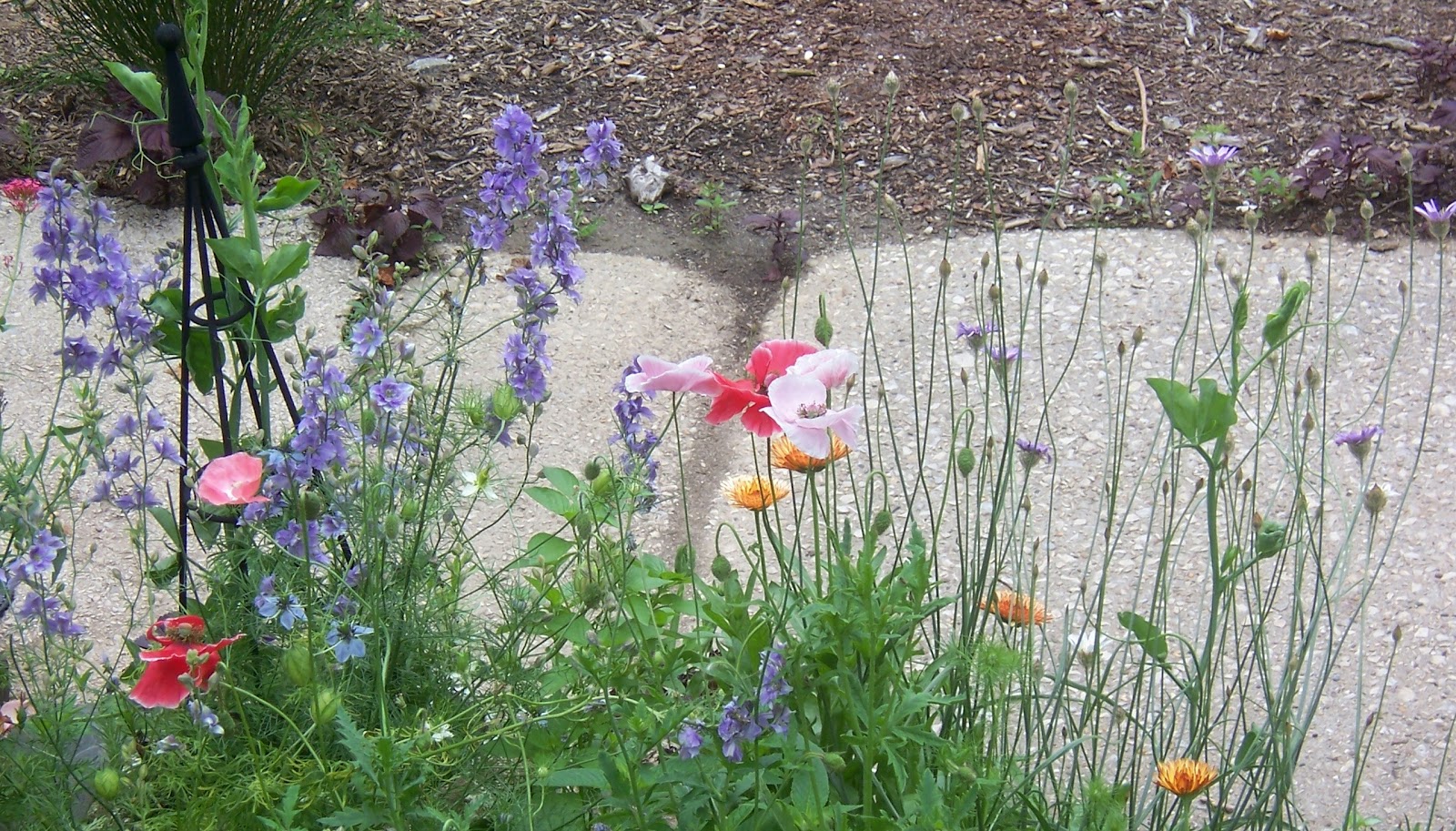
Every year in late winter I throw a lot of seed around. An illustration of the results is on the left. It shows three of my favorites,-- larkspur, poppy and pot marigold. Winter seeding brings lots and lots of  summer flowers.

On the right you can see these three, with sweet pea thrown in, filling in between the perennial Cupid's Dart, Coneflower and Lavender.  One of the people whose questions helped inspire me to write this blog wanted to know how I managed to have such dense planting with so much in bloom. Annual seeds are part of the answer.

To look good, most perennial gardens need to meet three needs: 1) they need to have a succession of abundant flowering and/or interesting foliage that lasts from early spring to late fall, 2)  week to week, with whatever is in or out of flowering, the garden needs to look visually balanced as a whole and 3) colors should not clash, nor should there be too much of any one shape of flower or leaf texture together, nor should the rise and fall of the overall composition of the plants be too uniform and boring.


Can you imagine trying to figure this all out logically? What a boring nightmare! Luckily you do not have to. You do need patience, some intelligence and a decent eye though. And an ability to throw seed on the ground.

Every year, all through the year, I take time to look at my garden and mentally note what is not working. Then, in spring and fall I transplant or plant as needed and every late winter I throw seed at bare patches. It makes for a dense, vibrant look that pleases me and many others. Plus, it does not take much time or money. Seeds are cheap.

How did I fall on this solution? Not by looking for a solution but by following desire.

16th century Belgium tapestry in the V & A, Creative Commons
Since I was young I have felt something strange, wonderful and good in the atmosphere I picked up from the style of some late Medieval, Northern European things. It's a style that shows in the interlacing narratives of the Arthurian romances and the flowery meads (see above) depicted in the backgrounds of miniatures and tapestries. It's a style with a delicate, graceful strength that to seems to quiet and transmute the arrogant and aggressive tendencies of its day.


As a decorative style it is called Mille Fleurs, a thousand flowers. I have no meadow clearing to dedicate to it. But I do have bits and drabs of a garden. And so it was by searching for an ideal that I discovered a highly practical reality. By using seed for old fashion annuals, and by allowing as much self-seeding as possible, I had figured out how to balance the garden thru the whole growing season, while filling it up to its brink.

But then I usually throw out the seeds while it still feels like winter. Is it too late, this spring in winter that feels out of time? I hope not. I need the frail, brilliant beauty of  poppies. I need their delicate, graceful strength.


----------------------------------------------------------------------------

How to Seed:  O.K., so I extravagated a bit about being able to throw -all- the seeds. Poppy seeds you can throw and maybe larkspeare. Sweet pea you really plant in. Most of the others you just barely cover. Take your finger, indent a trench about 1/8 of an inch deep, dribble in the seeds, dribble over some earth, done. Its that easy if...the ground is damp. Do it right after, or right before, rain.

Wednesday, December 7, 2011

Light in the Winter Garden

Post 19
                                                          
No, the garden is not over.


Nandina berries hang above angel by the door, the Heavenly Bamboo's lush foliage uplit by the variegated euonymus underneath


On the other side of the door, the Camellia, which last year did not bloom till February, now looks like it will soon mean business.


And this morning it did.


And another surprise, this one so unlikely as to bring a rush of wonder.


A violet. In spring violets cram the hellstrip, and in midfall there may be some rebloom...but in December? A December violet?


"A violet by a mossy stone,
Half hidden from the eye!
Fair as a star, when only one 
Is shining in the sky."


An image I have loved since High School, now, for a moment, seen.


The image comes from a group of poems by Wordsworth called "The Lucy Poems." His flower is of spring and isolation, growing along untrodden ways. But here is a very different violet indeed, one between well trodden sidewalk, stone and city street, blooming close to St Lucy's day.
--(If you live around Philadelphia and are open to Christian folk festivals (with strong pagan influence), get thee to Gloria Dei, Old Swedes Church to see a lovely antithesis to commercial pre-Christmas festivity.
Lucia Fest & St. Eric’s Fair at Old Swedes’ ChurchDecember 9-11, 2011Fri Dec. 9 - 6pm and 8pmSat and Sun Dec 10-11  2pm, 3:30pm and 5pm)--
Back to the garden... the hydrangeas still please


The grasses bend...
An azalea opens...
The roses bloom.


Early winter/late fall is not all brown after all, but can be full of good surprises. Less pie in your eye than midsummer, the light, nevertheless, remains sufficient to the day. Not a bad lesson to learn.


How to violet: Common Blue Violet or Viola papilionacea is another one of those plants that is hard to buy, but easy to find around. Yes, in proper conditions it will rapaciously self-seed, so keep it out of any place where you do not want it to spread. It flowers in spring in waste places that are moist and have dappled shade. Given enough moisture and shade the plants will continue till frost. In dry years or places, the plant will disappear, only to return the following spring.  And it is not just their shy beauty that is fetching, it is their odor as well. It is also an edible flower and looks lovely in salads, ice cream and on cupcakes.

Saturday, October 8, 2011

Hostas and the Funkia of Scenic Decay

Post 10


It is easy, but unproductive, to imagine the garden as an idyllic Eden beyond time's throes.  There is no garden without time. Gardens are made of time

How I wish I had taken pictures a few winters ago when a heavy frost hit the uncut-back garden. A pale hosta, which had remained in leaf, wilted overnight, its fronds decayed into ghost leaves. The limp leaves, which fell away from their roots to splay out in a circle, had gone greyish white.  Unhappy at the time, I'd gathered them up and hung them from the bishop's hooks behind the Buddha. For a day or two they dangled there, tokens of decay, translucent, beautiful and properly sad.

In my carpool this week, I told a colleague how I like to let some plants visibly decay, while removing others--it all depending on how attractive the decay is. Since she is a new gardener, she asked me when to cut back her plants, most especially her hosta. It made me remember the ghost leaves, and note how a popular 19th century plant like hosta, once called funkia, remains perpetually in style. Every year there are new varieties while the old ones remain ubiquitous. Everyone, it seems, has some funk.


What other factors, I wondered, can make for good garden funk, a bit of scenic decay?

A surge of fresh roses blooming beneath a turning tree.

A scattering of fallen rose petals on a stone staircase.


"You love the roses - so do I.  I wish the sky would rain down roses, as they rain from off the shaken bush.  Why will it not? Then all the valley would be pink and white And soft to tread on.  They would fall as light as feathers, smelling sweet; and it would belike sleeping and like waking, all at once!"  -  George Eliot, Roses 


The froth of spent flowerheads nuzzled by a strand of Kiss-Me-Over-The-Garden-Gate

Fading flower of Oak Hydrangea against turning leaves and an Autumn Joy sedum blooming in a cute thrift-store vase .


Or how about the sight of zinnias with new blooms, mature blooms, and old blooms all in one gaze?


Pastorius Park
 In our culture such a huge amount of resources: time, money and effort, is spent erasing time. And to what end? To deny that in the long run there is only one end for mortal creatures?  One cosmetic company is now developing a pill to keep your hair from turning grey. Only drawback--you have to take it for at least 10 years before your hair starts turning, and then, for how many years after? What's next, some soil additive to keep tree leaves from turning color and falling in autumn? To erase time erases life, erases change, erases us.
.
Pastorius Park


My perennial question behind this blog -- how does gardening change the gardener? --has perhaps one answer. Gardening embeds us in time. Most of our common culture does the opposite--it disembodies us into spectators while erasing time. By gardening we partner and co-operate with time.


Hence we learn through our bodies' labors that sometimes it is better and more graceful to accede to time's reality. To trust to something beyond our self-gratifying egos.  And so to let the leaves, all the leaves, fall where they may.


------------------------------------------------------------------------
How-to Hosta:  Hostas are originally native to China.  From there they were brought to Japan and Korea, and then, from there, in the mid-19th-century, to the Western world. Older versions make great groundcovers for shade and semi-shade. They come in all sizes, from smaller than an unabridged dictionary to bigger than a multi-cushioned sofa, but most end up at about 3 X 3. They also come in all shades and varigations of green, white, chartreuse and a waxy blue-green.  Some of the newer varities can take sun: most others will get leaf burn. They love our local clayey soil, sending down deep roots to deal with dryish shade. To make more plants just divide in spring or fall; small plants will fill in quickly. Be sure to keep watered for a few weeks after transplanting. Hosta are tough, adapatable, low care plants. So --  Enjoy your funk ( just, as they say, don' impose it on others.)

Tuesday, August 23, 2011

The Ease of Coneflowers, or Gardening's Dirty Secret

Post 5

Hey, most of gardening's secrets are dirty; it goes with the territory. Yields good results though.
Coneflowers with Red Maple
The big secret?  It's that very few people garden the way garden writers tell us to garden. We are told to learn about plants, prepare our soil and design a garden before putting a single plant in. We are told to hire experts or buy garden design plans . This message sometimes suggests that gardening is a dangerous activity apt to blow up in the unempowered novice's face.
GardenDesign

Well, people seem to really like my garden and I've never hired anyone or used any plans. I also knew very little when I plunged in. Most people know very little when they plunge in.

This is how it worked --I hated my new front yard's sickly grass even more than I hated its boring pachysandra. So I thinned out some of the pachysandra, and transplanted it to where I'd dug up grass. Then something inside of me felt an irrational tug, a temptation towards lights, colors, action! Friends of mine had flower gardens, why, why...not me? So, inspired, determined and deluded, I tromped off to the nearest box store to buy cheap flats of annuals. I put them in. Instant pizzazz. Positive feedback. I was hooked.

Coneflowers, Phloxes, Rose, Verbascum, Petunias
Now here is where friends and family came in. They offered me plants, not just the annuals of a summer but hardy perennials that came back every year. They gave me advice and encouragement. I learned where to put things. I learned to water. Bought perennials on sale. Took out library books on plants. Played around on the Internet and discovered a haven of good advice, Garden Web.


Piecemeal, it all came together. When I saw something I liked, I bought it and put it in where I had space. If it didn't look right I moved it or divided it. Sometimes I killed it by mistake, learning as I went. But after a few years-- there was not a bit of pachysandra or grass left.

Coneflowers and Daylilies


Your best design tool is your eyes. Just keep looking as you go. When things don't look right, change them till they do, till your gaze feels drawn in, welcome, happy to rest amidst the abundance. Its not rocket science; its gardening. So, if you don't much mind the exercise, or being outside in gorgeous weather or delicious smells or the feeling of cooperating with nature, you will look up one day while gardening and find that-- you have made yourself a garden.

So the dirty secret is that garden-making is not difficult. It is as if nature wants to cooperate, is happy to do the hard work for you. Non-perfectionist gardening is like one of the easiest, prettiest plants around: coneflowers.  They are the pink, daisy like flower in all the garden pictures.  And all they want to do is grow.

And if you do not believe me about making gardening easy, then believe these Handy Tips by Felder Rushing from his helpful new book, Slow Gardening

------------------------------------------------------

Coneflower, or Echinachea purpurea, is native to American prairies and so likes sun, good drainage and moderate water. However, it is a sturdy, highly adaptable plant; it will also take part shade and amended clay soil, but not damp soil. It has a good 6 weeks of bloom, usually from early to late summer, and, contrary to its Latin color name, is usually a lavender pink ,with a fat russetty domed center (that does look like a curled up hedgehog aka, in Greek, echinos.) It is easily divided, self seeds readily and can handily be grown from seed as long as the seeds have a period of cold. Because it is so hard to kill and because to have some coneflower means to soon have more coneflower, it is a perfect pass along plant, a good gift to a new gardener. There are many fancy varieties in wonderful colors: white, red, orange, magenta, yellow, bicolor and green, but they are less likely to seed or spread. Usually two feet tall , and with many 4 inch flowers on just one plant, it is a useful, easy, beautiful addition to most gardens. And , as a bonus, goldfinches seek out its seedheads for feasting. For information on its possible medical properties, go here