Showing posts with label Fertility. Show all posts

Thursday, March 15, 2012

Lead with seed to a flowery mead

Post 29

Is it too late?

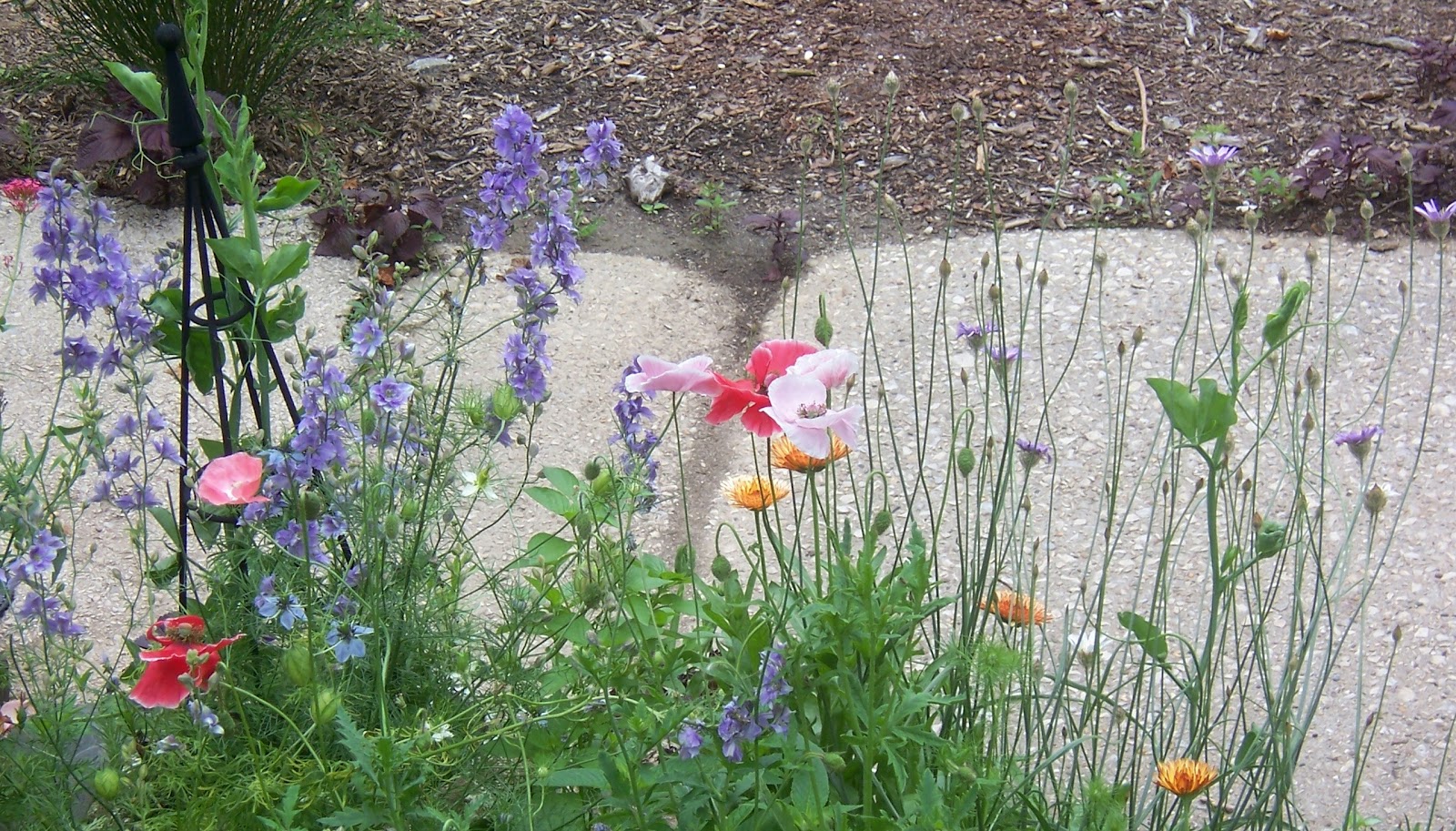
Every year in late winter I throw a lot of seed around. An illustration of the results is on the left. It shows three of my favorites,-- larkspur, poppy and pot marigold. Winter seeding brings lots and lots of  summer flowers.

On the right you can see these three, with sweet pea thrown in, filling in between the perennial Cupid's Dart, Coneflower and Lavender.  One of the people whose questions helped inspire me to write this blog wanted to know how I managed to have such dense planting with so much in bloom. Annual seeds are part of the answer.

To look good, most perennial gardens need to meet three needs: 1) they need to have a succession of abundant flowering and/or interesting foliage that lasts from early spring to late fall, 2)  week to week, with whatever is in or out of flowering, the garden needs to look visually balanced as a whole and 3) colors should not clash, nor should there be too much of any one shape of flower or leaf texture together, nor should the rise and fall of the overall composition of the plants be too uniform and boring.


Can you imagine trying to figure this all out logically? What a boring nightmare! Luckily you do not have to. You do need patience, some intelligence and a decent eye though. And an ability to throw seed on the ground.

Every year, all through the year, I take time to look at my garden and mentally note what is not working. Then, in spring and fall I transplant or plant as needed and every late winter I throw seed at bare patches. It makes for a dense, vibrant look that pleases me and many others. Plus, it does not take much time or money. Seeds are cheap.

How did I fall on this solution? Not by looking for a solution but by following desire.

16th century Belgium tapestry in the V & A, Creative Commons
Since I was young I have felt something strange, wonderful and good in the atmosphere I picked up from the style of some late Medieval, Northern European things. It's a style that shows in the interlacing narratives of the Arthurian romances and the flowery meads (see above) depicted in the backgrounds of miniatures and tapestries. It's a style with a delicate, graceful strength that to seems to quiet and transmute the arrogant and aggressive tendencies of its day.


As a decorative style it is called Mille Fleurs, a thousand flowers. I have no meadow clearing to dedicate to it. But I do have bits and drabs of a garden. And so it was by searching for an ideal that I discovered a highly practical reality. By using seed for old fashion annuals, and by allowing as much self-seeding as possible, I had figured out how to balance the garden thru the whole growing season, while filling it up to its brink.

But then I usually throw out the seeds while it still feels like winter. Is it too late, this spring in winter that feels out of time? I hope not. I need the frail, brilliant beauty of  poppies. I need their delicate, graceful strength.


----------------------------------------------------------------------------

How to Seed:  O.K., so I extravagated a bit about being able to throw -all- the seeds. Poppy seeds you can throw and maybe larkspeare. Sweet pea you really plant in. Most of the others you just barely cover. Take your finger, indent a trench about 1/8 of an inch deep, dribble in the seeds, dribble over some earth, done. Its that easy if...the ground is damp. Do it right after, or right before, rain.

Wednesday, December 7, 2011

Light in the Winter Garden

Post 19
                                                          
No, the garden is not over.


Nandina berries hang above angel by the door, the Heavenly Bamboo's lush foliage uplit by the variegated euonymus underneath


On the other side of the door, the Camellia, which last year did not bloom till February, now looks like it will soon mean business.


And this morning it did.


And another surprise, this one so unlikely as to bring a rush of wonder.


A violet. In spring violets cram the hellstrip, and in midfall there may be some rebloom...but in December? A December violet?


"A violet by a mossy stone,
Half hidden from the eye!
Fair as a star, when only one 
Is shining in the sky."


An image I have loved since High School, now, for a moment, seen.


The image comes from a group of poems by Wordsworth called "The Lucy Poems." His flower is of spring and isolation, growing along untrodden ways. But here is a very different violet indeed, one between well trodden sidewalk, stone and city street, blooming close to St Lucy's day.
--(If you live around Philadelphia and are open to Christian folk festivals (with strong pagan influence), get thee to Gloria Dei, Old Swedes Church to see a lovely antithesis to commercial pre-Christmas festivity.
Lucia Fest & St. Eric’s Fair at Old Swedes’ ChurchDecember 9-11, 2011Fri Dec. 9 - 6pm and 8pmSat and Sun Dec 10-11  2pm, 3:30pm and 5pm)--
Back to the garden... the hydrangeas still please


The grasses bend...
An azalea opens...
The roses bloom.


Early winter/late fall is not all brown after all, but can be full of good surprises. Less pie in your eye than midsummer, the light, nevertheless, remains sufficient to the day. Not a bad lesson to learn.


How to violet: Common Blue Violet or Viola papilionacea is another one of those plants that is hard to buy, but easy to find around. Yes, in proper conditions it will rapaciously self-seed, so keep it out of any place where you do not want it to spread. It flowers in spring in waste places that are moist and have dappled shade. Given enough moisture and shade the plants will continue till frost. In dry years or places, the plant will disappear, only to return the following spring.  And it is not just their shy beauty that is fetching, it is their odor as well. It is also an edible flower and looks lovely in salads, ice cream and on cupcakes.

Tuesday, September 6, 2011

Cleome, History's Muse

White Cleome
Post 6
Clio is the muse of history, but what does that mean? What inspires history, moving us to remember and commemorate the past, especially the good of the past?


Every gardener was once a child and as a child wondered through a garden or gardens, leaving vivid snapshot memories. Old fashioned flowers may call up scenes of a patio bordered by swaying lilies, or a porch swing near an unknown flower.


Cleo and Nicotiana alata

One difference between many present plants and ones we think of as old-fashioned is that the old fashioned plants reproduce.  Because modern taste has gravitated towards more and larger blooms that last longer, this has led to hybridization that keeps plants from setting seed, or setting seeds that reproduce unpredictibly.
 Select Seeds, one of the companies that specialize in old-fashioned seeds and plants,(Perennial Pleasures is another, Seed Savers' Exchange another,) gives these older plants this definition:
"Antique, or heirloom flowers are open-pollinated varieties that originated fifty or more years ago. Open-pollinated flowers are fertilized by insects, hummingbirds or wind, and the resulting seeds will produce plants that are identical or very similar to the parent plant." 
Cleome,  which makes me think of a voluptuous sylph in a silk dressing gown, manages to look blowsy and delicate at the same time. Originally from the West Indies, it is a repeating annual in our area -- by repeating, I mean that it reproduces every year from seeds it sheds the year before. Because it so easily reproduces from seed, once you have some you will soon have more. If it spreads too much, it is easy to pull out and transplant. Or give to a friend, which is how I acquired my first stand.

It starts blooming in July and often keeps up till frost.  This is because its flower turns into seed pods as the plant rises, making a sort of spiraling ladder.  The seed pods, which are like steps,  are easy to gather and spread where you would like. It is as if Cleome were writing its history in unwinding seed posd.

“All things are engaged in writing their history.” Ralph Waldo Emerson


So, my tentative answer to the opening question -- what is history's muse?-- is this. Though history, anyone's history, includes repungnant, not to mention sad and difficult incidents as well as happy ones, all  these incidents have been experienced by the self. And what has formed this self? On the most mundane level, it is love. For a child who is given no love or care at all dies. The baby's earliest sense of self comes from interaction with love.

" One does not love a place the less for having suffered in it, unless it has been all suffering."  Jane Austen


Clio, from www.oberlin.edu/history/Brown.
 
Perhaps, because love sets the structure of self, that structure brings a kind of love to what the self experiences. And so the past, and its path, acquires worth.

Cleome, tall, fertile and full-blown, self-seeds itself around the garden like memory, framing new vistas amidst old-fashioned plumes. It is a good flower to plant in a place that you love, there to perhaps bring history's best gifts,  good report and peace.

----------------------------------------------------

How-to: Cleome hasslerana is an easy self-seeder. In fall throw seed pods or seeds where you want it, then thin in late spring. I've seen it colored white, pink and white, bubblegum pink, lavender, lavender and white and purple. If it starts to fall over or gets too gangly, lop it off and two flowers will grow back lower. It like sun and lots of water or semi-shade and less water -- it looks piqued if allowed to dry out.