Showing posts with label Style. Show all posts

Saturday, May 25, 2013

What Makes a Style?


Post 75

Why do we like what we like? This week I've realized how much exciting times from my childhood have shaped my sense of style.

My small garden does not follow the usual  good taste model, that of planting in large drifts, with many plants of the same variety planted together. Large drifts work well for larger gardens, but for me, it can get boring in a small one. My eye needs to roam. It needs to be drawn in and then drawn forward,  moving in expectation and delight till it takes its moment of rest at a particular cynosure, only to re-energize and take off again.


 Part of my inspiration has been country meadaows, part late Medieval millefleur tapestries, part has been Fleur Cowles illustrations, but I've just understood another big, and highly unexpected influence: Lower Manhatten.

Growing up one of the most exciting things I could do was visit my Dad at his office in Hanover Place near Wall St in Manhattan. Which was very different than the city where I lived and spent my usual days.

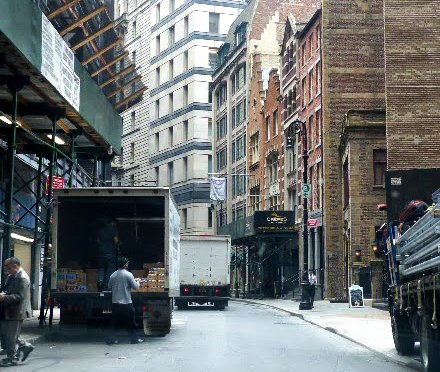
The city I knew was the spacious grid of the East Side where light shone thru wide canyons that opened up in logical right angles. It was a spacious, rational, prediciteble world where 65th Street followed 64th, where the blocks were all the same size and views were long and  unobstructed. But down around Wall Street was a different world.


 The streets were small, cantered and illogical. The buildings were all over the place and almost seemed to be falling over each other.


This new, hodge-podge city was wonderful to me because I was with my Daddy and it was his world.


Everybody knew him, many called him affectionate nicknames I'd never heard of. Through good and ill it was his kingdom. He loved it and came fully alive there.


Above, you can see him as he is today, or rather as he was a few days ago, on his 100th birthdy, when he rang the closing bell at the New York Stock Exchange. He, I and the NYSE are much different from what we were when I first saw Wall Street in the late 50s, early 60s -- but the geography of the place remains the same. And now I am old enough to be conscience of its past and present effect on me, and how it has perhaps inspired and strengthening my delight in fetching disorder.


So perhaps this is why, whatever I'm creating, it will usually have a combination, a balance, of order and disorder. My garden has its quinquinix structure, over, around, thru and about which, runs perennial plants acting like random meadow annuals.


And here I am below as a teenager with my dad in his salad days. He and my mother (as I mentioned in my post about Fleur Cowles) have influenced my style in more ways than I can say, for childhood loves make for much in adult life. Our styles, if authentic, often come from what we have loved, and how strongly we have loved.


Wednesday, March 6, 2013

Growing at The Flower Show

Post 67

Would I ever be so silly as to pose with a Guard? Of course not-
not unless drunk, or rather, drunk with the scents, sights and sounds of this year's Flower Show. (Do not miss the hourly video that plays across the clock's face. Do not.)


And the plants were pretty darn good too.

Above  is a combination I have never seen before but works: stone, Harry Lauder's Walking Stick, and the reddest of red English daisies. It's like the daisies are applauding the tree's movements. Clap your petals.


The common luxuriness of English cottage garden style was in evidence. As in the pic above  -- white Cosmo, the mallow that goes violet to purple and tall agaratum.

                                                                                                                                                    And isn't this the bees' knee's? Talk about  contrasts to make harmony.                                                                              A huge amount of what I have learned about gardening I learned at the Flower Show -- by just looking.                                                                                                                            It is easy to copy things, but unless you understand the principles behind the original, you will not copy well. You'll just get pastiche
I do not like to copy, but to understand and adapt. So I look and ask questions. From my answers grows my style. If I were to just steal or appropriate, I'd bypass growth. And growing a garden well means growing yourself as well.


Here I pause, my eye arrested by the contrasts of color and texture.

And hows this for a roar of color?  This bookcase of plants would only look right in the Tropics or under the too bright overheads of the Convention Center.


And maybe because I've been doing photography all Winter, I notice I am more drawn to strong, simple form that I used to be. Below is one of my favorite plants I saw.

I

It's like a male form of seafan coral.  And now, on to some pitcher plants next to granny bonnet daffs.


Behold the hills and vales of this lusious succulent.


These roots could be fruits--or are they?


This world is an amazing place and the plant life on it one of the many things that  makes it so amazing.


The Flower Show is a blast because it exposes you to all sorts of groovy new things, things you had not imagined existed.


But you find out they do, and with that knowledge and understanding your own imagination and sense of possibility grows.


And becomes a bit more amazing as well.


-------------------------------------------------------------------------

A short shout-out to Daniel Hogg who came all the way from the mists of Cornwall to tell tall tales (well--they couldn't all be true, ... could they?) of the fabled Lost Gardens of Heligan


To the Jane Austen Society for their award-winning display


And to this, the most lovely clematis I think I have ever seen, now slightly wilted, but still somehow unearthly in its not-quite white beauty.


And last of all, some wisdom


And a sign at the bottom of the barrow.


Monday, February 18, 2013

Grab Bag with Heavenly Bamboo and Fleur Cowles

Post 65


I am ready for spring, being uninspired on present garden matters, so this post will be a grab bag of incidentals.

Wouldn't it be wonderful if we had something like a simple interdenominational chapel in the Wissahickon? Something like this--

I'm going thru some old photos and found this shot of my garden in spring. This is what I am longing for. 


And if I can't have that---I'd like to be here (another old photo, pre-digital Anguilla.)


But things are not really grim. The old wisdom of having Heavenly Bamboo (Nandina domestica -- not the regular bamboo) by the door does pay off.


Evergreen, with red berries in winter and sorta meh off-white flowers in summer, it takes some shade and grows everywhere but in sandy soils. And while it spreads, it spreads slowly and controllably here. In the South it can be invasive but up North it is fine. It is one of those great background plants that lacks dramatic flowers but has other virtues. There are many fancier varieties than what I am showing here, so there is a version for every garden. It comes from Asia and the Japanese do plant it by the front door for luck.

And, on Valentine's Day, the red berries go well with hearts


Here is my Valentine. It is from a 50's mag/annual called Flair, put our by a painter called Fleur Cowles, whose gift for sophisticated whimsey delighted my mom--and thru her, me. With Flair Cowles mixed serious with fun without diminishing either. Bless her bright, casual sensibility.

Here is another one of her illustrations:


Her artwork was evocative, just skirting the edges were it could become overly sweet. She specialized in animals and flowers--but what animals and flowers!


She created new worlds with those animals and flowers, worlds you had never imagined before and which you wanted to imagine more of. This to me is true chic.  People forget that there is such a thing. Fresh, evocative of paradise, sweet and strange at the same time, delicately spare, charming and benign, these are terms not usually associated with chic. I doubt anyone would deny Cowles was chic--but her kind of chic I do not see much around anymore. Is it too difficult?


I've spent most of this winter inspired by circa-1815 chic (as channeled through the 1920s.) I've been turning my love and attention onto taking pics of the Free Library that show my vision of the place. It's not quite in the Wissahickon Valley, though close, so I've posted them on my other blog at My Other Blog.

I will probably post a third one soon-- (I am lucky yo have free access to a place that is so much like the Hotel de Crillon. But then, everyone in Philly does.) And then soon the snowdrops that are sticking their blades up through the dirt will turn into scented flowers, and the season of flowering will begin.


Thursday, March 15, 2012

Lead with seed to a flowery mead

Post 29

Is it too late?

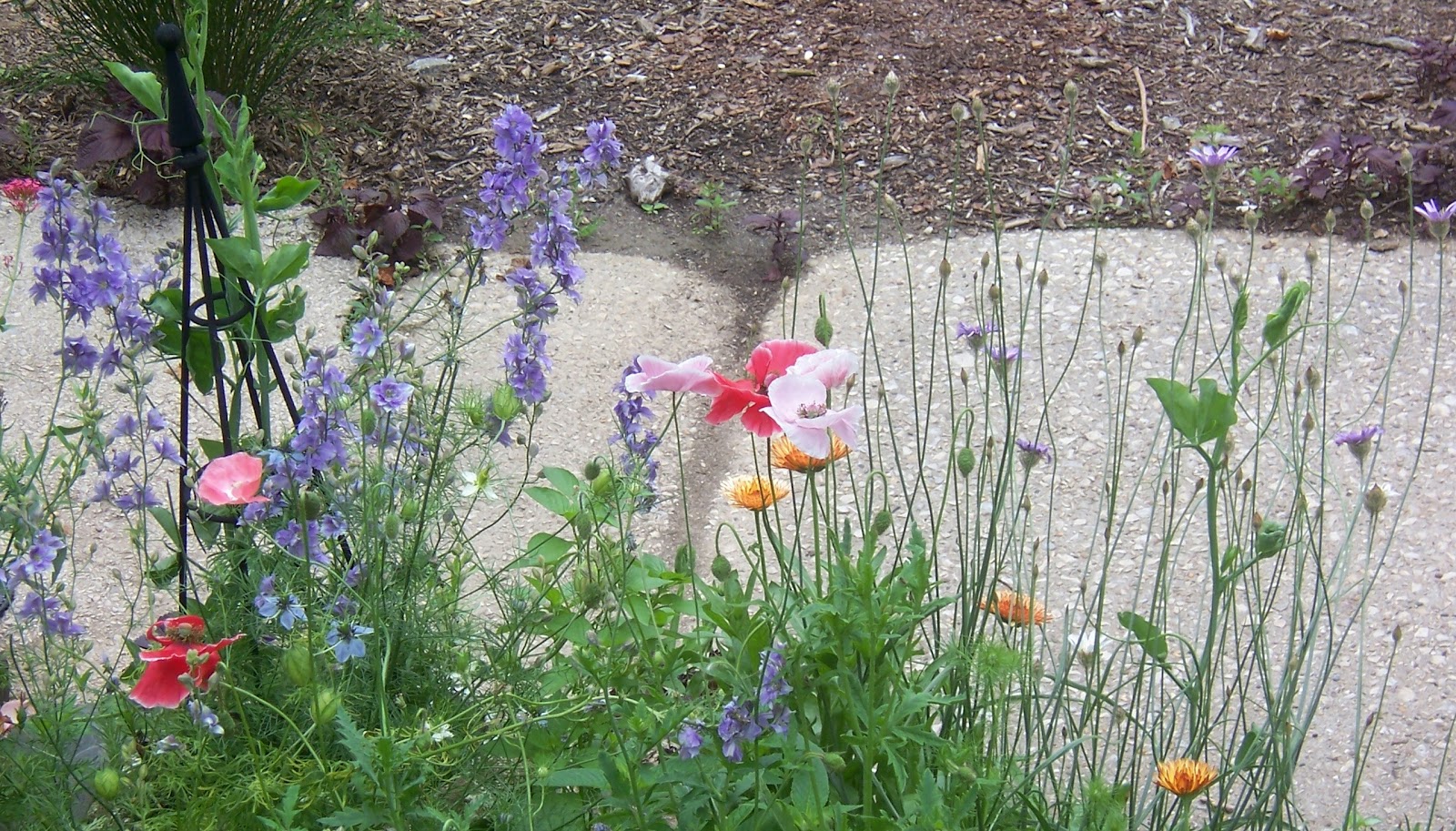
Every year in late winter I throw a lot of seed around. An illustration of the results is on the left. It shows three of my favorites,-- larkspur, poppy and pot marigold. Winter seeding brings lots and lots of  summer flowers.

On the right you can see these three, with sweet pea thrown in, filling in between the perennial Cupid's Dart, Coneflower and Lavender.  One of the people whose questions helped inspire me to write this blog wanted to know how I managed to have such dense planting with so much in bloom. Annual seeds are part of the answer.

To look good, most perennial gardens need to meet three needs: 1) they need to have a succession of abundant flowering and/or interesting foliage that lasts from early spring to late fall, 2)  week to week, with whatever is in or out of flowering, the garden needs to look visually balanced as a whole and 3) colors should not clash, nor should there be too much of any one shape of flower or leaf texture together, nor should the rise and fall of the overall composition of the plants be too uniform and boring.


Can you imagine trying to figure this all out logically? What a boring nightmare! Luckily you do not have to. You do need patience, some intelligence and a decent eye though. And an ability to throw seed on the ground.

Every year, all through the year, I take time to look at my garden and mentally note what is not working. Then, in spring and fall I transplant or plant as needed and every late winter I throw seed at bare patches. It makes for a dense, vibrant look that pleases me and many others. Plus, it does not take much time or money. Seeds are cheap.

How did I fall on this solution? Not by looking for a solution but by following desire.

16th century Belgium tapestry in the V & A, Creative Commons
Since I was young I have felt something strange, wonderful and good in the atmosphere I picked up from the style of some late Medieval, Northern European things. It's a style that shows in the interlacing narratives of the Arthurian romances and the flowery meads (see above) depicted in the backgrounds of miniatures and tapestries. It's a style with a delicate, graceful strength that to seems to quiet and transmute the arrogant and aggressive tendencies of its day.


As a decorative style it is called Mille Fleurs, a thousand flowers. I have no meadow clearing to dedicate to it. But I do have bits and drabs of a garden. And so it was by searching for an ideal that I discovered a highly practical reality. By using seed for old fashion annuals, and by allowing as much self-seeding as possible, I had figured out how to balance the garden thru the whole growing season, while filling it up to its brink.

But then I usually throw out the seeds while it still feels like winter. Is it too late, this spring in winter that feels out of time? I hope not. I need the frail, brilliant beauty of  poppies. I need their delicate, graceful strength.


----------------------------------------------------------------------------

How to Seed:  O.K., so I extravagated a bit about being able to throw -all- the seeds. Poppy seeds you can throw and maybe larkspeare. Sweet pea you really plant in. Most of the others you just barely cover. Take your finger, indent a trench about 1/8 of an inch deep, dribble in the seeds, dribble over some earth, done. Its that easy if...the ground is damp. Do it right after, or right before, rain.