Showing posts with label Annuals. Show all posts

Tuesday, September 11, 2012

Two Kindly Weeds: Morning Glory Grandpa Otts and Gloaming Mistflower

 Post 51

Early Fall is when the air freshens up and it is pleasure to go back into the garden, a pleasure, that is, until you notice the weeds.

As you start to clear stuff out: weeds and dead or rotting matter, mildewed stems and spotted leaves, you realize that there is less blooming than earlier in the season. Annuals, the ones that did not burn out in the heat, are still strong but most perennials are done.


If you are lucky some perennials will look good as they age , such as the cones of the Pee-Gee hydrangea, above right. Still, if it were not for two late-flowering, beautiful, rampant things,  much of the garden would loose luster well before its end.


Here is my hell strip with some pink asters and the two kindly weeds: Granpa Otts Morning Glory and Wild Ageratum, or Mist Flower.

Though they spread like green rampage, they can work well in a wild garden


And why would I call a Morning Glory a weed? Well, because this one acts like one; it's hard to kill, overpasses its boundaries and, if allowed, can strangle other plants. Nevertheless, it is a kindly weed because it does not get its full growth till late in the season when you have the space and need the color. Best of all, it is easy to yank or hoe out, you do not even have to dig.

Here is what the Seed Savers Exchange says about it--

"(Ipomoea purpurea) One of the original Bavarian varieties that started SSE. Given to Kent and Diane (Ott) Whealy in 1972 by her grandfather, Baptist John Ott, who lived on a 40-acre farm near St. Lucas, Iowa. Beautiful deep purple flower with a red star in its throat. Reliably self-seeds each year. Plants will climb 15' or more, if given support. Self-seeding hardy annual at Heritage Farm (zone 4)."

 So, buy one seed packet once, and you will have this forever. Because it is dark, and has a cool navy purple with streaks of hot violet, its flower, though small, looks  dramatic and dynamic.


 Mistflower, on the other hand, is a receding blue grey that looks best at twilight, when the blue takes on a weird, delightful glow. It is a bit of a filler since it looks best highlighted by bolder plants.

The way I handle its invasiveness is that every year, once bloom is done, I pull it out by its shallow roots. Yet, by June of the next year, it starts to pop up again. This is good, cause this is an area where I have had a lot of bulbs and spring ephemerals.  With this late riser, I get two seasons out of one patch of soil. 

For me, it's less effort to restrain vigorous plants than to cajole fussy ones. And I like the balance of wildness to tame that they engender. This is probably more of a reflection of my particular inner balance than of any practical gardening wisdom. 


Whatever it is that gives personal style to the garden, or any other aspect of your life, it comes from inside you.

 
All the tips in the world, books, quotes, guides, are just fodder for the deep part of yourself that creates.


That creates out of love. 

Thursday, August 30, 2012

A Jubilee Parade for Labor Day: Zinnias

Post 50


I love zinnias. They are tough yet easy-going; sweet and exuberant; individualist yet cooperative  determined and brilliant.  And they get the job done.


Even though I have time, money and land, I can only create a garden because Nature (or Nature's God) has created life-- my own and that of plants.


My job is choosing the plants that will thrive and create beauty. But it's the plants that make it happen. You could say they are dependent on me,-- but only if you add that I am dependent on them.


So Happy Labor Day to all the zinnias of this world. May they (we) be properly paid for our honest labor that keeps this world functioning.


It is our productivity that produces value,


A fair portion of which value we have a right to,


And a duty to use that value,


So that we ourselves help create a better, more functional, more sustainable, more beautiful world.


We are all sub-creators, whatever our position in life.


Even when we think we do not have the power,


Even when we seem done,


 Until we return from where we came, and truly learn what our imperfect efforts,

 What our imperfect love,

Has created.

Happy Labor Day

Thursday, March 15, 2012

Lead with seed to a flowery mead

Post 29

Is it too late?

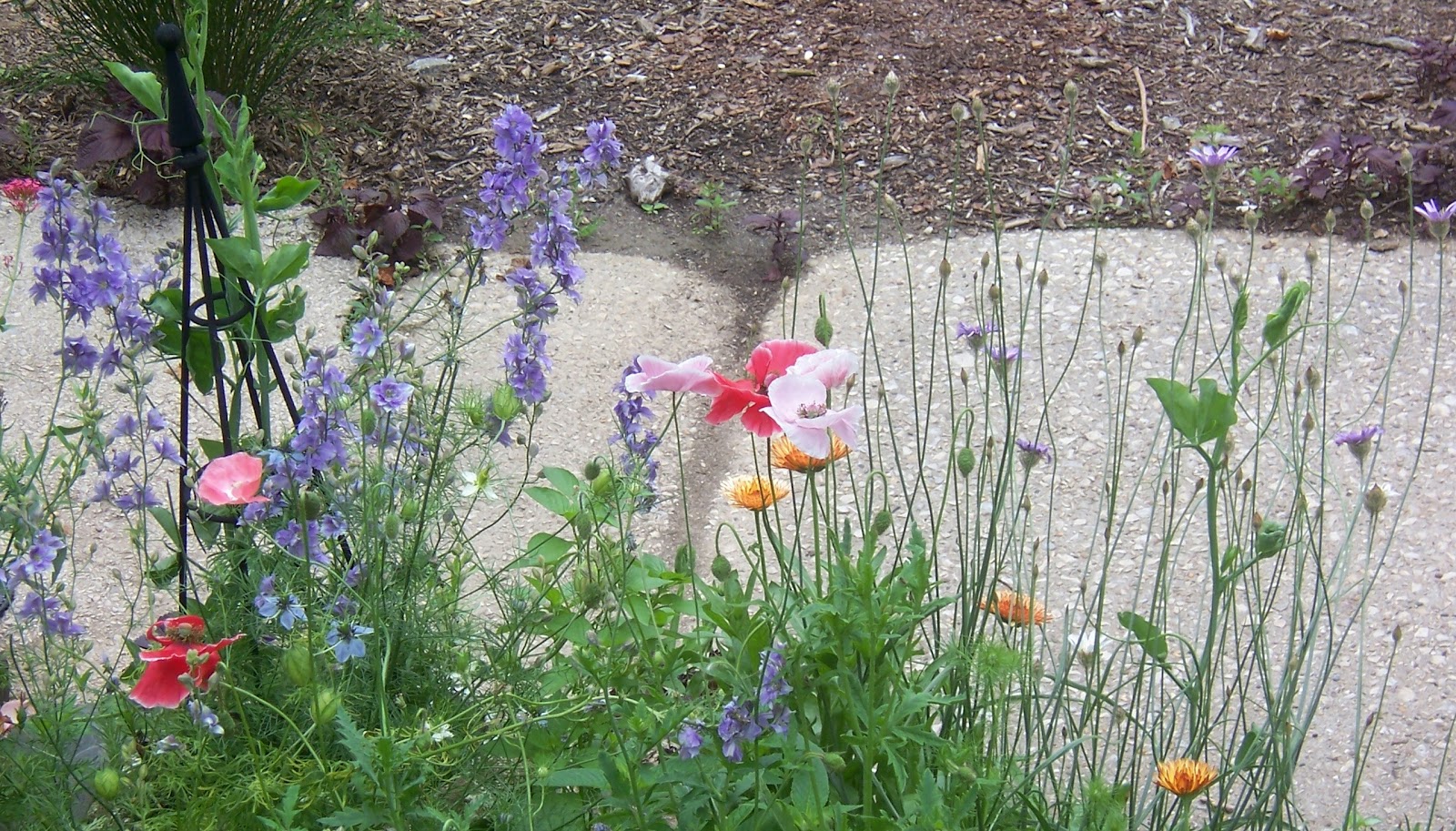
Every year in late winter I throw a lot of seed around. An illustration of the results is on the left. It shows three of my favorites,-- larkspur, poppy and pot marigold. Winter seeding brings lots and lots of  summer flowers.

On the right you can see these three, with sweet pea thrown in, filling in between the perennial Cupid's Dart, Coneflower and Lavender.  One of the people whose questions helped inspire me to write this blog wanted to know how I managed to have such dense planting with so much in bloom. Annual seeds are part of the answer.

To look good, most perennial gardens need to meet three needs: 1) they need to have a succession of abundant flowering and/or interesting foliage that lasts from early spring to late fall, 2)  week to week, with whatever is in or out of flowering, the garden needs to look visually balanced as a whole and 3) colors should not clash, nor should there be too much of any one shape of flower or leaf texture together, nor should the rise and fall of the overall composition of the plants be too uniform and boring.


Can you imagine trying to figure this all out logically? What a boring nightmare! Luckily you do not have to. You do need patience, some intelligence and a decent eye though. And an ability to throw seed on the ground.

Every year, all through the year, I take time to look at my garden and mentally note what is not working. Then, in spring and fall I transplant or plant as needed and every late winter I throw seed at bare patches. It makes for a dense, vibrant look that pleases me and many others. Plus, it does not take much time or money. Seeds are cheap.

How did I fall on this solution? Not by looking for a solution but by following desire.

16th century Belgium tapestry in the V & A, Creative Commons
Since I was young I have felt something strange, wonderful and good in the atmosphere I picked up from the style of some late Medieval, Northern European things. It's a style that shows in the interlacing narratives of the Arthurian romances and the flowery meads (see above) depicted in the backgrounds of miniatures and tapestries. It's a style with a delicate, graceful strength that to seems to quiet and transmute the arrogant and aggressive tendencies of its day.


As a decorative style it is called Mille Fleurs, a thousand flowers. I have no meadow clearing to dedicate to it. But I do have bits and drabs of a garden. And so it was by searching for an ideal that I discovered a highly practical reality. By using seed for old fashion annuals, and by allowing as much self-seeding as possible, I had figured out how to balance the garden thru the whole growing season, while filling it up to its brink.

But then I usually throw out the seeds while it still feels like winter. Is it too late, this spring in winter that feels out of time? I hope not. I need the frail, brilliant beauty of  poppies. I need their delicate, graceful strength.


----------------------------------------------------------------------------

How to Seed:  O.K., so I extravagated a bit about being able to throw -all- the seeds. Poppy seeds you can throw and maybe larkspeare. Sweet pea you really plant in. Most of the others you just barely cover. Take your finger, indent a trench about 1/8 of an inch deep, dribble in the seeds, dribble over some earth, done. Its that easy if...the ground is damp. Do it right after, or right before, rain.

Tuesday, November 29, 2011

Advent and the Calla Lily's Call

Post 17
Bare Tree, Bright Tree
Hello and welcome to Advent, the last part of the darkening year, the first part of the yet-to-be-born year.  Traditionally it's a time for quiet and meditation --after the garden's bounty, after the harvest and feast, before the light.

"God beyond answers
Lord beyond words
Spirit beyond imagining
Move us today. Amen"

This prayer, from the Church of Scotland's website, greatly moved me when I read it.  Unbidden, there arose in my mind's eye a globe, alight and vibrant with uncountable,  invisible connections.  And accompanying it, a bit like an inaudible trumpet's call, was the urge to write this...


"What if you could thank everyone who has ever prayed for you or blessed you or wished you well?

Who would you meet?

The stranger who once saw your stricken face through a car window?


The cashier you were impatient with?


The patron you were able to cheer?


Your spouse, in mid-argument? Your spouse, in mid-pleasure?


A teacher you can hardly remember?
Someone who read something you wrote, or heard secondhand something you said?
 
The atheist who wished you well?
The person whose dog played with your dog in the dog park?
The child or sibling or relative who never understood you, or whom you never understood? The child or sibling or relative you think doesn’t understand, but understands you too well?


The friend who sympathizes?  The friend who has outgrown you?  The friend you have outgrown?
The enemy who wishes you were not so easy to despise?  The enemy who wishes you were not so hard to despise?  The enemy who is no enemy at all?

The parent who wishes life could teach you more gently?  The parent who wishes life could teach you at all? The parent who wishes love had more power in this world? The child who wishes they could save their parents?


What if everyone you had prayed for, or blessed, or wished well, could thank you?


What if we found out we had all prayed for each other or wished each other well? Wished each other better?


What if we all forgave each other?

What if we were all grateful?

Would, even could I?  Would, even could you, any of us?

Or is that what something like heaven is for? I do not know, but I wonder."

If you think it's a bit treacly, well yeah, it might be. But why are we so overly afraid of treacly in our culture?  Cool is like a gangster boss inside our souls demanding cash for not much of value.  I chose not to give in to that.  So while I'm not much for mortifying my flesh; I am for mortifying my cool.


----------------------------------------------------------------------------------


How-to Calla:  The white and maroon trumpeting flowers you see above are scientifically no longer either Calla or Lily, but thankfully, such a melodious name for such a fetching plant remains. Their flowers remind me of the elongated instruments played by etoilated angels that brighten Medieval manuscripts.


Zantedeschia aethiopica, originates, as you can guess, in Africa. As such, our climate is a bit too cold and wet for them to overwinter. You can dig out their rhizones in the fall and overwinter them as you would a Dahlia. This means dig up the gnarly rootstock after cold has damaged the leaves, dry the rootstock out, then pack up in moistened perlite. In spring plant back up with plenty of water. Callas like some shade and water, while good drainage and rich soil is a plus. But all, in all, they are easy. 


They can be expensive though, which is why I only grew them one year.  (Should have overwintered them.  Should have overwintered them.)  I found the two varieties pictured above at Produce Junction, for a price too low to resist. (Produce Junction is a thrifty grab-bag of whatever they can pick up, fruits, veggies, plants, garden supplies--you never know week to week.) There is something fun about not knowing what pleasantly surprising plant you might find. And these Callas took my breath away.


Friday, October 14, 2011

Tweedia or Baby, It's Cold Outside

Pastorius Park
Post 11

There is that nip in the air. It's getting cold, and it is only going to get colder. We need stuff to keep us warm, to warm up our cockles and numb fingers. We need thick, strong stuff like cosy Polartec, down or tweed, maybe an old plaid Harris Tweed,  in landscape-like colors so worn the fabric has mellowed to the touch. I love the one at right, a fall view with a bit of sky in it.


A bit of sky...a few autumns ago I grew a Tweedia. The vine was a slow starter, did not even bloom till late August but then...what a September through November. People on the street stopped in their tracks because Tweedia is not one of those almost blues of the garden.  It is not the blue lavender of hardy Geraniums, mountain Bluet or Baptisia, fetching and periwinkle as those flowers are. Tweedia is different.


Tweedia is true, crisp, autumn sky, knock-your-eyes-out blue (though older petals can turn a cobalt violet that only highlights the turquoise center burr.) Plus, its petals are fleshy, squishy thick. It is a fairy tale flower tough enough for the real world. People would ask what it was. I would tell them only to see their eyes grow even more incredulous. How could something so beautiful be so unknown? Its bloomed, soldiering on as its world grew colder and colder. It kept my heart warm that autumn. Even after a hard frost put an end to it, its extaordinary beauty kept an inner bit of my heart warm through a long winter.

Pastorius Park
It is implausible impossibles like this that sometimes get us through the rough bits. Call it finding your inner strength, turning to God, seeing through illusion, shifting frames or wrapping yourself up in that indestructible, warm tweed. All withstanding, when you face the cold that should not be, and face it with goodwill, sincerity and humility, it can be a blessing what answers back from within you.

Tweedia is a fairy tale flower in the real world.  
But, like a blessing, it may not make everything alright. Suffering remains suffering, and suffering does real damage in the real world. In the real world, we need more than just our own blessings. We also need each others', real world blessings as well, especially: compassion, forgiveness, merciful justice and moral action.


It is getting colder. Soon it will be Halloween. So Happy Halloween, All Saints and All Souls. May our youngest adorables dress up as goblins and prowl the twilight for candy, laughing at darkness, death and fear. And may we remember all who have loved us and gently made a way for us, all the real fairy-tale flowers in our lives, whose love, like a good stong tweed blanket, has been woven to keep us warm through the night.


------------------------------------------------
How-to Tweedia: Tweedia caeruleum (sometimes called Oxypetalum caeruleum,) is a short vine from southern Brazil that we can grow as an annual.  It is not usually sold potted up so you have to start it from seed, which can be purchased from SummerHill Seeds. The seeds need warmth, between 70 and 80 degrees to germinate, so think of using a heating pad under the tray. Since Tweedia is a milkweed you need hardly cover the seeds, which should germinate in a few weeks. When you plant it out make sure to put it in a hot, dryish spot; it hates wet. Place it where it is easy to see. The flowers, are small, though, as Spencer Tracy might say, choice.

And, in case you think my trope of Tweedia/Tweed outlandish, take thought of this. Tweedia was introduced to the West by James Tweedie, a Scot, who was head gardener at Edinburgh Botanical Garden till he chucked it all and bolted to Buenos Aires, where he kept a small store and went off on plant-hunting expeditions. It was during one of these that he discovered Tweedia and, though he never darkened Scotland's mire again, he did send some seeds back home.

Now, what do you think an old-fashioned, Brit head gardener would tend to wear? Look and you will see an answer.  And tell me what that jacket is made of? Polyester? Egads, no.
And as for a wonderful wool blanket to pass on to later generations, look here at: Swans Island Blankets