Showing posts with label Garden Design. Show all posts

Thursday, March 15, 2012

Lead with seed to a flowery mead

Post 29

Is it too late?

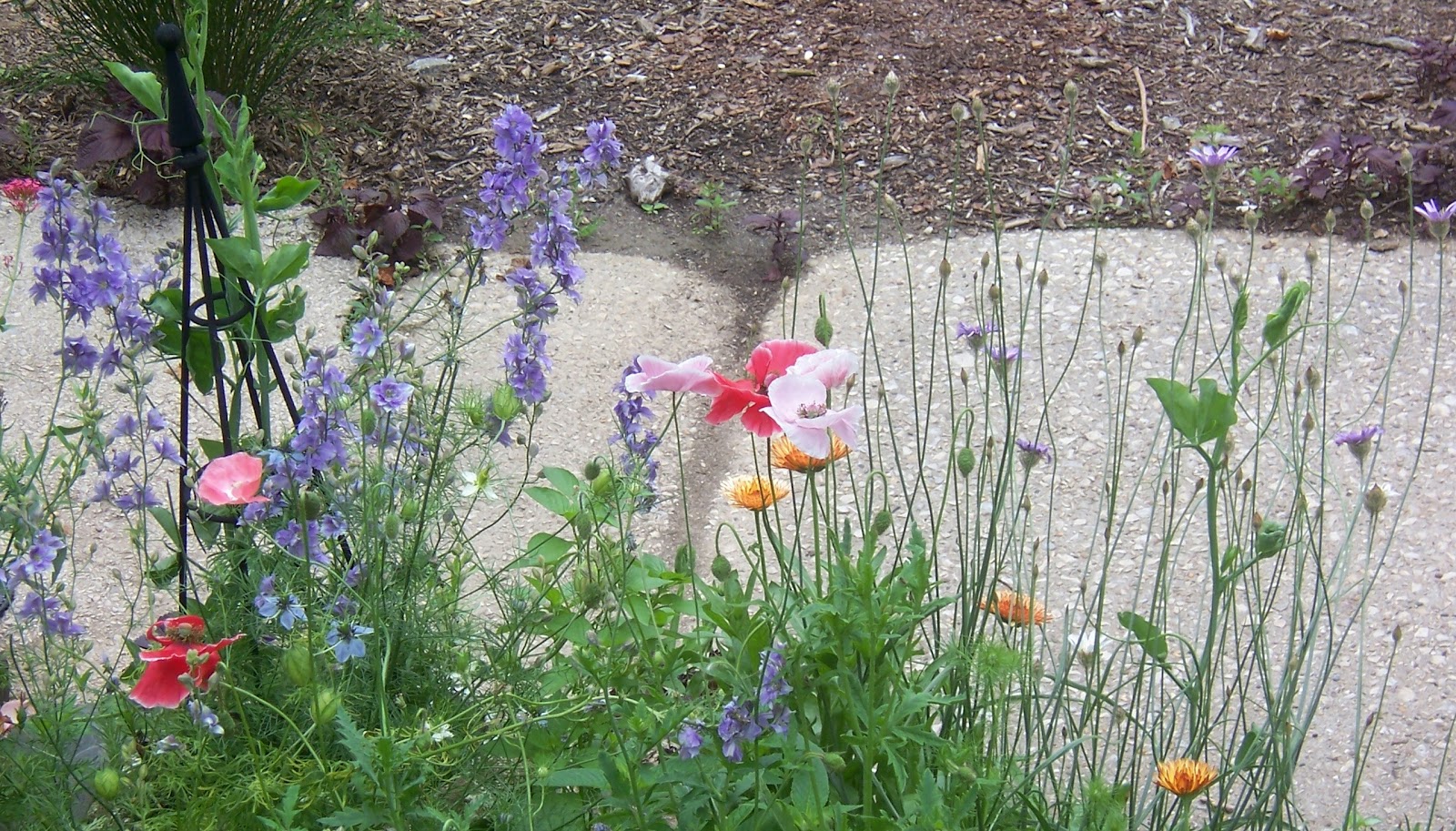
Every year in late winter I throw a lot of seed around. An illustration of the results is on the left. It shows three of my favorites,-- larkspur, poppy and pot marigold. Winter seeding brings lots and lots of  summer flowers.

On the right you can see these three, with sweet pea thrown in, filling in between the perennial Cupid's Dart, Coneflower and Lavender.  One of the people whose questions helped inspire me to write this blog wanted to know how I managed to have such dense planting with so much in bloom. Annual seeds are part of the answer.

To look good, most perennial gardens need to meet three needs: 1) they need to have a succession of abundant flowering and/or interesting foliage that lasts from early spring to late fall, 2)  week to week, with whatever is in or out of flowering, the garden needs to look visually balanced as a whole and 3) colors should not clash, nor should there be too much of any one shape of flower or leaf texture together, nor should the rise and fall of the overall composition of the plants be too uniform and boring.


Can you imagine trying to figure this all out logically? What a boring nightmare! Luckily you do not have to. You do need patience, some intelligence and a decent eye though. And an ability to throw seed on the ground.

Every year, all through the year, I take time to look at my garden and mentally note what is not working. Then, in spring and fall I transplant or plant as needed and every late winter I throw seed at bare patches. It makes for a dense, vibrant look that pleases me and many others. Plus, it does not take much time or money. Seeds are cheap.

How did I fall on this solution? Not by looking for a solution but by following desire.

16th century Belgium tapestry in the V & A, Creative Commons
Since I was young I have felt something strange, wonderful and good in the atmosphere I picked up from the style of some late Medieval, Northern European things. It's a style that shows in the interlacing narratives of the Arthurian romances and the flowery meads (see above) depicted in the backgrounds of miniatures and tapestries. It's a style with a delicate, graceful strength that to seems to quiet and transmute the arrogant and aggressive tendencies of its day.


As a decorative style it is called Mille Fleurs, a thousand flowers. I have no meadow clearing to dedicate to it. But I do have bits and drabs of a garden. And so it was by searching for an ideal that I discovered a highly practical reality. By using seed for old fashion annuals, and by allowing as much self-seeding as possible, I had figured out how to balance the garden thru the whole growing season, while filling it up to its brink.

But then I usually throw out the seeds while it still feels like winter. Is it too late, this spring in winter that feels out of time? I hope not. I need the frail, brilliant beauty of  poppies. I need their delicate, graceful strength.


----------------------------------------------------------------------------

How to Seed:  O.K., so I extravagated a bit about being able to throw -all- the seeds. Poppy seeds you can throw and maybe larkspeare. Sweet pea you really plant in. Most of the others you just barely cover. Take your finger, indent a trench about 1/8 of an inch deep, dribble in the seeds, dribble over some earth, done. Its that easy if...the ground is damp. Do it right after, or right before, rain.

Saturday, January 21, 2012

Wissahickon Style III, The Comfortable House

Post 24
Mansions, castles, etc. look great on the outside. In fiction, they are easy symbols of the multi-facited self. But in real life, would you pay to live in one?

Winchester Mansion in San Jose, CA
Too big and crazy ass to be comfortable, wouldn't you say?

People make fun of the midsize, comfortable house. Yet, in it's own way, it's close to perfection. And this area is replete with them.


                                                Here is one I love for its complex simplicity.

 I like the rough walls against the smooth door frame and the play of its shapes, rectangles and triangles. Your eye can break up the space into regular or irregular units.

The windows of the first and second floor are differentiated; the upper ones wink out from under indented eyebrows. The set-forward, right entrance rectangle feels like its upper window is dragged down by low ears, and then, to the left, the less formal, sideways rectangle opens up the space between the two stories. Compression and release.

I like how the colors work: drab stucco, pale limestone, bright blue wooden trim, blue-grayish slate roof and verdigrised copper piping. 

It looks like a good house to live in, solid and unpretentious, understating, yet stating, both virtue and style.

 Here is another one I like. Is it typical Stockbroker Tudor? Sure--but its a well done example.

This one feels like a house out of a late William Morris novel. It would belong to a hospitable yeoman with the sacred well right around the corner.                   

One thing I like is how it is landscaped. The curve of the right window is echoed  in the curve of the driveway and the raised hydrangea bed. The greenery seems to flow down from the house to the valley below, solid angularity contrasting with curves.

Both of these house share variegated blue-greyish slate roofs, limestone frames,verdigrised copper details and blue trim-- which I only realized after taking pictures of both of them. So here is one more house, more humble in materials and irregular in structure, to show I'm not too narrow in my tastes. But yeah, I do think it would look better with blue shutters.


Wednesday, November 16, 2011

Wissahickon Style I, or the Humility of Corydalis lutea, the plant money can't buy


Every place has its own feel. And the factors that go into this feel are too complex for rational analysis. No instrument can measure it; only human intuition is complex enough to process it


It's what the ancients called the Genius Loci, the intelligence of the place. If you garden in harmony with it, it will do the really hard work for you.

In Chestnut Hill/Mt. Airy/Germantown, with our Arts & Crafts Wissahickon Schist houses; acid, clayey soil; tall trees and the remnants of slate roofs and sidewalk, a distinctive style has spread without any trendy style guru laying down dictates, although a generous founding family has and does exert a benign influence.

Overall  it is a style that has evolved with the community through time. I love that, I love it and I love that folk-styles, of all sorts, can still exist in this product-driven ( fallen?) world.


Once this area was grand, where Philly's richest, (and those who strove to be its richest,) built. It was a shiny modern thing--a railroad suburb. Time has worn down the shine. Now it is home base for a combo of comfortable professionals, bohos, civil servants, middle and working class and the remains of a true American gentry, whose trust funds may not be what they once were,-- but whose taste is.

So often things are just a tad shabby. Items in the garden may look inherited, whether or not they are.You can always refer to wear as patina.


The Arts &  Crafts  influence (many of the houses were built 1880-1930,) comes in various substyles: Norman, Cotswold, Colonial, Queen Anne, William and Mary, Dutch, Carpenter Gothic and Italianate. Add to this some earlier houses, some Frank Loyd Wright-like numbers nestled into hillocks and brick rowhouse construction from Victorian times till post-WWII. None of these styles are pretentious. Some, if kept up gleamingly, may whisper wealth; none shout. One of the common factors to Wissahickon style is its mix of beauty with a comfortable lack of pretension.


"Homes built in the Wissahickon style of architecture are inspired by the vernacular architecture of France, England, and Colonial America ... They use native materials, such as Wissahickon schist, in their construction and native plants in their gardens...It’s very attractive, but it also makes sense ecologically,”  

Remark by historian David Contosta, from story in the Springfield Sun, Mar 24, 2011


When the houses have grown into the land, or the land has grown up around them,--and especially when its hard to tell which -- you've hit Wissahickon style paydirt. And in some corner or niche, you are likely to see a  humble, local weed/ flower. People who evaluate things by cost call it a weed, I call it an overlooked, undervalued treasure. Since it dislikes being potted up it usually spreads by seed, not sale. If you do not have any of this gem, yellow corydalis, just ask around. Chances are it modestly grows somewhere near you, peeking out of a crevice in a wall or from the underside of a step.

Its bluish, ferny, feathery foliage comes up early and leaves late. It blooms for months  in the spring and months in the fall; mid-summer it sulks and wishes it were north in a mountain glade. Each plant is short lived, but since it replaces itself so readily you are unlikely to notice this.  It is as good as a catmint or hardy geranium for underplanting larger, showier plants.

The nursery business has developed a slew of blue- and purple-flowered versions that are almost too lovely for words.  The bad news is that they are pretty finicky in our clay soil and high summer humidity. They are also expensive. I got a purple one, Blackberry Wine, to last for 3 years, but it never reseeded, which just did not seem right for a corydalis. There is a lovely, wispy biennial native form, Corydalis sempervirens, which has a pink and yellow flower and pines for mountain glades. There are also a host of yellow or white corydalis that the Brits grow as garden plants and which show up on sale from time to time. They are usually worth buying.
--------------------------------------


How to Corydalis.  Yellow corydalis or Corydalis lutea, likes semi-shade best. It will take full sun in spring as long as some foliage emerges above to provide relief during the hottest months. It can take full shade but does not like being directly under a tree or within the dripline of a house since it needs some moisture. It has an affinity for stone, liking soil a bit more alkaline than ours usually is. So if you have a wall, path, stairway, court, alley, well or edging in schist or slate, that is a great spot for it. The roots or corms (its rootstock looks like geraniums',) often break off, so transplanting is best done with tiny seedlings, not mature plants. And those tiny seedlings, once they come up in spring, will be large and billowing by fall. In fact, one is still blooming in a wind sheltered part of my garden.

Thursday, September 15, 2011

Garden Story with Hydrangeas

 Post 7 

If Cleome is for history, what is for story? And, how are garden and story alike?


In literary works, it's often the atmosphere, the mood of a piece that is remembered. An atmosphere, created as much by the author's prose style and choice of metaphors as by plot, theme or character, is like a visit into an exteriorized consciousness. It can be what can makes us love an author's work even if it isn't always successful.  How stories are told is what matters.  Gardens are like that too. They have moods, modes, spirits, that self-reveal within their larger context, so that gardens experienced become like stories told, poems recited, songs sung.

Below is my garden's story. Garden design-wise, what my garden lacks in planning, lists and drawn-up diagrams is make-up for by a fable.  Changes made in the garden work if they are congruous with the story's vision. It gives me, and the garden, a flexible, open structure, around which to grow

  "Once upon a time there lived an old woman in an old, stone house in Northwest Philadelphia.  On weekdays she would take the train to East Falls, where she taught Baroque Literature at Wissahickon College. But on weekends, vacations and those long summer evenings when the light wouldn’t go away, she made a garden.    
Mophead Hydrangea new, with Cranesbills and Ladies Mantle 
And what a garden it was. She packed it with every possible flower. She induced the plants to flourish so that they grew, climbed and tumbled into intersecting layers, too complex for the eye to take in all at once,  so that, by overfeeding the senses, it simultaneously quickened consciousness. It was so beautiful in growth or decay that it made you feel that somehow our world was more wonderful than you had previously imagined it, all meadowbright with possibility and discovery.  It was a magnificent garden, and as you may have guessed, it is not the garden that you now see.


Mophead Hydrangea old
For one day the lady, after decades of being old, went away. No one saw her again. New people came and lived in the house with its garden, and then even newer people. None of these people have gardened like the old lady. Still, the garden, messy and half-wild, has thrived. Though not as beautiful as it once was, it has persevered and so, prevailed.  It has continued, much like an old hydrangea blossom, its early sunburst of unearthly blue muted into petals mottled by mauve and green and aqua-like light.
Mophead, old, with Acanthus and hardy Begonia
A girl who had grown up int he house and played in the garden knew there was something unique about the garden and that it had to do with the garden’s shape. And love of course. Because a child would say that love was involved. That somehow the old lady’s love had seeped into the place.

And indeed, the garden, beneath its wild plantings, does show a distinct pattern. You can see it most clearly in winter. At the center stands an urn that is surrounded by four, sphere-topped columns arranged in a rectangle. A plaque on the urn read, “Quincunx/Lambda.”
No one knows exactly what that means. The first word is Latin, the second Greek, and few even try to guess why these words would be put together.  The child has grown up, and now lives in the house again and tends the garden.  And when she gardens she feels as if, time and again, she is bumping up against some invisible, solid, buried form, that is revealing itself, slowly but ineffably, a sign of she knows not what. 


-------------------------------------------------------------------------------------

How-to: Mophead, or Hydrangea macrophylla, is one of the most popular members of the hydrangea family ( Oak-leaf, Lacecap and Pee-Gee are also much loved and thrive in our area.)  Historically called Hortensia Hydrangeas, French Hydrangeas or Penny Macs, Mopheads are originally from Japan. They make a big-leafed, water-fond bush of about 5 feet that is happy in sun or semi-shade.


One of the fun things about Mopheads is that many varieties (though not all,) can bloom  pink, blue or purple, depending on the pH of the surrounding soil. To get the blue end of the spectrum, you need very acidic soil with aluminum in it. This is not too difficult in the Wissahickon Valley, since most of our soil here is naturally acidic. This is often not true, however, around the foundation of our houses, where leaching from cement and other building materials can over sweeten the soil.  I have 2 Mopheads up against the house and use Espoma Soil Acidifier to blue them. If that dosn't do it --try throwing some cheap aluminum nails into the soil around the bush.

If you want pink you need to do the opposite. Add lime to sweeten the soil, then--if you use chemical fertilizer, use one with a high phosphorus count; phosphorus blocks aluminum intake. I have less experience with this -- for me, the bluer the Mophead the better. One year I had one that was almost turquoise and am still trying to duplicate it.

Most hydrangeas tinge towards russet as they age. Some then pale into beige and sand.  You can also trim the heads off when they're still fresh and hang the heads upside down in a dark place to dry. They look good in dried arrangements. A spritz of hair spray will keep them from crumbling too soon.

It used to be that all Mopheads were prone to losing buds to freezing and thawing in winter, and therefore might not bloom come summer. "Endless Summer" and other like varieties have put an end to this problem, since they bloom from new spring buds and are dependable. They cost a bit more, but are worth it.

Tuesday, August 23, 2011

The Ease of Coneflowers, or Gardening's Dirty Secret

Post 5

Hey, most of gardening's secrets are dirty; it goes with the territory. Yields good results though.
Coneflowers with Red Maple
The big secret?  It's that very few people garden the way garden writers tell us to garden. We are told to learn about plants, prepare our soil and design a garden before putting a single plant in. We are told to hire experts or buy garden design plans . This message sometimes suggests that gardening is a dangerous activity apt to blow up in the unempowered novice's face.
GardenDesign

Well, people seem to really like my garden and I've never hired anyone or used any plans. I also knew very little when I plunged in. Most people know very little when they plunge in.

This is how it worked --I hated my new front yard's sickly grass even more than I hated its boring pachysandra. So I thinned out some of the pachysandra, and transplanted it to where I'd dug up grass. Then something inside of me felt an irrational tug, a temptation towards lights, colors, action! Friends of mine had flower gardens, why, why...not me? So, inspired, determined and deluded, I tromped off to the nearest box store to buy cheap flats of annuals. I put them in. Instant pizzazz. Positive feedback. I was hooked.

Coneflowers, Phloxes, Rose, Verbascum, Petunias
Now here is where friends and family came in. They offered me plants, not just the annuals of a summer but hardy perennials that came back every year. They gave me advice and encouragement. I learned where to put things. I learned to water. Bought perennials on sale. Took out library books on plants. Played around on the Internet and discovered a haven of good advice, Garden Web.


Piecemeal, it all came together. When I saw something I liked, I bought it and put it in where I had space. If it didn't look right I moved it or divided it. Sometimes I killed it by mistake, learning as I went. But after a few years-- there was not a bit of pachysandra or grass left.

Coneflowers and Daylilies


Your best design tool is your eyes. Just keep looking as you go. When things don't look right, change them till they do, till your gaze feels drawn in, welcome, happy to rest amidst the abundance. Its not rocket science; its gardening. So, if you don't much mind the exercise, or being outside in gorgeous weather or delicious smells or the feeling of cooperating with nature, you will look up one day while gardening and find that-- you have made yourself a garden.

So the dirty secret is that garden-making is not difficult. It is as if nature wants to cooperate, is happy to do the hard work for you. Non-perfectionist gardening is like one of the easiest, prettiest plants around: coneflowers.  They are the pink, daisy like flower in all the garden pictures.  And all they want to do is grow.

And if you do not believe me about making gardening easy, then believe these Handy Tips by Felder Rushing from his helpful new book, Slow Gardening

------------------------------------------------------

Coneflower, or Echinachea purpurea, is native to American prairies and so likes sun, good drainage and moderate water. However, it is a sturdy, highly adaptable plant; it will also take part shade and amended clay soil, but not damp soil. It has a good 6 weeks of bloom, usually from early to late summer, and, contrary to its Latin color name, is usually a lavender pink ,with a fat russetty domed center (that does look like a curled up hedgehog aka, in Greek, echinos.) It is easily divided, self seeds readily and can handily be grown from seed as long as the seeds have a period of cold. Because it is so hard to kill and because to have some coneflower means to soon have more coneflower, it is a perfect pass along plant, a good gift to a new gardener. There are many fancy varieties in wonderful colors: white, red, orange, magenta, yellow, bicolor and green, but they are less likely to seed or spread. Usually two feet tall , and with many 4 inch flowers on just one plant, it is a useful, easy, beautiful addition to most gardens. And , as a bonus, goldfinches seek out its seedheads for feasting. For information on its possible medical properties, go here 

Tuesday, August 16, 2011

Mistakes, or the Misplaced Butterfly Bush

Post 4

Mistakes: you will make them.


Can you spot it? It's that blobitity lump of silver-green smack in the middle front. A Butterfly Bush I was deluded enough to think would stay small. It didn't, ruining an otherwise successful rock garden.  Plus, the bush's mass confuses the flow of space; instead of drawing the eye in, it pushes the gaze out. Which irks me. Part of me wants the garden to be better, perfect, a sort of garden porn. 
 
Do you see the problem here? Red myrtle, red maple and ... invasive Lythrum salicaria, aka Purple Loosestrife. In England it is a lovely, manageable garden plant.  Here it destroys rivers, clots streams and chokes wetlands. I must pull it out. Which hardly seems fair since I did not plant it. The wind and rain did. But it's my responsibility now.

The words humus, humility and human are cognate. Sometimes, as I garden, it feels as if humility is seeping up into me from the humus. And it feels like strength, not weakness, a beatitude of the garden.

"Imperfection is in some sort essential to all that we know of life. It is the sign of life in a mortal body, that is to say, of a process and change. Nothing that lives is, or can be, rigidly perfect: part of it is decaying, part nascent…And in all things there are certain inequalities and deficiencies, which, are not only sources of life but sources of beauty." Alvar Aalto


The Butterfly Bush is now in bloom, and true to its nature, it is making the butterflies very happy. It will bloom, on and off, from now till fall, when I will transplant it to a better place further back in the yard. It will still please the flutterbys, but also contribute to the overall beauty of the garden.

The beauty I want to create is a different kind of beauty than the usual, temptingly-perfect garden porn.  What I want instead, is a sensuous expression of the integrity and inter- and outer-connectiveness of a particular environment.  For me, to garden is to find and express a presence, an itness, a balance of energy and order of being, tempered to a loved and local, time and place. 

"Presence is why we love what we cannot eat or mate with... Presence matches our speed; thus it seems not flow, but all arrivals— The beginning mirrored everywhere. The true indictment. The end all through the story."  Les Murray in "Sunflowers"
++++++++++++


Addendum--posted the above yesterday and this morning noticed that a spider had thrown a guyline from the pink coneflowers (you can see them in the bottom pic,) to a stem at the back of the bush.  This pleases me, since around here, garden spiders are good news. They are nonpoisoness and eat mosiquitos and other pests. ---------------------------------------------------------------------------------------------


How-to: Butterfly Bush or Buddleia davidii, is hardy in our area and easy to grow. It likes sun and some water (but not bog,) will survive drought, and depending on the variety, can be anywhere from 3 to 12 feet tall. The trick is to remember to prune it in the spring, not fall, and only after you can see the beginnings of new buds. For the most blossoms, prune the stems down to about 6 inches. If, however, you want to encourage height, you will still get some bloom if you prune it up higher. It can make an attractive, overhanging backdrop to a sunny or even slightly shaded border. Besides the lavender-blue pictured above, it also comes in a wonderful dark purple, white and even some reddish and orangey shades. It is a dependable, unfussy plant, but can look awkward if badly placed (duh!) or if left undeadheaded after blooming, since numerous curly wands of brown decay can be a hard look to make work.