Showing posts with label Imagination. Show all posts

Friday, November 2, 2012

Wissahickon Style VIII, Smaller Hidden Kingdoms

Post 55

Hidden kingdoms can be hidden in plain sight. Like here, with blue Wolfsbane receding behind bramble and pink anemones.


I was lucky that I had parents who knew how to look for beauty and who taught me the habit. So when I come out of Weaver's Way in Chestnut Hill and am loading my grocery bags into the car, it is not unusual for my interest to be piqued by this...

  
Hmmm, what is the old stone wall from and these ruined buildings beyond.  And beyond them,  is that a charming garden I spy?


There is something about an expanse of old wall that excites curiosity.


What is this stuff and how did it get into contemporary, built-up Chestnut Hill?

So, imagine my pleasure when I was garage sailing one morning and a lovely, gardening couple allowed me into their back yard, where I was lured forward by lulling sights like this...


To turn to one side and see...


That I had stumbled upon one small hidden kingdom without even knowing it.  For here in this charming garden that I had hitherto only imagined,  lay a reality far more charming than I had been able to imagine.


The gentleman of the couple explained to me a bit about what he had heard about the ruins. Once a farm with its own s smokehouse (which explains the barn-like structure,) the property had been bought by Ruth's Funeral Home, where in that very smokehouse, they stored the cold dead bodies.


So--Boo! Ha! And  doesn't this recent discovery make for a perfect All Souls' Day post?  So the next time you're at Weaver's Way and see that quaint old barn thing...

Remember that the lovely body you are filling with such healthy food is but a bit dust and ash in the long haul!

And that some think something may or may not lie beyond. Of which we can not discern much. But rumor does ascribe great beauty and even greater charm to what, for now, we can at best only imagine.

 So prayers now for the beloved dead, if that is your wont. And isn't that a neat lamp on the back of the smokehouse? And, yeah, yeah, the light beyond, etc. Had no idea I was going to go all symbolic when I started this post. But the metaphors just seemed to line themselves up.
-------------------------------------------------------------------

I got to be part of a Halloween celebration that entailed wearing a costume to work. I work in a complex place and it was a complex costume --having something to do, I think, with Katherine Hepburn and time travel and the makings of: a currently mislaid, silent movie from the twenties that inexplicably stars an almost 60-year old Hepburn; "Bringing Up Baby, " and; "The Madwoman of Chaillot."  To stifle my usual long-windedness  I nicknamed it for the feminist literary crit. classic "The Madwoman in the Attic."

And while I rarely show myself in this blog, I figure this isn't really,  me-- so what the hey? Therefore, mix well this small dusting of ash with a big pinch of salt.




Tuesday, June 12, 2012

Chanticleer, or Wonder at the Call of the Dawn


 Post 42

Is the wish to share wonder the first stirring of art?


To combine wildness and order, light and shade through love so that you can share the inklings and glimmers of infinity that fill you, and seem to overflow from you?

Welcome to Chanticleer.


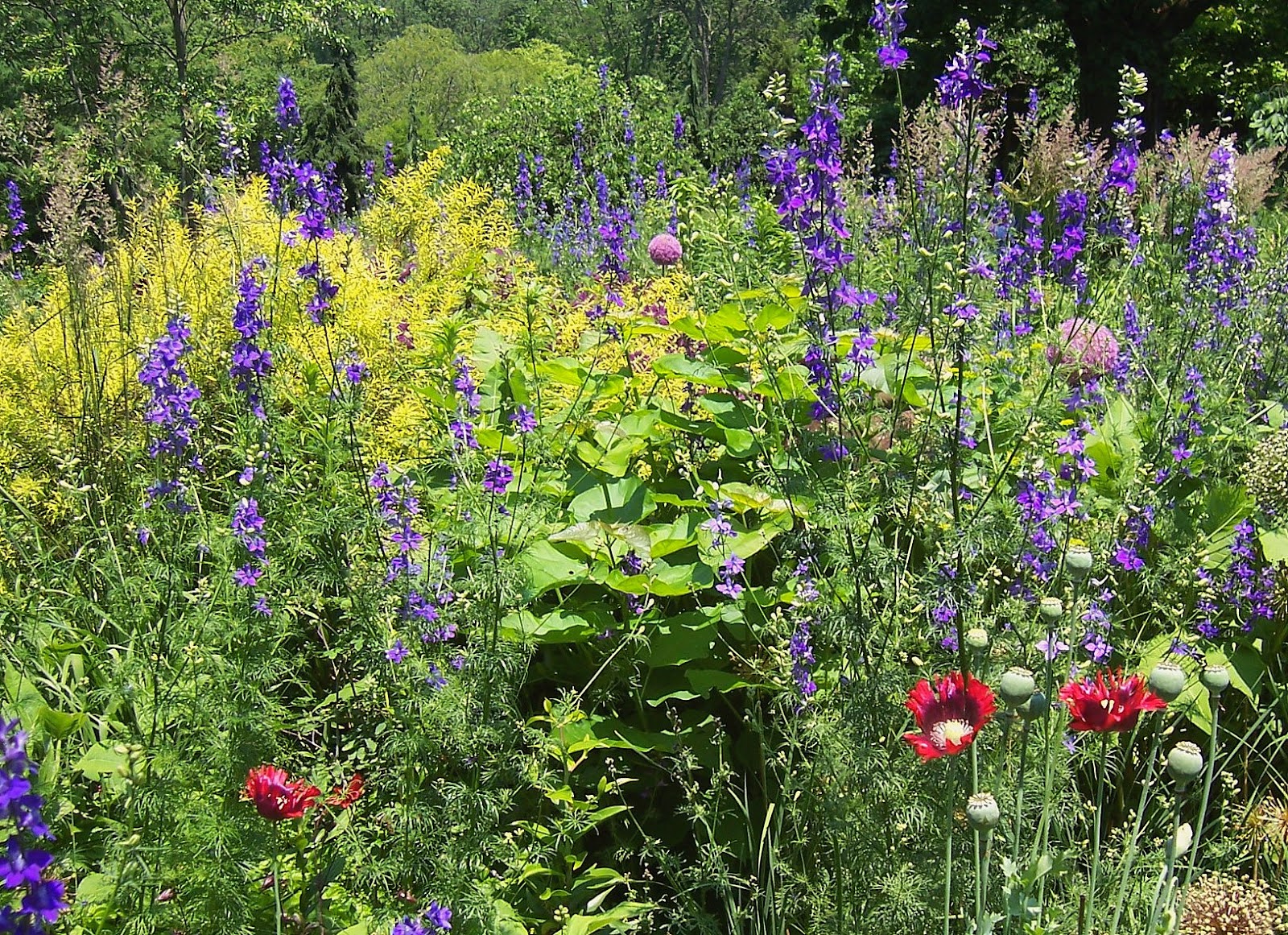
Chanticleer  is an extraordinary pleasure garden on the Main Line.  Chanticleer is named after a rooster who shows up in Northern European folklore. a rooster like the one emblemed on top of this pool houses.


How do you communicate moments of wonder, when your senses seem to be taking in more than they can hold? Like at first light, when out of nowhere, emerges the rich complexity of reality.


Go to Chanticleer, walk around, maybe sit for a bit.


Such beautiful, expansive and witty public gardens, 'built solely for pleasure', are a blessing of this area. Within a few hours or less you can reach Chanticleer, Longwood Garden, Winterthur, Scott Arboretum , Morris Arboretum, Mt. Cuba , Wavehill, Brooklyn Botanical Gardens New York Botanical Garden and others. All of these are inspiration on many levels,


So, if you are lucky and willing, here are dawns, foretastes, or deep tastes, of what reality might be, or could be, or is, at sublime moments of joy and awe.


When everything mixes up at levels of complexity beyond human reason, but not beyond human experience, imagination and art.


Perhaps it is what Coleridge called Reason. Or not. Perhaps something else. But whatever it is, it includes the wonder that overflows and makes people make things.


... gardens, emblems of possibility, if you can just let its pleasures reach you. 


P.S. --Apologies for the pics, which do not do justice to this great garden. It was mid-day on a sunny day when I was there, and that is a hard time to get decent shots.

Sunday, April 8, 2012

Resurrection: Night and Day


Post 33


Resurrection: An easy, yet not easy concept to grasp.


What would it be like to be resurrected into a new life where everything was the same, but different. Different in a fully-embodied, liberated, amazing way, better than your best dream, on the edge of unimaginable.


What would the moment before resurrection be like?


What would death be like?


We do not, cannot know.


But life we can somewhat know.  And new life we can guess at, imagine, perhaps even experience for blessed instances within our present mortality. Instances that are an earnest of a greater, deeper reality from which we have come, and to which we go. Ancient poets have written of the tears in things, but sometimes I feel as if there is a greater happiness just beating within all things, just waiting for the joy that is theirs, and ours, truest inheritance of all.


HAPPY EASTER!


Wednesday, March 7, 2012

Lungworts and Hyacinths, or Breathing Happiness

 Post 28


Green stalks prod their way up through soil seeking... what? If plants could feel, what would it feel like, pushing your way through earth for reasons you do not know?  To break through and feel something unexpected, such as light, course into your pores as photosynthesis, energy, begins. 

It probably would feel like what we felt, when as infants we pushed our way out to take in that first gulp of air, a substance for which we had no anticipating concept. AIR!, Strange, improbable, undreamt of air. Surprise! Of course we cried out, then quieted, finding a rhythm in this new thing breath. And rhythm we knew from our mothers' bodies.

We can't remember..., but we can imagine. Nature, thriftily-extravagent, uses similar processes at different levels in different ways, allowing for some imaginative analogy, empathy in context.  And gardens,-- where skill, comensurate with sensitivity, developes, --are great places for imagining. Enhancing sensitivity and imagination is one way gardening can change the gardener.

To breathe the air, to feel light, to enter a different state of being, how did we ever survive the shock? Well, cause not everything changed, there remained the lilt of known voices, touch, being held, tenderness, states we came to know as love and trust. From these, with these, we could grow to find pleasure in strange new things such as light and air. 

Here is the beginning of the pink Lenten Rose at the crest of the old buried staircase. Only one stalk is blooming, facing down towards a Lungwort which is about to bloom.

Lungworts are usually grown in some shade and therefore aren't usually this early. But I grow grey-leaved ones in sun. Older strains have greener leaves and need more shade. 

The reason the plant is called Lungwort is because its spotted leaves were once thought to resembled lungs. The flowers are the breath, the leaves are the lungs.


It's right there, isn't it?  It's a world I hardly knew existed before gardening. As a gardener, I've learned so many things -- sensitivity and skill, patience, respect, cooperation, and something else.  Something very like an everyday ecstasy. 

“Flowers and sunlight, air and silence—‘luxe, calme et volopte.’”  Patricia Simon

It comes to different people in different ways. For me, it's after I've been working in the garden for awhile. I'm physically tired but alert. So I lean forward or back to preen this frond or that and there it is, a stillness, a lively, peaceable calm. It is like the smell of a hyacinth as you walk down a busy street when, for a moment, everything else disappears, or rather, becomes more real.


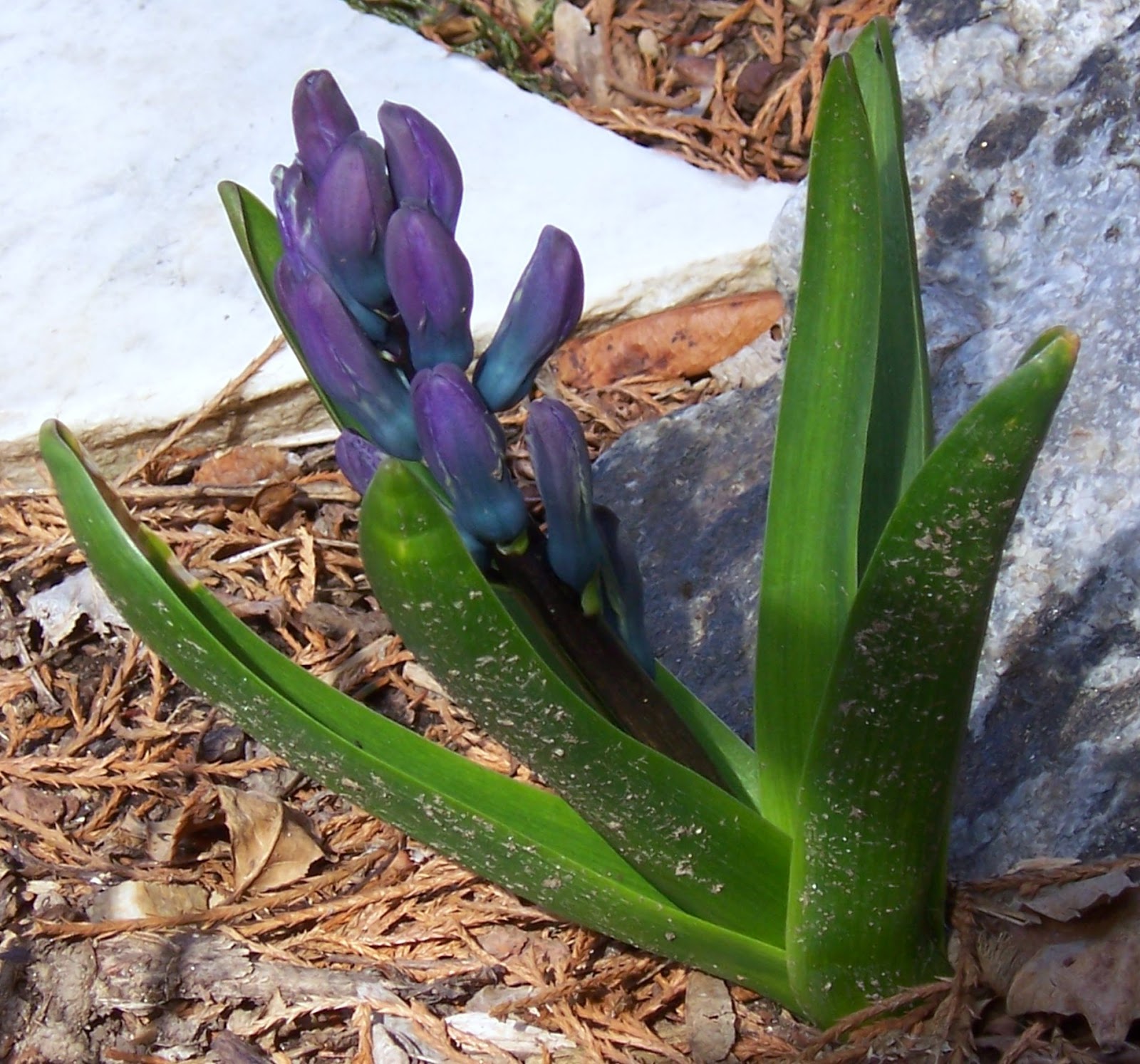
And you are a child again. A hyacinth has been placed on your windowsill for Easter. You watch it grow. At first it is a stalk of dark, deeply purple, secretive shells, like a long row of muscle shells fastened onto seaweed on the beach at tide-turn. Then the purple lightens, the shells slowly open  and they aren't shells at all, but tender, pliable flowers. And the smell, the smell is like nothing at all, or everything. It is everywhere, it is nowhere, it is Air. And as you  breathe it in, it is a delivery, an earnest, on the strange promise of that very first unremembered breath.

_______________________________________________

How to Lungwort (another great plant that easily grows around here): If you have shade or sun, like blue, purple, pink  or almost white flowers, this is a useful plant. Lungwort, or  Pulmonaria grows from rhizomes and needs moisture, especially if it gets a lot of light. Part of its appeal is that it blooms for almost two months, its escalating flowery bits growing ever longer. The best thing to do for it is to cut the flowers back hard before they are fully done blooming. So at about six weeks clip back as much of it as you can: flowers, stems and any tatty leaves.  If you do this new leaf growth with proceed nicely and you will end up with great foliage plants for the rest of the summer. If you do not cut it back when it needs it, I have found that it can  droop, get mildew or even die, especially in sun. It is as if making new leaves while keeping up the old stuff is almost too much for it  If you want more plants, and you have a variety that makes viable seed, just shake a handful of spent stems over a moist bit of shaded earth. Next spring you will have babies to transplant as you wish.


Most writers tell you not to grow Lungworts in clay, but I have found they do fine in my only slightly amended clay soil. So just make sure they are in somewhat well-drained soil, not pure clay where the rhizomes can rot. Many of mine are on the slope of a hill, which must help.


Hyacinth a few days later

How to Hyacinth: Hyacinthus Orientalis is a bulb that has been bred from the wild Hyacinth, a native of Turkey. As with most bulbs, plant it to a depth just a little deeper than its own size in the fall. It will bloom for a short time the next spring, and if you are lucky, again the year after.  For all that bother though, the powerful sweet scent is well worth the effort. The blue/purple flower, versus the other colors, is perhaps the most treasured of all; it stands for sincerity.

Full bloom
.  

Wednesday, February 1, 2012

Roses in February

Post 25


It may be warm,  but it is bleak and the garden, well... see what I mean.

I need a rose.

Yes, that helps. It is not easy to write a gardening blog in these months, especially if you want to avoid the usual winter cliches. Looking at the local architecture that holds up our gardens, cradles and rocks them, is a partial solution, but not an entirely gratifying one. The light is hard, the buildings unsoftened. I need more roses.

Yes, better.  One of the drawbacks of bleakness, which feels like nature's boredom, can be a lack of solid inspiration. And without real inspiration I may start to extravagate (no, not a word but should be (OED--pay attention! (Like Auden, one of my dream aspirations is to coin a new word and get it credited there; unlike Auden, it's a dream aspiration.))) To clarify, to extravagate means to unthinkingly exaggerate to a point almost past truth (though a kernel remains.) It lacks malice but remains an easy temptation for those of us who are of imagination a bit too compact. Itself an example of extravagation, it is a word that I made up in High School without realizing I'd made it up. I extravagantly extravagated exaggeration into extravagate. 

In short, in my last post I extravagated. I dissed mansions and castles. I do not really dislike them, just the more money than taste ones. 

And now, keeping on theme,(yes, there is a theme,) I am going to slip back towards an earlier post, "Roses in January," and fill in some information I did not include in the earlier post on The Red Rose Girls.

Below is a picture of Cogslea that shows more of the house and less of the caryatids.


And here's one of Cogshill from the back


The pergola at Cogshill.


And here is a relevant illustration from Elizabeth Shippen Green's scrapbooks at the Free Library of Philadelphia.


Last of all. I want to credit the source of most of my information on The Red Rose girls. It is the book,  The Red Rose Girls: An Uncommon Story of Art and Love by Alice A. Carter, ISBN 978-0810944374.

And I also want to add a caveat, that this is an informal blog. Like informal correspondence and other forms of informal writing, such a blog is not meant to be read as a solid reference source. I try to be accurate but I do not fact check everything. For instance, I made a mistake about Edith Emerson in my earlier RRG post. I have gone back and corrected it as I value accuracy.  At times however, I can find even myself a bit too transported by the act of writing, and end up extravagating reality's rose into a slightly stranger flower. So please, take this with a grain, though not a bucket, of salt. I know I do.

Thursday, September 8, 2011

Chicory and the Flora of the Imagination

Post 2
Roadside Chicory and Queen Anne's Lace from wildeherb.com

Right now, in this heat, the flora of the moment is Chicory, that supposed weed, a lavender blue dilly blooming along roadsides, robustly blooming because its long taproot descends down into the water table.

The Bookish Gardener has a wonderful entry on this flower, quoting gardener extraordinaire Henry Mitchell, which confirms my suspicion that this is a weed worth reckoning with. It is beautiful, it is edible, it can be made into coffee. But because of that long taproot, it dislikes being potted up, constrained and commodified. It must be grown wild from seed or it perishes.

You have to admire a plant like that -- though there is none of it in my garden. Because my garden is a real garden and has constraints. It's a small garden and chicory likes a wide swathe to spread out. So it only thrives in my imaginary garden, one I garden just as resolutely as I garden my real one. For in my imaginary garden go all the ideas, plants and opportunities for which there is no room in reality.


The Secret Garden, from Project Gutenberg
  
This secret dream garden is important because it is the backbone of the real garden. From it you can draw out a wisp of an idea, a possibility, and tend it into fuller reality. Like a real garden, you need to cultivate its soil, achieve tilth, find fertility. Without an imaginary garden, your real garden will be a collection of plants skillfully arranged.

 Some gardens seem to have an extra shot of life in them, a vibrancy. It is a quality hard to describe and even harder to achieve, but, like pornography--you know it when you see it. Great gardens have it. And part of that greatness comes because you can catch a glimpse of the dream garden within the real one.

So now, the more I think about it, maybe I should  try a stand (no room for a swathe,) of chicory next spring out along my hellstrip. I imagine it would look mighty good come next midsummer's heat. and it would make my dream garden that much closer to the one I actually tend. Which would make me happy. And that is another secret identity of the garden.  That it makes you happy.

Dream Garden by Maxfield Parrish and Louis Comfort Tiffany