Saturday, May 25, 2013

What Makes a Style?


Post 75

Why do we like what we like? This week I've realized how much exciting times from my childhood have shaped my sense of style.

My small garden does not follow the usual  good taste model, that of planting in large drifts, with many plants of the same variety planted together. Large drifts work well for larger gardens, but for me, it can get boring in a small one. My eye needs to roam. It needs to be drawn in and then drawn forward,  moving in expectation and delight till it takes its moment of rest at a particular cynosure, only to re-energize and take off again.


 Part of my inspiration has been country meadaows, part late Medieval millefleur tapestries, part has been Fleur Cowles illustrations, but I've just understood another big, and highly unexpected influence: Lower Manhatten.

Growing up one of the most exciting things I could do was visit my Dad at his office in Hanover Place near Wall St in Manhattan. Which was very different than the city where I lived and spent my usual days.

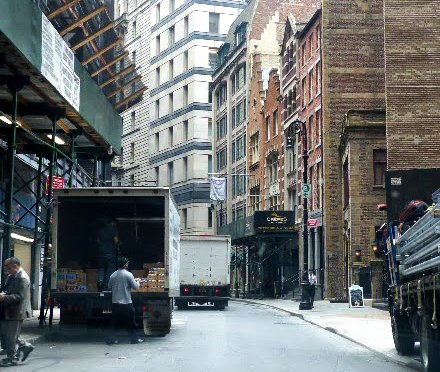
The city I knew was the spacious grid of the East Side where light shone thru wide canyons that opened up in logical right angles. It was a spacious, rational, prediciteble world where 65th Street followed 64th, where the blocks were all the same size and views were long and  unobstructed. But down around Wall Street was a different world.


 The streets were small, cantered and illogical. The buildings were all over the place and almost seemed to be falling over each other.


This new, hodge-podge city was wonderful to me because I was with my Daddy and it was his world.


Everybody knew him, many called him affectionate nicknames I'd never heard of. Through good and ill it was his kingdom. He loved it and came fully alive there.


Above, you can see him as he is today, or rather as he was a few days ago, on his 100th birthdy, when he rang the closing bell at the New York Stock Exchange. He, I and the NYSE are much different from what we were when I first saw Wall Street in the late 50s, early 60s -- but the geography of the place remains the same. And now I am old enough to be conscience of its past and present effect on me, and how it has perhaps inspired and strengthening my delight in fetching disorder.


So perhaps this is why, whatever I'm creating, it will usually have a combination, a balance, of order and disorder. My garden has its quinquinix structure, over, around, thru and about which, runs perennial plants acting like random meadow annuals.


And here I am below as a teenager with my dad in his salad days. He and my mother (as I mentioned in my post about Fleur Cowles) have influenced my style in more ways than I can say, for childhood loves make for much in adult life. Our styles, if authentic, often come from what we have loved, and how strongly we have loved.


Wednesday, May 8, 2013

Sweet Air: Chanticleer and Shalom

Post 74
Ahhh, Chanticleer...


Enter the woods as ferns unroll,


And earth meets sky,


You'll roll down the hill as if you were five,


When lilacs crossed the sky.


Enlivened by color,


Peace enters in,


As though spores of pleasure


Blew in the wind.


What can you say


When all breathes Shalom,


Silent the bliss


That knows its way home.


It is hard to write prose about Chanticleer. Last Sunday I experienced the new woodland walk. It was as if I was on some favorite hike through a valley tween the Green Mountains, and all around me Nature was so happy, so fulfilled, so fully alive, that it felt as if it was coming alive in its heavenly aspect. Swathes of new foliage and wildflowers unrolled between the trees. The smells of this time of year, when the lilacs, ferns, lilies of he valley, and who knows what else, are so intensely in bloom that the air turns sweet to envelope consciousness. After about 20 minutes of this I started to feel such a peaceful, lively happiness that I could have blessed everything and everyone I have ever known.


Such moments do not last, probably are not meant to. But the garden is one of the best signs of them that I know.


A natural garden, if done well, is where the plants are happy, well-nourished, expressing themselves in all their fullness. It is as if they are singing as you walk, and you sing back. As if you sustain each other, nurture each other, enjoy each other, celebrate each other, making a reciprocal ecosystem.


And what is best is that when you get home to your own small plot, the beauty experienced at Chanticleer makes your own garden feel that much better. It enhances your sensitivity to the beauty  around you and the reciprocal relationships you experience.


Yes the world can still be a bad place. This is not a hallucination; it is an alternative. An alternative to cultivate and give thanks for.


Friday, May 3, 2013

The Perfectly Imperfect Woodland Garden

Post 73

I can imagine the perfectly imperfect woodland garden in spring.


For an understory it would have bluebells and forget-me-nots, daffs and species tulips, hellebores, trilliums, woodland poppies, primroses, may apples, wild ginger, ferns, barrenworts, money plants and plants I do not yet know the names of.


The midstory would be azaleas, rhodos, fothergillas, dogwoods, serviceberries and magnolias.


All this would be under ancient trees, with an modest farmhouse and a few well-used outbuildings sharing the plot.


And, of course, this bucolic kingdom (too small, comfortable and unpolished to be an estate,) would be somewhere near a convenient village center, but hidden away, maybe reached by a dirt road winding off a rarely-used street.


Could such a place exist? Yes. of course it could. In fact it does, tended by a retired geneticist who still comes out and digs up a primrose here and there to gift a worthy up-coming plant sale. May we all have her vigor, intelligence, generosity, humor, busy life and green thumb at 92! Hmmm, and would we had and have such virtues at an younger age too.


While few of us live in such natural splendor, many of us garden yards that are at least partially shaded by big trees. This expanse of spring loveliness is an inspiration of what can be done under such conditions.


All these plants spread on their own and grow well between tree roots.


Do you need some of the plants listed and pictured above?  if so, you are in luck. It is almost time for the Ned Wolf Park plant sale.

"Ned Wolf Park is located at the corner of Ellet St. and McCallum St. in the beautiful Mt. Airy section of Philadelphia.  This year we've scheduled our annual sale of perennials, shrubs, annuals & miscellaneous garden stuff for Saturday, May 11th from 10 am to 1 pm. "
http://nedwolfpark.blogspot.com/


Monday, April 22, 2013

The Easy Beauty of Quince and Bluebells, with a side glimpse at the Golden Apples of the Hesparides

Post 72


 This time of year it is hard to chose what to write about. So much is burgeoning forward.  In past years I've written about old-fashioned tulips that come back along with kerria, as well as lungworts and hyacinths.  This still leaves too many choices from the bulbs, shrubs and early perennials that appear around now.

But even spoiled for choice, it is hard to resist this:


Extraordinary, yeh?  Well the ancients thought so. Well before there were any sort of noteworthy apples in Europe there was quince, called the honey apple, a hard fruit that has to be cooked and mixed with honey to be edible. And these were its flowers.

Above the blooms are in full flower; on the side they are just starting, most of the blooms are just pale, round peas thickly clustering the bough. So when they bloom it is like there is hardly room for them. No roses have ever clustered so densely.


My bush is Chaenomeles x superba "Cameo. "  There are varieties that have orange or red flowers, but I like this color best --its crayon could be called "Caucasian Flesh."  And yes--quince is originally from Caucasia. 


It is absurdly easy to grow in sun. In fact, the only real effort needed to tend it is to offer a periodic douse of  restraint. It grows to about 5 feet to five feet, so keeping it within three feet by three feet (best size for my small garden,) means I need to prune after bloom and in fall remove the suckers that appear. That's all. Easy beauty, -- no wonder quince was decicated to Venus and said to be the apple of the Hesparides.

And do you know what else is easy? Virginia Bluebells.


Nothing beats true blue in the garden (Caucasian Flesh may be a tie, though.) Bluebells, our native ones, flourish around here as long as they get some sun.  In fact, they spread.


If early quince flowers look like pale peas, early bluebells look like violet fingernails. Thats right, like many true blue plants in the borage family, they start pink. Above you can see early blooms top right and left, the one in the middle has broken out into blue. They are all surrounded by epimedium, both the yellow flowers and the leaves, plus a few muscari. All this is right under a tree--normally a hard place  to plant.


Here it all is a few days later, the bluebells all now beginning blue. I like having them with some epimedium, which is a superb, tough groundcover.  Because the bluebell is a spring ephemeral, after about three weeks of ever-enlarging bloom it will start to go to seed. And it's pretty round leaves will start to look charred and raggety. But said leaves will by then be covered by the epimidiem,-- which never looks bad. 

So, between bluebells


 And quince


It's not hard, this time of year, to find easy beauty in the garden.


Sunday, April 14, 2013

Sakura Sunday

Post 71


The mood of early spring is hard to define. But here and there you get perfect days, cool, not yet balmy but gentle nevertheless, brightening light intensified by the lack of tree cover, revealing the unexpected delicacy of emerging vegetation.


Somehow the Japanese cherry, Prunus serrulata, sums up, in its bloom,  the beauty of the season in which it blooms.

Philadelphia, like D.C. and Newark, has a magnificent public collection of cherry trees, thanks to the generosity of the Japanese people, who, for over a century have donated several thousand trees to these and other American cities.


Just from the way the blossoms fall,  you feel like you understand Japanese aesthetic sensibility that much better. And there are worse ways of encouraging international understanding than sharing beauty.


Today is Sakura Sunday, the day of the Cherry Blossom Festival. Sakura is the Japanese word for cherry tree. Below is a picture of one of the two cherries we have previously planted as street trees.


And today we planted our third. Thanks to a sale at Lowes, this one is a weeper. It bloomed early and is now without blossoms, but only until next year.


Small at they are now, it is comforting to think how they will look in 20, 50, 100 years. When they grow as large as the wonderful specimens in Rittenhouse Town, trees that each have a history and a personality of its own, like this one below.


Or these two, that seem to be holding hands and dancing.


It feels good sharing beauty, knowing that a future you will never see will be that much better.


I am grateful to the generations of Japanese who developed these trees and shared them with the world.

----------------------------------------------------------

For the last few months I have had the luck of  walking daily thru an exhibit of Japanese prints put up by my accomplished colleague, Marian Jahn.  Below is a photo of a portion of one of my favorites of these prints, the photo is taken from the Art Department's Facebook page at: http://www.facebook.com/pages/Art-Department-Free-Library-of-Philadelphia. The exhibit has one more week to run.

 When I was growing up  my mom would often call  my attention to certain things that she felt were the best of their kind; she called this educating the eye. Now I wonder if my exposure to these beautiful prints might have influenced how I have apprehended this spring's blossoming, thus inspiring this post.

We never know all the ramifications of the simple deeds we do in our lives. I thank Marian for all the effort and knowledge she put into this exhibit, because here the influence can be traced and she can be thanked. We owe so much to so many. And as the cherry blossoms fall after their quickening bloom, I hope I can keep that knowledge with me.