Monday, March 26, 2012

Wish upon a Wishniak, or Spring Cherries and Schist

Post 31


It is officially spring, a time of new beginnings. So sit down, maybe on a wall of Wissahickon Schist, look at the blooming cherries (in Polish: wisnia,) and have a shot of Wishniak to better wishes coming true. Above are some of the old, magnificent weeping cherries in historic Rittenhouse town.
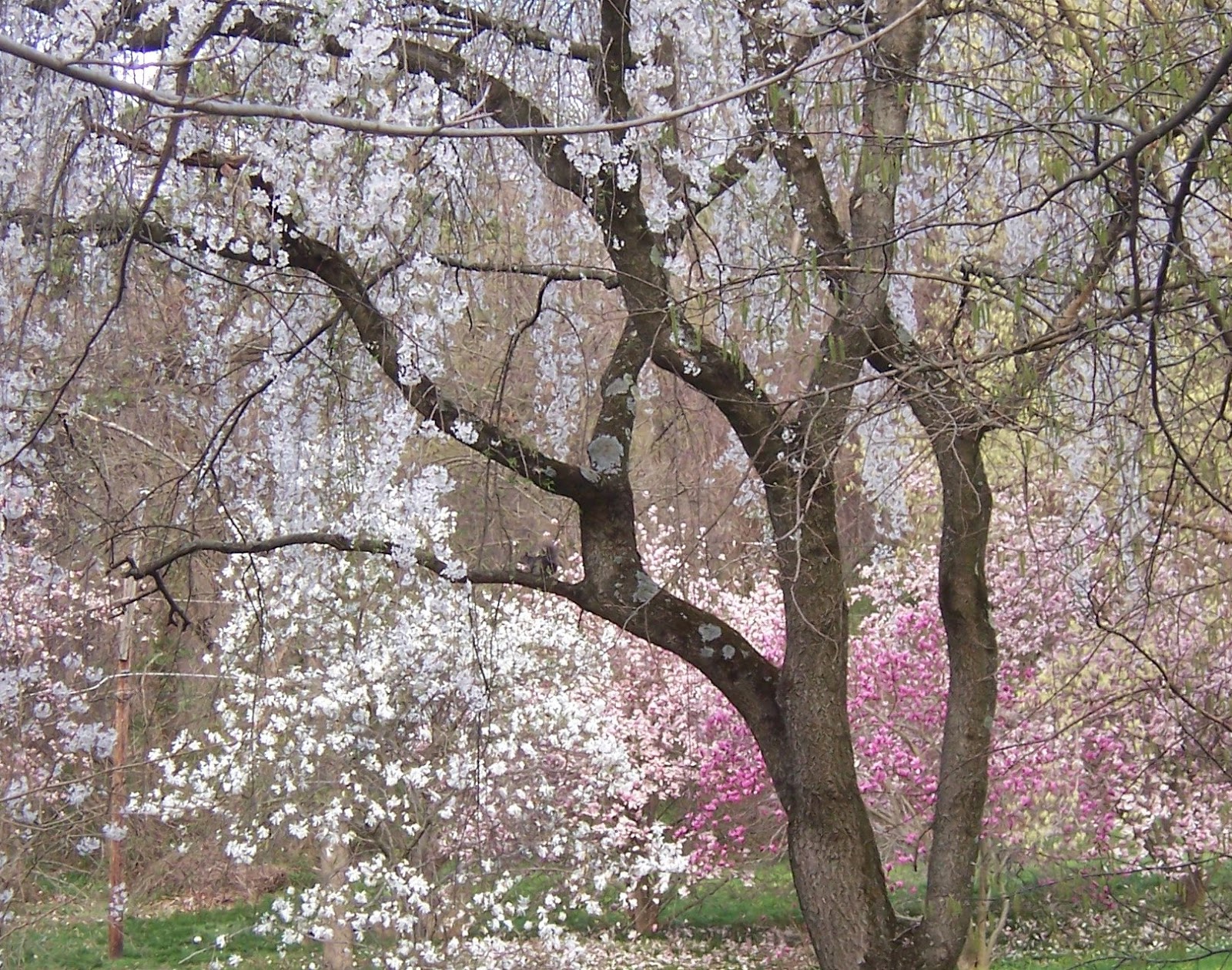


Blooming trees are one of those things that can make me catch my breath in wonder. The ephemeral, whirly beauty can be overwhelming in the best way.


Here is one of the cherries we planted outside our house. I bought its tiny self  when it was no longer in bloom, and hence on sale from Home Depot. It was so small I grew it in our front lot for a few years till it got big enough to at least pretend to be a street tree. And as you can see, it is doing fine as such.


It is a Yoshino cherry, probably a Somei-yoshima. I like it because it is such an easy color to work with, the buds are reddish and open to flowers of such a pale pink they seem white, while retaining a red center. This does not clash with the daffs or tulips near it.

So, if wishes were flowers, what would this one be?


And even wishes need structure. Perhaps made from a good stone like Wissahickon Schist. So--do you know where to get some. Many of our old houses are made of it. What if you want to fix something, or build more? Where could you find it?


Wissahickon Stone Quarry, LLC  is where you go. To quote from their website:"We mine on-site and quarry from the bedrock which makes the stone very hard; the schist has the same bearing weight as limestone.  We guillotine cut on site and our saw cut veneer is cut by experienced professionals in upstate Pennsylvania, which includes beautiful corner cuts." 


At 1-A Waverly Road Glenside, PA 19038, just off Cheltenham Ave.


Wishes should be practical as well as beautiful. And so, good wishes for good wishes all around.


Monday, March 19, 2012

Time of Soft Trees

Post 30


Now is the time of soft trees, 
the beginning, when hints of pink, green and yellow tint the taupes and blues of winter.

So, below, a poem about life. Very short. Very slight. 
And fit for an Equinox, - at least half bright.


Tilth


Deep in the underhush 
   Dig low, pile high;
Warm as the underbrush
   Deep as the sky


Warm as the underbrush,
   Grasses and sedge,
Berries and daisies
   Fringe a low ledge.


A stream at the edge
Moves through the dew,
The deeper the life
The stronger the clue.


Happy Spring


Thursday, March 15, 2012

Lead with seed to a flowery mead

Post 29

Is it too late?

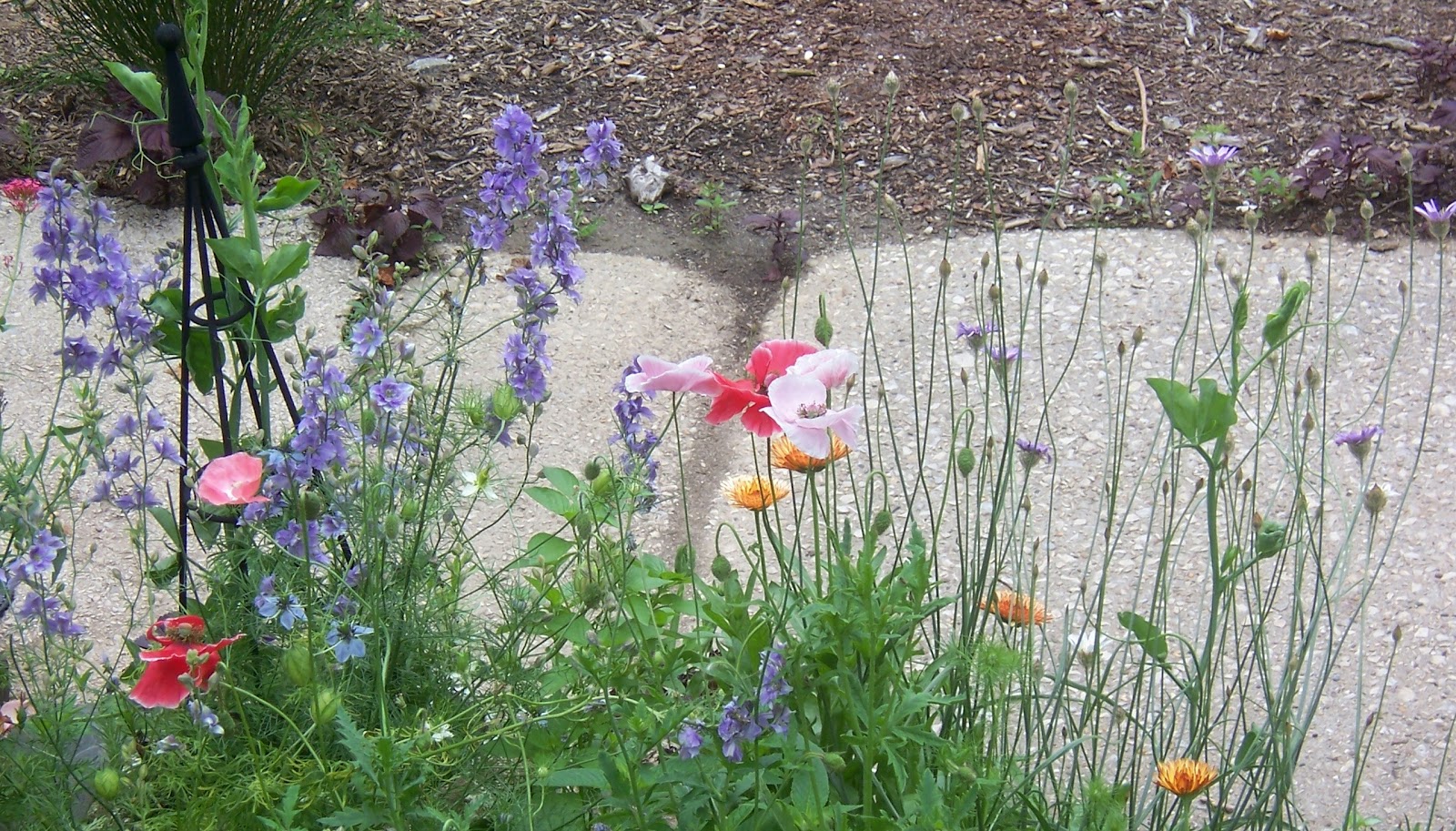
Every year in late winter I throw a lot of seed around. An illustration of the results is on the left. It shows three of my favorites,-- larkspur, poppy and pot marigold. Winter seeding brings lots and lots of  summer flowers.

On the right you can see these three, with sweet pea thrown in, filling in between the perennial Cupid's Dart, Coneflower and Lavender.  One of the people whose questions helped inspire me to write this blog wanted to know how I managed to have such dense planting with so much in bloom. Annual seeds are part of the answer.

To look good, most perennial gardens need to meet three needs: 1) they need to have a succession of abundant flowering and/or interesting foliage that lasts from early spring to late fall, 2)  week to week, with whatever is in or out of flowering, the garden needs to look visually balanced as a whole and 3) colors should not clash, nor should there be too much of any one shape of flower or leaf texture together, nor should the rise and fall of the overall composition of the plants be too uniform and boring.


Can you imagine trying to figure this all out logically? What a boring nightmare! Luckily you do not have to. You do need patience, some intelligence and a decent eye though. And an ability to throw seed on the ground.

Every year, all through the year, I take time to look at my garden and mentally note what is not working. Then, in spring and fall I transplant or plant as needed and every late winter I throw seed at bare patches. It makes for a dense, vibrant look that pleases me and many others. Plus, it does not take much time or money. Seeds are cheap.

How did I fall on this solution? Not by looking for a solution but by following desire.

16th century Belgium tapestry in the V & A, Creative Commons
Since I was young I have felt something strange, wonderful and good in the atmosphere I picked up from the style of some late Medieval, Northern European things. It's a style that shows in the interlacing narratives of the Arthurian romances and the flowery meads (see above) depicted in the backgrounds of miniatures and tapestries. It's a style with a delicate, graceful strength that to seems to quiet and transmute the arrogant and aggressive tendencies of its day.


As a decorative style it is called Mille Fleurs, a thousand flowers. I have no meadow clearing to dedicate to it. But I do have bits and drabs of a garden. And so it was by searching for an ideal that I discovered a highly practical reality. By using seed for old fashion annuals, and by allowing as much self-seeding as possible, I had figured out how to balance the garden thru the whole growing season, while filling it up to its brink.

But then I usually throw out the seeds while it still feels like winter. Is it too late, this spring in winter that feels out of time? I hope not. I need the frail, brilliant beauty of  poppies. I need their delicate, graceful strength.


----------------------------------------------------------------------------

How to Seed:  O.K., so I extravagated a bit about being able to throw -all- the seeds. Poppy seeds you can throw and maybe larkspeare. Sweet pea you really plant in. Most of the others you just barely cover. Take your finger, indent a trench about 1/8 of an inch deep, dribble in the seeds, dribble over some earth, done. Its that easy if...the ground is damp. Do it right after, or right before, rain.

Wednesday, March 7, 2012

Lungworts and Hyacinths, or Breathing Happiness

 Post 28


Green stalks prod their way up through soil seeking... what? If plants could feel, what would it feel like, pushing your way through earth for reasons you do not know?  To break through and feel something unexpected, such as light, course into your pores as photosynthesis, energy, begins. 

It probably would feel like what we felt, when as infants we pushed our way out to take in that first gulp of air, a substance for which we had no anticipating concept. AIR!, Strange, improbable, undreamt of air. Surprise! Of course we cried out, then quieted, finding a rhythm in this new thing breath. And rhythm we knew from our mothers' bodies.

We can't remember..., but we can imagine. Nature, thriftily-extravagent, uses similar processes at different levels in different ways, allowing for some imaginative analogy, empathy in context.  And gardens,-- where skill, comensurate with sensitivity, developes, --are great places for imagining. Enhancing sensitivity and imagination is one way gardening can change the gardener.

To breathe the air, to feel light, to enter a different state of being, how did we ever survive the shock? Well, cause not everything changed, there remained the lilt of known voices, touch, being held, tenderness, states we came to know as love and trust. From these, with these, we could grow to find pleasure in strange new things such as light and air. 

Here is the beginning of the pink Lenten Rose at the crest of the old buried staircase. Only one stalk is blooming, facing down towards a Lungwort which is about to bloom.

Lungworts are usually grown in some shade and therefore aren't usually this early. But I grow grey-leaved ones in sun. Older strains have greener leaves and need more shade. 

The reason the plant is called Lungwort is because its spotted leaves were once thought to resembled lungs. The flowers are the breath, the leaves are the lungs.


It's right there, isn't it?  It's a world I hardly knew existed before gardening. As a gardener, I've learned so many things -- sensitivity and skill, patience, respect, cooperation, and something else.  Something very like an everyday ecstasy. 

“Flowers and sunlight, air and silence—‘luxe, calme et volopte.’”  Patricia Simon

It comes to different people in different ways. For me, it's after I've been working in the garden for awhile. I'm physically tired but alert. So I lean forward or back to preen this frond or that and there it is, a stillness, a lively, peaceable calm. It is like the smell of a hyacinth as you walk down a busy street when, for a moment, everything else disappears, or rather, becomes more real.


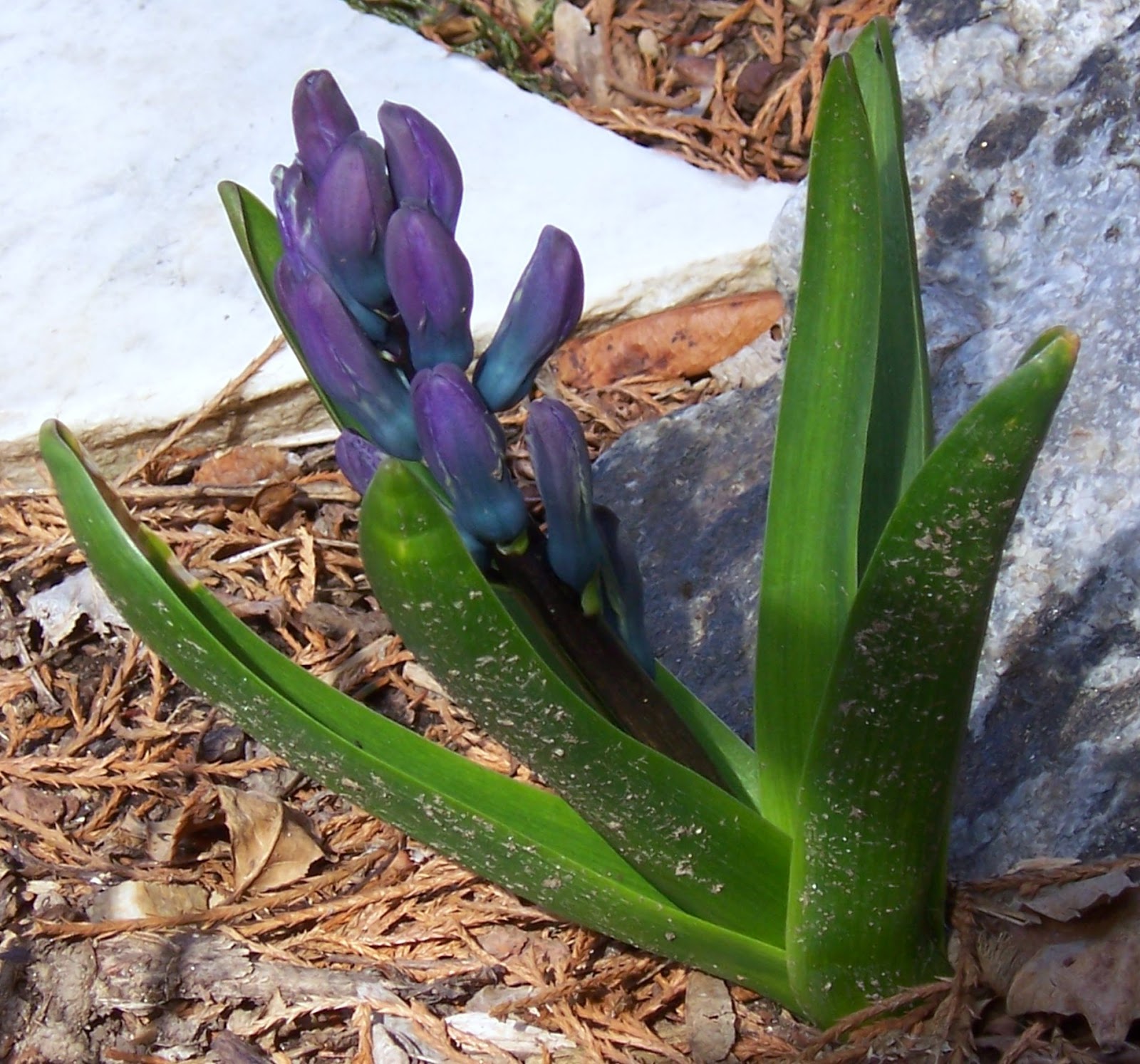
And you are a child again. A hyacinth has been placed on your windowsill for Easter. You watch it grow. At first it is a stalk of dark, deeply purple, secretive shells, like a long row of muscle shells fastened onto seaweed on the beach at tide-turn. Then the purple lightens, the shells slowly open  and they aren't shells at all, but tender, pliable flowers. And the smell, the smell is like nothing at all, or everything. It is everywhere, it is nowhere, it is Air. And as you  breathe it in, it is a delivery, an earnest, on the strange promise of that very first unremembered breath.

_______________________________________________

How to Lungwort (another great plant that easily grows around here): If you have shade or sun, like blue, purple, pink  or almost white flowers, this is a useful plant. Lungwort, or  Pulmonaria grows from rhizomes and needs moisture, especially if it gets a lot of light. Part of its appeal is that it blooms for almost two months, its escalating flowery bits growing ever longer. The best thing to do for it is to cut the flowers back hard before they are fully done blooming. So at about six weeks clip back as much of it as you can: flowers, stems and any tatty leaves.  If you do this new leaf growth with proceed nicely and you will end up with great foliage plants for the rest of the summer. If you do not cut it back when it needs it, I have found that it can  droop, get mildew or even die, especially in sun. It is as if making new leaves while keeping up the old stuff is almost too much for it  If you want more plants, and you have a variety that makes viable seed, just shake a handful of spent stems over a moist bit of shaded earth. Next spring you will have babies to transplant as you wish.


Most writers tell you not to grow Lungworts in clay, but I have found they do fine in my only slightly amended clay soil. So just make sure they are in somewhat well-drained soil, not pure clay where the rhizomes can rot. Many of mine are on the slope of a hill, which must help.


Hyacinth a few days later

How to Hyacinth: Hyacinthus Orientalis is a bulb that has been bred from the wild Hyacinth, a native of Turkey. As with most bulbs, plant it to a depth just a little deeper than its own size in the fall. It will bloom for a short time the next spring, and if you are lucky, again the year after.  For all that bother though, the powerful sweet scent is well worth the effort. The blue/purple flower, versus the other colors, is perhaps the most treasured of all; it stands for sincerity.

Full bloom
.  

Sunday, February 26, 2012

The Lenten Rose, or Slowly Lengthening into Spring

Post 27

Lent


Slowly lengthening into spring,
Warm-up days, cooled by night,
Dream for me that everything's
Just waiting now for new delight--

(what never was before its since,)
Hence here a brace of bawdy hints.


For what if all did best resolve,
Even past just human hope,
Could any really hope to cope
With the life they would evolve,

And bring a faith to resurrection
Beyond both fear and false projection?


Merry truth must think it strange
How easily perceptions change,
So as this Lent brings us the sun,
--Let's look to see how we have done.


               Flowers only thrive where Nature
         With the Gardener does concur,
When life bestirs us, Spirit proves us,
As we chose a better view.


Newly brought into the light...
Dearly bought, and eagerly sought,
Longingly and lovingly wrought,
Now here in time, by time begot.


---------------------------------------------------------------

How to Hellebore: The top two pictures are of Lenten rose, or Helleborus orientalis or hybrids of. The top picture is in my neighbor's yard, the second in my own. This plant, which eats semi-shade for breakfast and, once established, may be able to compete with your tree roots for water, comes in shades of red, burgundy, pink, white, greenishy-yellowey and a subtly spectacular greyed lavender slate.  It blooms, in a typical year, in March (and because the flowers are really septals, can persist through June.)  The old fashioned ones have hanging heads and therefore look good planted on a rise so you can look up towards them. These also reseed readily. Newer hybrids can be more upfacing. 


They need only some shade, decent soil of a moderate pH, and some water. The only care they need is to have a haircut in late winter-spring, when their evergreen leaves turn tawdry. Leave the flowers on the plant and watch the seed pods swell into summer. Soon you will have babies. This is a plant that can be expensive to buy but is so worth it. It is a doer that will not let you down.

Wednesday, February 15, 2012

Wissahickon Style IV, Lack of Pretension

Post 26

A bad back has increased my grouchiness while decreasing my inspiration. Hence my not keeping up with weekly posts, So I'm going to go for an easy topic: lack of pretension, to keep things going. 

By lack of pretension -- I mean everything from having an undisguised television set (no, not media center, never media center,) in the living room to a sign for your garden written in chalk. For me, the best of Wissahickon style is not hoity-toity,  but scuffed-up white shoe.


Here are street number tiles embedded in a schist wall. They are old tiles, probably Mercer, cracked and riven, much like the rock and mortar they are set in. One of the clues to real style is that it has an unifying integrity. Pretension usually shows itself up as the slapping together of various items with nothing in common but their value as status tags. Hence the odd fact that style can seem to reflect a moral state.

Time as eventual destroyer of all things is never recognized by pretension. Old objects are only valued as consumer goods. The imprecations of time as such are usually erased by the up-to-date or, even more oddly, by other old items from whatever historical period is currently au courant.

A true unitive integrity of style may be as impossible to achieve as perfectly human integrity, but for any attempt at either, humility is needed. And humility means being in touch with our true humanity, the humus of our being, that we are mortal, fallible creatures at the mercy of time and tide.

Architecture that rears up against this truth is unlikely, in the long run, to enhance human flourishing. But architecture that helps us own up to our humanity softens the imprecations of time. It can then become a comforting presence, and, as an unifying style, set an example of how to get things right.


Wednesday, February 1, 2012

Roses in February

Post 25


It may be warm,  but it is bleak and the garden, well... see what I mean.

I need a rose.

Yes, that helps. It is not easy to write a gardening blog in these months, especially if you want to avoid the usual winter cliches. Looking at the local architecture that holds up our gardens, cradles and rocks them, is a partial solution, but not an entirely gratifying one. The light is hard, the buildings unsoftened. I need more roses.

Yes, better.  One of the drawbacks of bleakness, which feels like nature's boredom, can be a lack of solid inspiration. And without real inspiration I may start to extravagate (no, not a word but should be (OED--pay attention! (Like Auden, one of my dream aspirations is to coin a new word and get it credited there; unlike Auden, it's a dream aspiration.))) To clarify, to extravagate means to unthinkingly exaggerate to a point almost past truth (though a kernel remains.) It lacks malice but remains an easy temptation for those of us who are of imagination a bit too compact. Itself an example of extravagation, it is a word that I made up in High School without realizing I'd made it up. I extravagantly extravagated exaggeration into extravagate. 

In short, in my last post I extravagated. I dissed mansions and castles. I do not really dislike them, just the more money than taste ones. 

And now, keeping on theme,(yes, there is a theme,) I am going to slip back towards an earlier post, "Roses in January," and fill in some information I did not include in the earlier post on The Red Rose Girls.

Below is a picture of Cogslea that shows more of the house and less of the caryatids.


And here's one of Cogshill from the back


The pergola at Cogshill.


And here is a relevant illustration from Elizabeth Shippen Green's scrapbooks at the Free Library of Philadelphia.


Last of all. I want to credit the source of most of my information on The Red Rose girls. It is the book,  The Red Rose Girls: An Uncommon Story of Art and Love by Alice A. Carter, ISBN 978-0810944374.

And I also want to add a caveat, that this is an informal blog. Like informal correspondence and other forms of informal writing, such a blog is not meant to be read as a solid reference source. I try to be accurate but I do not fact check everything. For instance, I made a mistake about Edith Emerson in my earlier RRG post. I have gone back and corrected it as I value accuracy.  At times however, I can find even myself a bit too transported by the act of writing, and end up extravagating reality's rose into a slightly stranger flower. So please, take this with a grain, though not a bucket, of salt. I know I do.