Monday, May 26, 2014

Damage and Recovery

Post 91

Now is iris,


And the first few roses


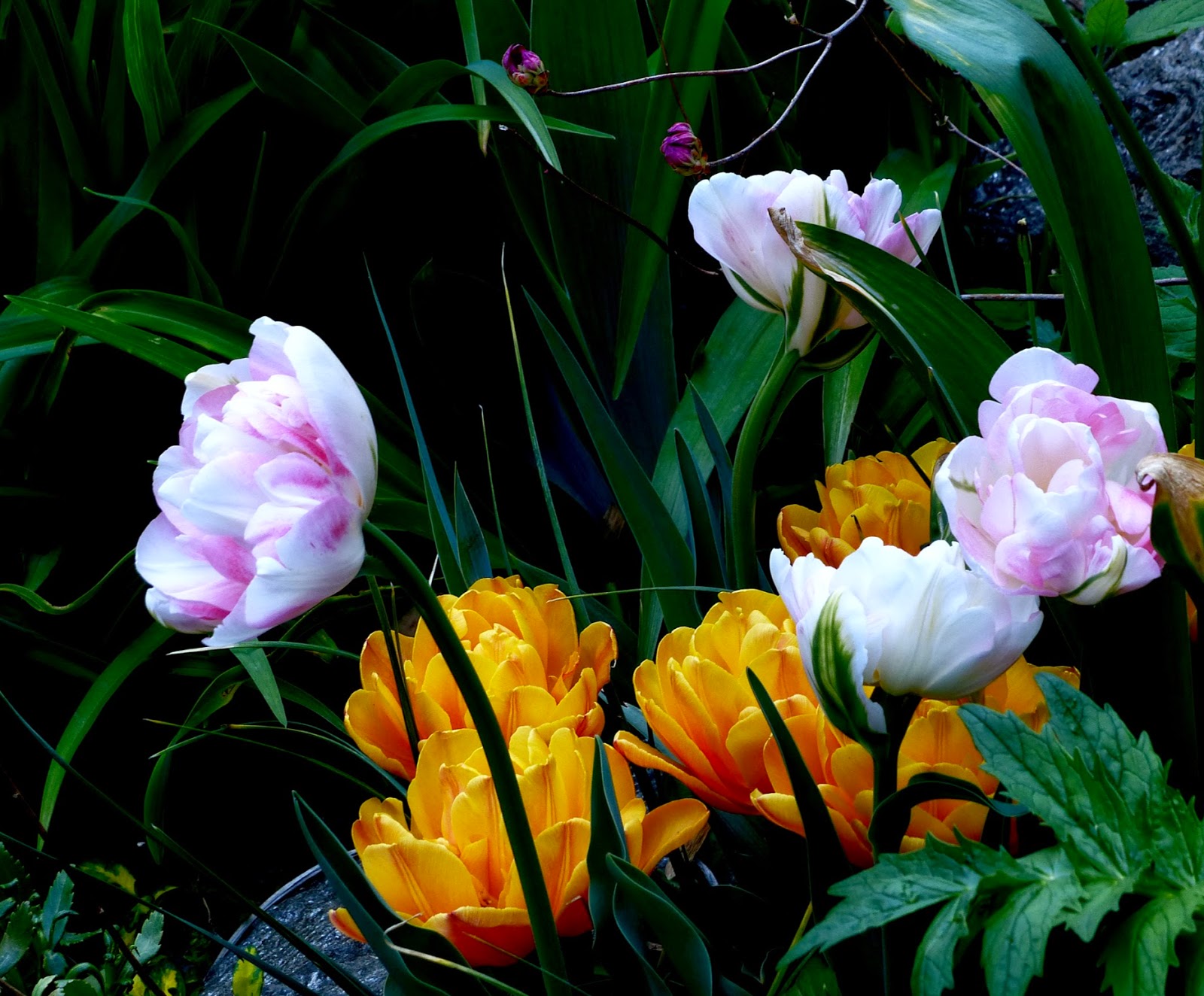
I look forward to seeing what the arc of the roses is going to look like. In late March, when I pruned them, there was much more dead wood than usual. The poor Rugosa was mostly dead  yet it is still the first bloomer. I do know that it has been a good spring for iris, which have bloomed copiously, colorfully and long.
 The water table is full and the mix of rain and sun has been just right. But it is the coolness that has really let what is blooming last. I have seen the Lady Jane tulips fall apart in days due to heat. This year they set a record of three weeks in bloom.

 This brisk Spring has felt glorious. But is that a fluke or because of the contrast with the hard winter, or just because we like to tell ourselves that good often comes out of what had been bad?

 There is a name for this last idea in Christian Theology--the Fortunate Fall ( if Christian theology is not your cuppa, please be not  displeased. I'm really talking about a human tendency to think a certain way.)

The Fortunate Fall is the concept that though humans messed up in some way, allowing evil into the world, their end state will be better than if they had never messed up. It shows up in a lot of English Literature, which is where I was first introduced to it, long before I had any use for religion.

It seems to reflect an aspect of human ratiocination, the part of us that often forgets, ignores or hides suffering by drawing attention to better things. I do this because it helps me from dwelling on the bad stuff, which I can do and which then creates more suffering. It seems to help many deal with adversity.The downside is, of course, that it can decrease our ability to see and relieve suffering.

Recently, I was talking to a coworker whose parents have had some money issues and who have moved in with her and her son. One consolation is that this allows her to do more things outside the house. She has been working out and blooming with good health. But this is only a small consolation compared to the greater difficulties at issue. Do we see the small goods that difficulties create as consolations sent by grace, karma or human love and ingenuity, or as the direct results of the difficulties?

C.S. Lewis took the first view(see Perelandra,) although many Christians assume that the idea of the Fortunate Fall is manditory. It is not.

In the garden, a milder winter might well have brought an even more splendiferous Spring. We will never know.This is the Spring we have.
Might spiritual maturity mean not indulging in to the human need to always, not just explain or  understand the reality we experience, but to justify it?

This Spring is beautiful and I am enjoying it in the garden. The difficulties of last winter do not increase or decrease this. I'm even a tad inspired and writing poetry. I will be ending this post with a poem in progress. In poetry, blogs or lived life, I'm happy to celebrate what functionally and gently deepens my experience of reality. Gardening makes me pay attention to Nature's cycles, loss and delivery, effort and reward. What has been lost does not make what remains more beautiful, nor does it take away from the present beauty.


BALANCE

Flying? ... what if I tilt or go backwards?

My Dad in college bought a roadster that only
Drove in reverse. Into the Great Smokies

He'd venture, backwards bravadoing towards
Sweet moonshine and misplaced wishing.

So, What is the chance that dyslexic me
Could navigate as well as that thirsty

Ranker, busting his way through Prohabition?

What're my Great Smokies..? A licit island,
With springs and creeks, waves gurgling through seagrass,

Beaches, salt winds, salt waves, sky wide-fashioned,
Woods, meadows, bays, a garden village. Its sands

My time, its tides inhaling and exhaling through my sails
As I stand, weightlessly, on its unseen scale.


Wednesday, May 14, 2014

When Pleasure is a Duty

Post 90

If May were yet to burn away
In flower flame, both fain and fill,
I would stand here still and say,
--It stood a day. And what a day.
May it almost scary in its beauty. Sometimes it feels as if its beauty could overrun my capacity to bear it. I guess that is somewhat what Edmund Burke meant when he referred to the sublime. Some people take the sublime to mean scary as in creepy; I think it has more to do with, not scary exactly, but awesome, amazing, rapturous.
 The garden took some hits this winter that have lessened its spring blooms and will cost it this summer. Yet  it still contains more than enough plenitude to dazzle my senses, and I find I'm not really morning the loss of wallflower, yarrow, verbascum and hydrangea bloom. What is, is enough.

Leigh Hunt wrote some light verse about May where he refers to it as the "month when pleasure is a duty."

"May's the blooming Hawthorne bough;
May's the month that's blooming now
I no sooner write the word,
That it seems as if it heard,
And looks up, and laughs at me."
"There is May in books for ever;
May will part with Spenser never;
May's in Milton, May's in Prior,
May's in Chaucer, Thomson, Dyer:"
"May's in all the Italian books;
She has old and modern nooks,
Where she sleeps with nymphs and elves
In happy places they call shelves,"
"And will rise , and dress your rooms
With a drapery thick with blooms."
"Come ye rains then, if you will,
May's at home and with me still:
But come rather, thou, good weather
And find us in the fields together."

It can be hard to write of beauty without lapsing into petty prettiness, hence Hunt's wisdom in keeping his tone whimsical. The sweet sublime may be one of the hardest things to put into words or images. And to top it all off, May is not just a month of beauteous views, it is also the month of fascinating smells: lily of the valley, lilacs, tree peony. Smells that deliver the sweet sublime in elusive packets that fade as they radiate, intensify as they recede..
.I doubt I am the only one who finds great beauty a little scary, a little other, a disruption of the ordinary even though there are few things more ordinary than spring.
Is this why, by the Church Year, this is not Ordinary Time? I doubt it with my understanding, but it makes sense to the rest of me.


Monday, April 28, 2014

Spring Sprung Anew


Post 89

Here is my front yard in early spring, which I count as early April in Northwest Philly.  White and gold daffodils bloom with cerulean Siberian squill--both cheapish bulbs that once planted, thrive and slowly spread .


Peter Rabbit has been back many times, perhaps I have a lot of tender shoots for him to nibble on. It seems that last year there were a few rabbits down the block and now there are more than a few all over the block. At some point I may have to get Farmer McGregorish, but for now I am enjoying the company.  They are wild and beautiful and so far have only eaten some crocus and one tulip, which seems small fare for the pleasure of their company.


Aren't these great crocus? They are in my neighbor's garden, backdropped by late sun and completely uneaten. I need to find out what they are and widen their spread. I am lucky to now have gardening neighbors. When I first moved in it was pachysandra, ivy and grass as far as the eye could see. One long gone neighbor even told me the soil was poisoned! Well, I proved that wrong, new neighbors moved in and now we have three front gardens in a row with lots of  perennials and shrubs to keep what small bits of wildlife we have around happily wildlifing. One couple is older but still does a lot of the work themselves; the other couple is younger but has other houses and interests and are generous enough to have a service come in a few times a year to beat back the prolific weeds. Still--this spring I have enjoyed seeing so many birds and other beasties scurrying around around between the three properties. It's a small habitat for them, but it seems to be enough to attract them. I like knowing that even a small effort can make for a change in the neighborhood.


Before we did our taxes my husband and I thought that this would be a prosperous year, since both of us had gotten small raises. So in the euphoria of feeling flush I went out and bought some fancy pants annuals, something I usually try to avoid. Here is my box worth, with small unusual pansies, foliage plants and English daisies which I do usually buy. See those unusual tawny lavender pansies--they are interesting, pretty, not finicky and doing well in my clay, close to the violets that return every year to glam up the hellstrip.


There is, however, a small catch. The raises my family got do not quite cover the exceptions and some other things we lost this year, a fact we only realized after doing our taxes. So no more fancy annuals for me. Or not many. Because, since I anticipated a year's worth of carefree annual buying, I did not start many seeds. I have to admit, as I age and keep working, I do have less energy. An easier summer seemed worth a try.  So now I'm playing out-of-breath  catch-up on every window sill I can muster.


Yet somehow the garden has not heard that bit of bad news, so it is still doing great. This last Sunday it all caught my breath, as I looked out on a beauty I couldn't possibly have had anything to do with bringing about. Me? No way. Maybe some miracles only come when you understand your own limitations, and yet are still willing to push on.

 P.S.
I love serendipity, and not just for ice cream. Part of my job as a librarian involves evaluating books, some of which are books of poems, so some of these poems I read (I'm evaluating, not enjoying;-) I'm currently looking at "Two New Yorkers" from, we think, 1938 and from an obscure printer. It has the feel of Lower East side, ethnic, progressivism with its earthy prints by Alexander Kruse. And poems by Alfred Kreymborg. I have not heard of either but will do some research (and perhaps find my initial categorization all wrong.) Anyway, it is a charming book in feeling so very much of its time and place. It includes a rustic April poem which has a fine lilt to it.

I'M FOOL ENOUGH

I'm fool enough to think,
while April's in clover
the sun and the rain
will change what they can.

Ass enough to see
nose enough to smell
that what grows as grass
may be the whole plan:

Ears that can hear
how the wet and dry
as they mingle and mellow
May yet sweeten man.

It is the sort of short lyric I like, musical and suggestive. I would change the 8th line to "may be part of a plan," but I'm still impressed. The etching/aquatint next to it is titled "Long Island Peasant."

I love the pleasant surprises that come with this job, like stumbling over a blossom you never expected to be there.


Tuesday, April 22, 2014

Earth St. George's Day Eastertide

Post 88


A lot of important days seem to occur during this time of year. Perhaps that is because love is what this season feels like? Nourishing love, sustaining love, redeeming love. Love.

Yet to love well is so difficult as to be almost impossible. Nevertheless we keep trying. And when it is done right, or close enough, then there is nothing like it, the great universal, attracting, uniting impulse. Love structures our reality.

Are there opposing impulses? Many. But almost all of them are initially founded on love of some kind. If someone cuts you off in traffic you may be angry with them but your anger comes from your perceiving that they have offended against what you love: your sense of fairness, your sense of self, your love of the soon-to-be-drunk-but-now-delayed morning coffee that is waiting for you at the office. Love makes value. Without love of some sort there is not much to life.


So--if it is all love, all the way down, why are there such problems in this world?

Obviously--I do not know. Neither do most of us. But sometimes I, like others, surmise. One surmise I find suggestive is from Dante, who works within the Christian tradition. He offers the idea that it is important to order one's loves. One way to order them is to make sure that love itself is the final value, since love lifts up all it loves. If you put self as the final value you are not making enough room for either you or love. Love needs the space to love what is outside of itself, other selves, other loves, greater love. Self-love as highest good can cramp love and can cheat the self.
Another surmise is an idea from paganism-- it is the idea from Greek Mythology that here on this earth maybe you do want to invite Eris to the feast. Since, to even have a clue as to how to order your loves, you first need to have self-knowledge and self-knowledge often comes from some level of conflict or frustration. Still, the more tempered by love the delivery of that knowledge is, the easier it is to adjust to. That gentleness can be the difference tween a tragic and a comic hero. The comic hero survives and prospers because she has learned how to order her loves. The tragic hero often receives this knowledge too late or not sufficiently, or despairingly and so it is deadly for her. (This Shakespeare-inspired aside is for St. George's Day, patron saint of the English-Speaking Union and, as of today, the 450the Bday of William Shakespeare.)


Humans have always dealt with this conundrum of conflict and always will. Right now there is a conflict between those who think stewardship of the earth means exploiting its resources, and those who think it means responsibly managing its resources. Wherever you stand (and it should be obvious where I do,) Earth Day is this week.  One way or the other humanity does appear to control the earth's future. Like many, I love this earth. I hope we will be willing to act on our love to redeem our fragile island home. To degrade it is to degrade ourselves.
The earth, human consciousness, love, redemption-- I am sure they connect better than I have been able to word them here. If I had more answers I would be able to write more clearly. All I've got are questions and intuitions that sometimes feel as inchoate and delicate as spring, and some pictures, to give a small form of spring to what is greater than any of us.


Wednesday, April 2, 2014

Begin with Snowdrops and Modest Panache

Post 87

This year, more than ever, the lag between cause and effect, the position of the sun and earth's response, feels especially large. I think I might have missed the first day of Spring if the garden hadn't delivered a messenger.

 Never  before had I seen a bunny in my garden , let alone one as fat and shiny-coated as this one. Wild Long Island rabbits I've seen have always looked rangy. I wonder if this sweety was an escaped pet. But by the time I'd taken this photo, it was gone. And so also, when I got home from work, were the fresh-tasting blooms on my croci, a small sacrifice for such a fitting beginning of Spring.


Luckily, croci aren't all that is up the garden. Snowdrops have been doing their job of heralding larger, warmer, more colorful things with their usual modest panache.


There are so many great things about snowdrops  that it is hard to list them all: nothing eats them, neither snow nor cold faze them, they spread naturally at a controllable pace, and their foliage fades out and disappears early in the year, so they can thrive in the same place as a a later plant. If you want to get fancy, there are many varieties with frillier and larger blooms. And every year they will give you an even lovelier display.

So--if you want to begin gardening, find a friend with snowdrops and get them to dig up a few. Because buying snowdrop bulbs in Fall usually does not work, best results are achieved by transplanting now. Then, once you have them allow them to set seed. In a few years, you will have enough to give away.


Do not worry if they are snowed on. They don't mind.

Meanwhile, 

 
The Lenten Roses are getting frisky. Like the daffs, they have been out in Center City for awhile. Below is a pic of some from downtown, 10 days ago, at the Barnes.


But living as we do in the high country of Northwest Philly, ours will take longer.


Have you done winter clean-up yet? With light comes work. I'm 3/4ths done but when I have the time to finish things up, it is always raining.

The important thing for me to get done is to prune the roses. Usually I have it done by mid-March, because the growing buds demand it. This year however, the buds have hardly reddened up, let alone greened. But still-- it needs to get done, rain or not.
Because I want this later in the year--

                                                                            So for now, it is work and little flower play.  But soon, the work will pay off. In just the last few days buds on the quince have gone from almost indistinguishable to prominent. My eyes are watching for early, purple bluebell foliage.  Some bright blue squill are out. A hyacinth is getting ready to burst and with hyacinth comes scent and the sense that Easter is soon to blossom.
I'm holding on.