Wednesday, March 7, 2012

Lungworts and Hyacinths, or Breathing Happiness

 Post 28


Green stalks prod their way up through soil seeking... what? If plants could feel, what would it feel like, pushing your way through earth for reasons you do not know?  To break through and feel something unexpected, such as light, course into your pores as photosynthesis, energy, begins. 

It probably would feel like what we felt, when as infants we pushed our way out to take in that first gulp of air, a substance for which we had no anticipating concept. AIR!, Strange, improbable, undreamt of air. Surprise! Of course we cried out, then quieted, finding a rhythm in this new thing breath. And rhythm we knew from our mothers' bodies.

We can't remember..., but we can imagine. Nature, thriftily-extravagent, uses similar processes at different levels in different ways, allowing for some imaginative analogy, empathy in context.  And gardens,-- where skill, comensurate with sensitivity, developes, --are great places for imagining. Enhancing sensitivity and imagination is one way gardening can change the gardener.

To breathe the air, to feel light, to enter a different state of being, how did we ever survive the shock? Well, cause not everything changed, there remained the lilt of known voices, touch, being held, tenderness, states we came to know as love and trust. From these, with these, we could grow to find pleasure in strange new things such as light and air. 

Here is the beginning of the pink Lenten Rose at the crest of the old buried staircase. Only one stalk is blooming, facing down towards a Lungwort which is about to bloom.

Lungworts are usually grown in some shade and therefore aren't usually this early. But I grow grey-leaved ones in sun. Older strains have greener leaves and need more shade. 

The reason the plant is called Lungwort is because its spotted leaves were once thought to resembled lungs. The flowers are the breath, the leaves are the lungs.


It's right there, isn't it?  It's a world I hardly knew existed before gardening. As a gardener, I've learned so many things -- sensitivity and skill, patience, respect, cooperation, and something else.  Something very like an everyday ecstasy. 

“Flowers and sunlight, air and silence—‘luxe, calme et volopte.’”  Patricia Simon

It comes to different people in different ways. For me, it's after I've been working in the garden for awhile. I'm physically tired but alert. So I lean forward or back to preen this frond or that and there it is, a stillness, a lively, peaceable calm. It is like the smell of a hyacinth as you walk down a busy street when, for a moment, everything else disappears, or rather, becomes more real.


And you are a child again. A hyacinth has been placed on your windowsill for Easter. You watch it grow. At first it is a stalk of dark, deeply purple, secretive shells, like a long row of muscle shells fastened onto seaweed on the beach at tide-turn. Then the purple lightens, the shells slowly open  and they aren't shells at all, but tender, pliable flowers. And the smell, the smell is like nothing at all, or everything. It is everywhere, it is nowhere, it is Air. And as you  breathe it in, it is a delivery, an earnest, on the strange promise of that very first unremembered breath.

_______________________________________________

How to Lungwort (another great plant that easily grows around here): If you have shade or sun, like blue, purple, pink  or almost white flowers, this is a useful plant. Lungwort, or  Pulmonaria grows from rhizomes and needs moisture, especially if it gets a lot of light. Part of its appeal is that it blooms for almost two months, its escalating flowery bits growing ever longer. The best thing to do for it is to cut the flowers back hard before they are fully done blooming. So at about six weeks clip back as much of it as you can: flowers, stems and any tatty leaves.  If you do this new leaf growth with proceed nicely and you will end up with great foliage plants for the rest of the summer. If you do not cut it back when it needs it, I have found that it can  droop, get mildew or even die, especially in sun. It is as if making new leaves while keeping up the old stuff is almost too much for it  If you want more plants, and you have a variety that makes viable seed, just shake a handful of spent stems over a moist bit of shaded earth. Next spring you will have babies to transplant as you wish.


Most writers tell you not to grow Lungworts in clay, but I have found they do fine in my only slightly amended clay soil. So just make sure they are in somewhat well-drained soil, not pure clay where the rhizomes can rot. Many of mine are on the slope of a hill, which must help.
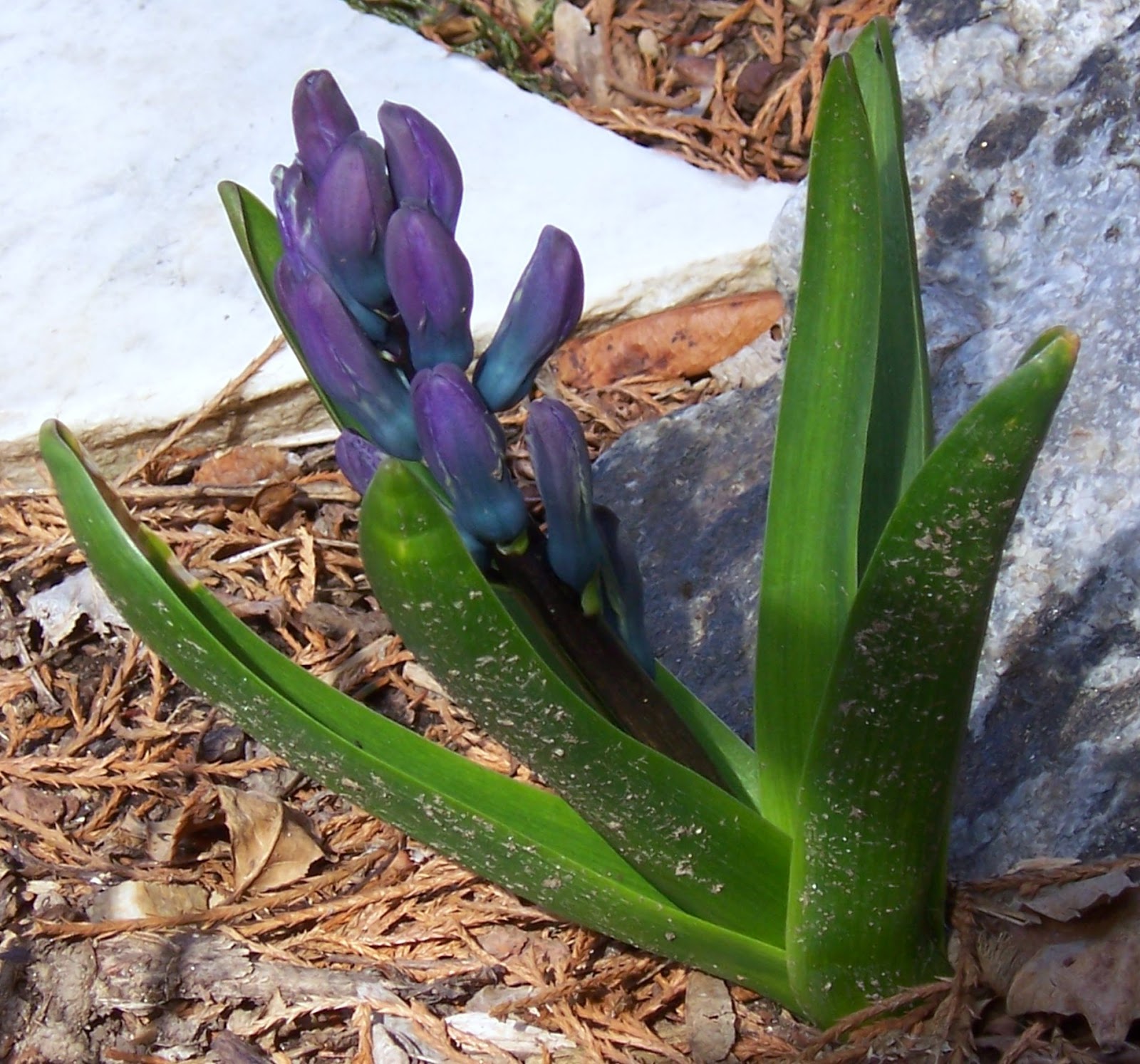


Hyacinth a few days later

How to Hyacinth: Hyacinthus Orientalis is a bulb that has been bred from the wild Hyacinth, a native of Turkey. As with most bulbs, plant it to a depth just a little deeper than its own size in the fall. It will bloom for a short time the next spring, and if you are lucky, again the year after.  For all that bother though, the powerful sweet scent is well worth the effort. The blue/purple flower, versus the other colors, is perhaps the most treasured of all; it stands for sincerity.

Full bloom
.  

Sunday, February 26, 2012

The Lenten Rose, or Slowly Lengthening into Spring

Post 27

Lent


Slowly lengthening into spring,
Warm-up days, cooled by night,
Dream for me that everything's
Just waiting now for new delight--

(what never was before its since,)
Hence here a brace of bawdy hints.


For what if all did best resolve,
Even past just human hope,
Could any really hope to cope
With the life they would evolve,

And bring a faith to resurrection
Beyond both fear and false projection?


Merry truth must think it strange
How easily perceptions change,
So as this Lent brings us the sun,
--Let's look to see how we have done.


               Flowers only thrive where Nature
         With the Gardener does concur,
When life bestirs us, Spirit proves us,
As we chose a better view.


Newly brought into the light...
Dearly bought, and eagerly sought,
Longingly and lovingly wrought,
Now here in time, by time begot.


---------------------------------------------------------------

How to Hellebore: The top two pictures are of Lenten rose, or Helleborus orientalis or hybrids of. The top picture is in my neighbor's yard, the second in my own. This plant, which eats semi-shade for breakfast and, once established, may be able to compete with your tree roots for water, comes in shades of red, burgundy, pink, white, greenishy-yellowey and a subtly spectacular greyed lavender slate.  It blooms, in a typical year, in March (and because the flowers are really septals, can persist through June.)  The old fashioned ones have hanging heads and therefore look good planted on a rise so you can look up towards them. These also reseed readily. Newer hybrids can be more upfacing. 


They need only some shade, decent soil of a moderate pH, and some water. The only care they need is to have a haircut in late winter-spring, when their evergreen leaves turn tawdry. Leave the flowers on the plant and watch the seed pods swell into summer. Soon you will have babies. This is a plant that can be expensive to buy but is so worth it. It is a doer that will not let you down.

Wednesday, February 15, 2012

Wissahickon Style IV, Lack of Pretension

Post 26

A bad back has increased my grouchiness while decreasing my inspiration. Hence my not keeping up with weekly posts, So I'm going to go for an easy topic: lack of pretension, to keep things going. 

By lack of pretension -- I mean everything from having an undisguised television set (no, not media center, never media center,) in the living room to a sign for your garden written in chalk. For me, the best of Wissahickon style is not hoity-toity,  but scuffed-up white shoe.


Here are street number tiles embedded in a schist wall. They are old tiles, probably Mercer, cracked and riven, much like the rock and mortar they are set in. One of the clues to real style is that it has an unifying integrity. Pretension usually shows itself up as the slapping together of various items with nothing in common but their value as status tags. Hence the odd fact that style can seem to reflect a moral state.

Time as eventual destroyer of all things is never recognized by pretension. Old objects are only valued as consumer goods. The imprecations of time as such are usually erased by the up-to-date or, even more oddly, by other old items from whatever historical period is currently au courant.

A true unitive integrity of style may be as impossible to achieve as perfectly human integrity, but for any attempt at either, humility is needed. And humility means being in touch with our true humanity, the humus of our being, that we are mortal, fallible creatures at the mercy of time and tide.

Architecture that rears up against this truth is unlikely, in the long run, to enhance human flourishing. But architecture that helps us own up to our humanity softens the imprecations of time. It can then become a comforting presence, and, as an unifying style, set an example of how to get things right.


Wednesday, February 1, 2012

Roses in February

Post 25


It may be warm,  but it is bleak and the garden, well... see what I mean.

I need a rose.

Yes, that helps. It is not easy to write a gardening blog in these months, especially if you want to avoid the usual winter cliches. Looking at the local architecture that holds up our gardens, cradles and rocks them, is a partial solution, but not an entirely gratifying one. The light is hard, the buildings unsoftened. I need more roses.

Yes, better.  One of the drawbacks of bleakness, which feels like nature's boredom, can be a lack of solid inspiration. And without real inspiration I may start to extravagate (no, not a word but should be (OED--pay attention! (Like Auden, one of my dream aspirations is to coin a new word and get it credited there; unlike Auden, it's a dream aspiration.))) To clarify, to extravagate means to unthinkingly exaggerate to a point almost past truth (though a kernel remains.) It lacks malice but remains an easy temptation for those of us who are of imagination a bit too compact. Itself an example of extravagation, it is a word that I made up in High School without realizing I'd made it up. I extravagantly extravagated exaggeration into extravagate. 

In short, in my last post I extravagated. I dissed mansions and castles. I do not really dislike them, just the more money than taste ones. 

And now, keeping on theme,(yes, there is a theme,) I am going to slip back towards an earlier post, "Roses in January," and fill in some information I did not include in the earlier post on The Red Rose Girls.

Below is a picture of Cogslea that shows more of the house and less of the caryatids.


And here's one of Cogshill from the back


The pergola at Cogshill.


And here is a relevant illustration from Elizabeth Shippen Green's scrapbooks at the Free Library of Philadelphia.


Last of all. I want to credit the source of most of my information on The Red Rose girls. It is the book,  The Red Rose Girls: An Uncommon Story of Art and Love by Alice A. Carter, ISBN 978-0810944374.

And I also want to add a caveat, that this is an informal blog. Like informal correspondence and other forms of informal writing, such a blog is not meant to be read as a solid reference source. I try to be accurate but I do not fact check everything. For instance, I made a mistake about Edith Emerson in my earlier RRG post. I have gone back and corrected it as I value accuracy.  At times however, I can find even myself a bit too transported by the act of writing, and end up extravagating reality's rose into a slightly stranger flower. So please, take this with a grain, though not a bucket, of salt. I know I do.

Saturday, January 21, 2012

Wissahickon Style III, The Comfortable House

Post 24
Mansions, castles, etc. look great on the outside. In fiction, they are easy symbols of the multi-facited self. But in real life, would you pay to live in one?

Winchester Mansion in San Jose, CA
Too big and crazy ass to be comfortable, wouldn't you say?

People make fun of the midsize, comfortable house. Yet, in it's own way, it's close to perfection. And this area is replete with them.


                                                Here is one I love for its complex simplicity.

 I like the rough walls against the smooth door frame and the play of its shapes, rectangles and triangles. Your eye can break up the space into regular or irregular units.

The windows of the first and second floor are differentiated; the upper ones wink out from under indented eyebrows. The set-forward, right entrance rectangle feels like its upper window is dragged down by low ears, and then, to the left, the less formal, sideways rectangle opens up the space between the two stories. Compression and release.

I like how the colors work: drab stucco, pale limestone, bright blue wooden trim, blue-grayish slate roof and verdigrised copper piping. 

It looks like a good house to live in, solid and unpretentious, understating, yet stating, both virtue and style.

 Here is another one I like. Is it typical Stockbroker Tudor? Sure--but its a well done example.

This one feels like a house out of a late William Morris novel. It would belong to a hospitable yeoman with the sacred well right around the corner.                   

One thing I like is how it is landscaped. The curve of the right window is echoed  in the curve of the driveway and the raised hydrangea bed. The greenery seems to flow down from the house to the valley below, solid angularity contrasting with curves.

Both of these house share variegated blue-greyish slate roofs, limestone frames,verdigrised copper details and blue trim-- which I only realized after taking pictures of both of them. So here is one more house, more humble in materials and irregular in structure, to show I'm not too narrow in my tastes. But yeah, I do think it would look better with blue shutters.


Monday, January 9, 2012

Roses in January

Post 23

Come close...

 Closer...

Now take a look.


What you see is the entry of one of the houses lived in by the Red Rose Girls, who, of course, were not girls at all but independent women and who, despite their fanciful name, were hard working artists whose images was so ubiquitous that it could be argued that they were three of the most popular artists of their time. Yet you may never have heard of them, even though they lived right here in Mt. Airy.

Cogshill Today

Still doesn't ring a bell, right?

                                                                         
Well, of course not.  They were women, remember. And middle class women who had to earn a living if they did not want to marry. Round the turn of the century, when they really started getting going, being a female, fine artist, and therefore one fit for critical regard, was for the Cecilia Beauxes or Mary Cassatts of the world, rich girls with connections (not that they did not have their own struggles and trials.) No,Jessie Willcox SmithViolet Oakley and Elizabeth Shippen Green needed to work, work their way through PAFA, work their way through classes at Drexel with Howard Pyle, and work their way through the world, so that they could live as they wished. And they wished to live together.

A Colliers's cover by Violet Oakley


When they (including their house manager Henrietta Cozens,) first formed their household at the Red Rose Inn on the Main Line, they quite consciously pledged themselves to each other as a family. Smith and Cozens were a pair and Oakley was obviously smitten by the flirt of the group, Green, who appears to have enjoyed both male and female regard (yes, dear reader, the plot will complicate around this point.)

                                 
                            (The above bouquet is by Green at age 11, preserved by her father Joel 
                            and found in the first volume of her scrapbooks, which are owned 
                            by the Free Library of Philadelphia.)

When the Red Rose Girls (RRG) could no longer lease the Red Rose Inn, they looked for a bucolic, romantic old house near Philadelphia. George Woodward (whom they dubbed St. George ( legend has it that this is how a disjointed bit of Allen's Lane became St. George's Lane,)) offered them 5 acres and an old farmhouse that would be redone by architect Frank Miles Day.  This was a generous offer, since the rent Woodward proposed cost less than what they were paying for at the Inn. Hence the genesis of Cogslea with its stables and outbuildings. Why Cogslea?  Well, Cogs for the initials of the 4 women, and lea because it was an olde timey way of saying meadow. 

Cogslea, photo taken by permission of resident
If you are lucky enough to see the property as it is at present, what is most striking about it is not the comfortable-looking old-fashioned house, but the two caryatids in its front yard,


Their topknot hairstyles feel evocative of ...

Illustration by Elizabeth Shippen Green from her scrapbooks.


... As you step towards the gate it is as if two of the RRGs have come out to welcome you. According to my understanding, these evocative caryatids were bought by the current resident at an auction run by the now defunct Fairmount Park Commission. It appears that they come from the Philadelphia Gasworks building that once stood at Arch and Broad. It is unusual to find such a sensitive, enhancing addition to an historical site.The obscurity of the spot, and the statues' silent presence beneath towering trees gives the visitor an  uncanny, time-out-of-time moment.


This is lower Cogslea, the stable turned studio where Violet Oakley worked and later lived with her post-Green amorota and assistant, Edith Emerson, who later became a Director and Curator of the Woodmere Art Museum in Chestnut Hill.

The house pictured in the first four pictures of this post is Cogshill, the house Jessie Willcox Smith and Henrietta Cozens moved into after Elizabeth Shippen Green jumped ship to enter into what appears to have been a white marriage with Huger Elliott, and Violet Oakley's volatile temperament found relief in an intense but proselytizing turn to Christian Science. 

All these houses take much of their temperament from their placement at the top of a steep valley made by Cresheim Creek as it pours towards the Wissahickon. This powerful, romantic landscape set somehow within a major city was a sympathetic setting for four practical romantics who managed to live as they wished without devolving into the excesses of undisciplined bohemianism. They retained the privileges of social respectability and financial prudence (which were far more crucial for woman than men in those days,) while exercising their talents, their sexual preferences and their vision of a fairer world.

Smith and Cozens at Cogshill. Image from the Library Company

There is no utopia on this earth. But there are moments when things get a bit brighter. And the approx. 10 years during which the RRGs worked and loved, creating a supportive environment that helped them each to be happy, stable and productive, appears to qualify as such.

"Life is Made for Love and Cheer" E.S.G. Harper's Mag., 1904


Monday, January 2, 2012

New Year News

Post 22


Happy New Year.


Flora has thinned out, though a few confused but hardy plants plug on.


I walked out on my Birthday to see this tiny sun of a pot marigold grabbing heat from a schist slab on the hellstip. The seed packet said half-hardy, three quarters is more like it.


A small patch of roses remains sheltered from the weather.


More Camellias coming.


And the first, bright head of Helleborus foetidus has nodded forward.


Still, it feels like a long time time before spring, and the yard does look a bit dreary. Taking a walk round the neighborhood found a few bright spots to inspire better winter planting.


And lastly, a little fauna with the flora.


Am currently working on a more content-rich post for next week, so please forgive the brevity of this attempt.


So, may the New Year bring the blessings we need and even some we want, perhaps:  hard, rewarding and rewarded work with enough rest to equal the work; the contentments of love, intimacy and friendship; safety but not boredom, supported challenges; greater knowledge and understanding through a kinder sense of sight, foresight and insight; and most of all, that undefinable Spirit and Something that brings things to right well past our own doings.